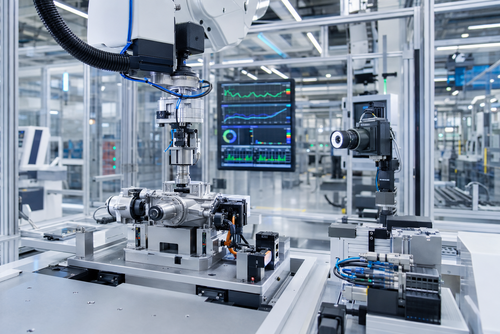
Modern mobility systems increasingly depend on components that directly influence vehicle control, stability and operational safety. Steering systems, braking technologies, actuators, sensors and electronic control units must operate reliably under demanding conditions throughout their lifecycle.
At the same time, these products are becoming more complex. Mechanical elements are increasingly combined with electronics, sensors, software and communication interfaces. This creates new manufacturing challenges: components must be assembled precisely, critical process parameters must be monitored, functions must be tested, and relevant production data must remain traceable.
Advanced automation helps manufacturers integrate these requirements into stable and scalable production processes. By connecting precision assembly, inspection, testing and data management, manufacturers can establish a consistent quality strategy from the first component to the completed product.
What Makes a Mobility Component Safety-Critical?
A component can be considered safety-critical when a malfunction could affect the safe operation or control of a vehicle or transportation system. Depending on the application, this may include:
- Steering components
- Braking systems
- Sensors and control units
- Electronic and electromechanical actuators
- Power electronics
- Hydraulic and pneumatic components
- Safety-related communication interfaces
These applications are not limited to passenger vehicles. Safety-related components are also found in electric vehicles, commercial vehicles, rail systems and off-highway equipment.
The exact manufacturing and validation requirements depend on the product, its function and the applicable standards. However, manufacturers frequently face similar challenges: demanding tolerances, increasing product complexity, comprehensive testing requirements and the need for reliable production data.
HAHN Automation Group supports manufacturers across these applications with advanced automation solutions for Mobility.
Quality Must Be Built into the Manufacturing Process
Quality cannot simply be added at the end of production. It must be established and monitored throughout the manufacturing process.
An end-of-line test can verify whether a completed component performs as expected under defined conditions. However, it cannot always identify the origin of every hidden process deviation. Reliable production therefore requires a combination of controlled assembly, inline inspection, functional testing and traceability.
A comprehensive manufacturing concept typically considers:
- Component identity and condition
- Correct part orientation
- Assembly position and alignment
- Joining forces, distances and torque values
- Electrical connections
- Software and parameter versions
- Calibration results
- Inspection and test data
Connecting these elements creates a more complete view of product and process quality.
Precision Assembly for Complex Mechatronic Products
Many safety-critical mobility products combine mechanical, electronic and software-based functions. Their production requires different processes to operate reliably within one coordinated automation system.
Controlled Handling and Positioning
Sensors, electronic assemblies, connectors, seals and actuator components may be sensitive to mechanical stress, contamination or incorrect orientation. Automated feeding and handling systems help ensure that parts arrive at the assembly station in the correct position and condition.
Robotic handling, vision-guided positioning and automated presence checks can reduce manual variation and improve process repeatability. Accurate positioning is particularly important for sensors and actuators, where small deviations may influence signal quality or functional performance.
Monitored Joining Processes
Safety-related components often require controlled pressing, screwing, gluing, welding or dispensing processes. Depending on the application, the production system can monitor parameters such as:
- Force and distance
- Torque and angle
- Pressure and temperature
- Dispensing volume
- Process time
Monitoring these values helps manufacturers identify deviations during assembly instead of relying only on final testing. The relevant parameters and acceptance limits must always be defined according to the specific product and process requirements.
Inline Inspection Detects Deviations Early
Inline inspection helps identify defects before additional value is added to a product. This reduces the risk of defective components moving through the complete production process.
Depending on the application, automated inspection can verify:
- Component presence
- Correct part orientation
- Dimensional characteristics
- Connector and seal positions
- Assembly completeness
- Adhesive or dispensing patterns
- Labels and identification codes
Machine vision, sensors and measurement systems can be integrated directly into assembly stations. This allows manufacturers to respond to deviations earlier and establish controlled processes for non-conforming parts.
The inspection technology must be selected for the specific component. Reflective surfaces, small tolerances and complex geometries may require tailored lighting, optics and measurement strategies.
Functional Testing Verifies Product Performance
While inline inspection evaluates individual components and process steps, functional testing determines whether the assembled product performs according to the defined requirements.
Typical testing processes for mobility components may include:
- Electrical testing
- Leakage testing
- Pressure and flow testing
- Force and torque measurement
- Sensor calibration
- Communication testing
- Software and parameter verification
- Actuator testing
- End-of-line functional testing
The appropriate testing strategy depends on the product architecture and risk assessment. Some characteristics can be verified during assembly, while others require a completed subsystem or product.
For steer-by-wire applications, for example, automated testing can verify the interaction between sensors, electronic control systems, communication interfaces and actuators.
The Role of End-of-Line Testing
End-of-line testing is an important final verification step for many safety-critical mobility components. It confirms whether the completed product meets defined functional and quality requirements before leaving the production line.
A typical automated testing sequence may include:
- Identification of the individual product
- Verification of electrical connections
- Software and parameter checks
- Functional testing under defined conditions
- Evaluation of measured values
- Documentation of test results
- Release or controlled rejection of the product
Automated testing supports repeatable test sequences, consistent evaluation and reliable data acquisition. Its greatest value is achieved when the results are connected with data from upstream assembly and inspection processes.
Learn more about the requirements for automated testing in Why 100% End-of-Line Testing Is Critical for Steer-by-Wire Systems.
Traceability Connects Product and Process Data
Traceability creates a documented relationship between an individual product and the processes used to manufacture it. Depending on the application, a production record may include:
- Serial numbers and component identifiers
- Batch information
- Machine and station data
- Relevant process values
- Calibration parameters
- Inspection results
- Functional test results
- Software versions
- Production status and timestamps
Data Matrix codes, QR codes or RFID tags can be used to identify components and assemblies throughout production. The appropriate method depends on the product and customer requirements.
Traceability helps manufacturers investigate deviations, analyze quality issues and document whether defined production steps were completed. Connected production data can also reveal relationships between process parameters and final test results, creating a foundation for continuous improvement.
Flexible Automation for Changing Requirements
Mobility technologies continue to evolve. Manufacturers must prepare for changing designs, new software versions, additional product variants and uncertain production volumes.
Modular automation concepts can provide greater flexibility by combining standardized interfaces with product-specific process stations. Depending on the application, scalable systems can support:
- Recipe-controlled product changeovers
- Replaceable tooling
- Additional inspection requirements
- Extended testing sequences
- New product variants
- Future capacity expansion
The objective is not to maximize flexibility at any cost. Manufacturers should identify which changes are likely during the product lifecycle and design the automation concept accordingly.
Automation Supports Functional Safety but Does Not Replace It
Functional safety is established through the complete product development and lifecycle process. Standards such as ISO 26262 provide a framework for managing functional safety in road vehicles.
Manufacturing automation contributes to this strategy by enabling controlled processes, repeatable testing and documented production results. However, automation does not independently certify a product or guarantee its functional safety.
A robust manufacturing strategy should align:
- Product requirements
- Process risk assessments
- Assembly controls
- Inspection concepts
- Testing requirements
- Traceability specifications
- Quality management processes
Early collaboration between product development, manufacturing engineering, quality teams and automation specialists helps ensure that production requirements are considered before the product design is finalized.
Conclusion
Safety-critical mobility components place demanding requirements on manufacturing. Complex mechatronic architectures, tight tolerances, extensive testing and growing traceability expectations require a coordinated production strategy.
Advanced automation helps manufacturers combine precision assembly, controlled joining, inline inspection, functional testing and digital traceability within one production environment.
By integrating these capabilities, manufacturers can improve process stability, identify deviations earlier and create reliable production records for each product. As mobility technologies become more connected, electrified and software-driven, this combination of manufacturing precision and data transparency will become increasingly important.
Automate Your Next Mobility Project
HAHN Automation Group supports manufacturers of complex mobility products with customized solutions for assembly, testing, inspection and traceability.
Whether you are industrializing a new safety-related component, scaling an existing process or introducing additional product variants, our experts help develop automation concepts tailored to your manufacturing requirements.