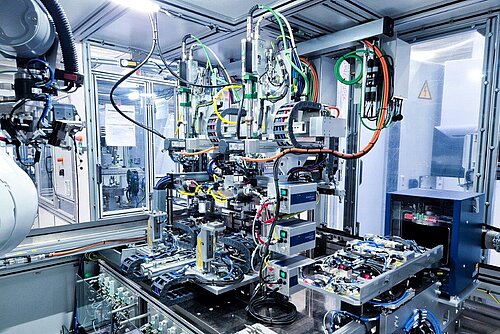
LiDAR sensor technology is becoming a cornerstone of modern Mobility applications, particularly in advanced driver assistance systems (ADAS) and autonomous driving.
Manufacturers are under increasing pressure to:
- ensure high product precision
- maintain consistent quality
- scale production efficiently
At the same time, LiDAR sensor manufacturing presents unique challenges due to the combination of optical, electronic, and mechanical processes.
Automation plays a critical role—but only when systems are designed to handle precision, integration, and scalability simultaneously.
This article provides an overview of:
- key challenges in LiDAR sensor manufacturing
- proven automation strategies
- best practices for system design
Key Challenges in LiDAR Sensor Manufacturing
Ensuring High Precision
LiDAR sensors rely on highly accurate optical alignment. Even minimal deviations can affect performance.
Challenges include:
- tight tolerances
- sensitive components
- complex alignment processes
Learn more: Challenges in Automated LiDAR Sensor Assembly
Maintaining Accuracy in Automated Processes
As production scales, maintaining consistent accuracy becomes more difficult.
Typical issues include:
- process variability
- mechanical tolerances
- insufficient measurement integration
Learn more: How to Improve Accuracy in LiDAR Sensor Assembly
Scaling Production Systems
Moving from pilot production to high-volume manufacturing introduces new challenges.
These include:
- maintaining precision at higher throughput
- synchronizing complex processes
- ensuring system stability
Learn more: How to Scale LiDAR Sensor Production Systems
Core Principles of Efficient LiDAR Automation
Across all challenges, several principles consistently apply:
- System integration
Align all processes within a unified production system. - Process synchronization
Ensure consistent timing across all steps. - Minimized handling
Reduce risks associated with sensitive components. - Integrated measurement and calibration
Maintain accuracy throughout the process. - Scalable system architecture
Enable efficient production growth.
These principles are essential for building high-performance automation systems.
Centralized vs. Decentralized Production Systems
Decentralized Systems
- multiple independent units
- limited coordination
- higher variability
Centralized Systems
- synchronized processes
- improved control
- higher efficiency
For LiDAR sensor manufacturing, centralized systems often provide better performance and stability.
The Role of Automation in Mobility Applications
Mobility applications, including automotive and advanced sensor systems, require:
- high precision
- consistent performance
- scalable production
Automation enables manufacturers to meet these requirements while ensuring efficiency and reliability.
Case Example: Automated LiDAR Sensor Production
A manufacturer implemented a fully automated system to produce LiDAR sensors at scale.
The solution included:
- integrated assembly and testing
- high-precision positioning systems
- synchronized process chains
- controlled production environments
The results:
- consistent product quality
- improved process stability
- scalable production capacity
Explore the full case study for detailed insights:
How to Approach LiDAR Automation Strategically
When planning automation systems, manufacturers should consider:
- current production limitations
- precision requirements
- scalability needs
- integration of testing and calibration
A system-level approach ensures long-term performance and flexibility.
Conclusion
Automation in LiDAR sensor manufacturing is not just about increasing output—it is about building systems that combine:
- precision
- stability
- scalability
Manufacturers who adopt an integrated approach can achieve:
- consistent product quality
- efficient production processes
- long-term competitiveness in Mobility markets
Looking to optimize your LiDAR sensor production?
Get in touch with our automation experts to explore tailored solutions for your specific requirements.