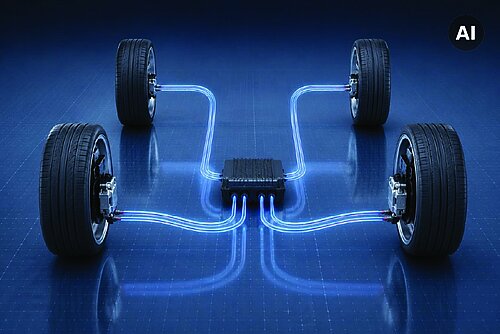
Vehicle architecture is undergoing a fundamental transformation. Mechanical systems are increasingly being complemented or replaced by electronic controls, intelligent sensors and software. Brake-by-wire is a key part of this development.
Instead of transmitting the driver’s braking input exclusively through mechanical or hydraulic connections, brake-by-wire systems use sensors, electronic control units and actuators. This allows braking functions to become more responsive, adaptable and closely integrated with the vehicle’s wider electronic architecture.
For manufacturers, this shift creates new opportunities in vehicle development. At the same time, it introduces demanding requirements for the production, calibration and testing of safety-critical components.
What Is Brake-by-Wire?
Brake-by-wire describes braking systems in which the driver’s input is detected electronically and transmitted to the braking actuators as an electrical signal. Sensors measure the position or force applied to the brake pedal. An electronic control unit processes this information and determines the braking force required at each wheel.
Depending on the system architecture, the braking force may then be generated hydraulically, electrohydraulically or entirely electromechanically. Several concepts are therefore grouped under the term brake-by-wire:
- Electrohydraulic brake-by-wire systems use electronic control while retaining hydraulic actuation at the wheel.
- Hybrid systems combine electronic control with selected mechanical or hydraulic backup functions.
- Electromechanical or dry brake-by-wire systems generate braking force directly through electrically operated actuators at the wheel.
The degree of electrification varies, but all these concepts reduce the dependence on conventional mechanical connections between the brake pedal and the wheel brakes.
Why Vehicle Manufacturers Are Moving Toward Electronic Braking
Brake-by-wire offers greater freedom in the design and control of vehicle braking systems. Because the driver’s input is converted into electronic signals, braking behavior can be adjusted through software and coordinated with other vehicle functions.
This enables several important advantages:
- Faster system response
- Precise brake force distribution
- Improved integration of regenerative braking
- Reduced mechanical complexity
- Greater design flexibility
- Enhanced diagnostic capabilities
These advantages are particularly relevant for electric and automated vehicles. Electric vehicles must coordinate friction braking with regenerative braking to recover energy while maintaining consistent deceleration. Brake-by-wire allows the vehicle control system to manage this transition more precisely.
The technology also supports the broader shift toward intelligent and interconnected Mobility solutions. Braking is no longer an isolated mechanical function. It becomes part of a coordinated electronic system that includes propulsion, steering, stability control and advanced driver assistance functions.
Brake-by-Wire in Software-Defined Vehicles
In a software-defined vehicle, many functions are controlled, adapted and updated through software. Brake-by-wire creates the technical foundation needed to integrate braking into this architecture.
The braking system can exchange information with sensors, control units and other vehicle systems in real time. This makes it possible to adjust braking behavior according to the driving situation, vehicle condition or selected driving mode.
For example, the system can coordinate braking with:
- Electronic stability control
- Adaptive cruise control
- Collision avoidance systems
- Automated parking
- Regenerative braking
- Autonomous driving functions
Electronic braking also complements developments such as steer-by-wire in software-defined vehicles. Together, these technologies enable vehicle functions to be controlled more flexibly and integrated more closely into centralized electronic architectures.
New Possibilities for Vehicle Design
Removing or reducing conventional mechanical and hydraulic connections gives vehicle engineers more freedom when designing the interior, chassis and overall system layout.
Brake pedal characteristics can be generated electronically instead of being determined solely by the physical behavior of the hydraulic system. This allows manufacturers to create a consistent pedal feel across different operating conditions and vehicle variants.
Future brake-by-wire concepts may also reduce the number of hydraulic components, simplify vehicle assembly and support more compact packaging. This is especially relevant as electric vehicle platforms require space for battery systems, power electronics and new interior concepts.
However, greater design freedom also increases the importance of system integration. Sensors, actuators, control units, communication interfaces and software must operate together reliably under all specified conditions.
Safety and Redundancy Remain Central
Braking is one of the most safety-critical vehicle functions. Any electronic braking architecture must therefore be designed to remain controllable even if individual components or communication paths fail.
Depending on the system concept, this may involve redundant sensors, independent power supplies, additional communication channels or backup actuation mechanisms. The control system must continuously monitor component status, identify deviations and respond appropriately.
These requirements influence not only product development but also industrial manufacturing. Each component must be assembled with high precision, and electrical, mechanical and functional characteristics must be verified consistently.
Reliable production therefore depends on controlled processes for:
- Component handling and positioning
- Joining and fastening
- Electrical connections
- Sensor and actuator calibration
- Leak and pressure testing
- Functional validation
- Data acquisition and traceability
From Vehicle Innovation to Industrial Production
As brake-by-wire technology develops, manufacturers must transfer new system concepts from engineering and pilot production into stable industrial manufacturing.
Production systems need to accommodate sensitive electronics, tight mechanical tolerances and multiple product variants. At the same time, they must provide the data required to document every relevant assembly and testing step.
Modular automation concepts can support this transition by allowing processes, stations and testing functions to be expanded as products mature or production volumes increase. Flexible system designs also make it easier to respond to changing component generations and evolving brake architectures.
Based on extensive experience in precision assembly, testing and traceability, HAHN Automation Group develops concepts for the industrialization of future braking technologies. The Brake-by-Wire Systems case study provides an overview of the relevant automation capabilities, from controlled assembly processes to comprehensive end-of-line testing.
Preparing Production for the Next Generation of Braking
Brake-by-wire is more than a replacement for conventional braking technology. It changes how braking functions interact with the entire vehicle and creates new possibilities for electric, automated and software-defined mobility.
Successfully industrializing these systems requires close coordination between product development, process engineering, automation and testing. Production concepts must combine precision, flexibility and comprehensive quality assurance from the beginning.
By preparing manufacturing processes for new system architectures, changing variants and increasing production volumes, manufacturers can create a reliable foundation for the next generation of electronic braking systems.