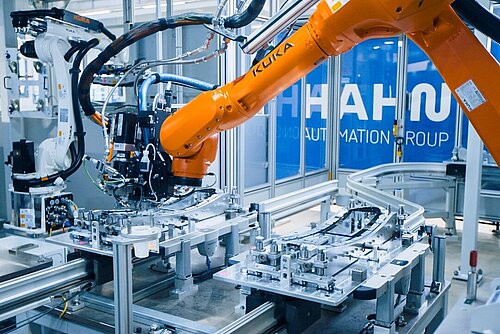
Manufacturing industries are facing increasing pressure: shorter product life cycles, growing product variety, and a persistent shortage of skilled labor are reshaping production requirements. Traditional, rigid production systems are no longer sufficient.
Flexible automation in special machine engineering enables companies to adapt quickly to changing market demands while maintaining high efficiency and quality standards.
What Is Flexible Automation?
Flexible automation refers to production systems that can be easily adapted to new products, volumes, or processes. Unlike fixed, dedicated systems, flexible solutions rely on modular design and intelligent control systems.
Key characteristics include:
- Modular machine architecture
- Scalable production lines
- Software-driven adjustments instead of mechanical changes
- Integration of robotics and AI
Why Companies Are Investing in Flexible Automation
Today’s manufacturing environment requires companies to:
- Respond quickly to market changes
- Produce smaller batch sizes efficiently
- Manage increasing product variants
- Minimize downtime
Flexible automation addresses these challenges by significantly reducing changeover times and enabling cost-effective production across varying product configurations.
The Role of Special Machine Engineering
Special machine engineering is essential when standard solutions reach their limits. Customized systems are required to meet specific production requirements.
The HAHN Automation Group develops tailored automation solutions designed to match each customer’s exact needs. By combining advanced technologies, these systems ensure maximum flexibility and long-term efficiency.
Typical industries include:
- Automotive
- MedTech
- Electronics
- Consumer Goods
Key Technologies Enabling Flexibility
1. Modular Systems
Modular production systems allow individual stations to be configured or replaced independently. This reduces investment risks and improves long-term adaptability.
2. Robotics and Collaborative Systems
Modern robotic systems can be reprogrammed quickly for different tasks. Collaborative robots (cobots) also enable safe human-machine interaction.
3. Digital Twins
Digital twins allow simulation and optimization of production processes before implementation. Adjustments can be tested virtually, saving time and costs.
4. AI and Data Analytics
Artificial intelligence enables continuous process optimization and predictive maintenance, reducing downtime and improving overall efficiency.
Key Benefits for Manufacturers
Flexible automation delivers measurable advantages:
- Reduced time-to-market
- Improved product quality
- Lower changeover times
- Better resource utilization
- Future-proof investments
Challenges in Implementation
Despite its advantages, flexible automation comes with challenges:
- Higher initial investment
- Increased system complexity
- Demand for skilled personnel
An experienced partner like the HAHN Automation Group helps companies overcome these challenges and implement sustainable, high-performance solutions.
Conclusion
Flexible automation is no longer a trend—it is a necessity for modern manufacturing. Companies that invest in adaptable production systems early gain a decisive competitive advantage.
Special machine engineering, driven by companies like the HAHN Automation Group, plays a crucial role in enabling future-ready production strategies.