For decades, automotive cockpits were built around mechanical gauges, physical buttons, and clearly separated interfaces. Instrument clusters primarily focused on displaying speed, fuel levels, and warning signals, while infotainment systems remained secondary components within the vehicle interior.
Today, however, the cockpit is undergoing a fundamental transformation. Driven by electrification, software-defined vehicles, and advanced driver assistance systems, automotive displays are becoming central interaction platforms that define the overall user experience.
What once started with small digital displays has rapidly evolved into fully integrated cockpit environments featuring:
- large curved displays
- OLED and Mini-LED technologies
- seamless touch interfaces
- passenger displays
- augmented reality head-up displays
- pillar-to-pillar display architectures
Modern vehicles increasingly rely on displays not only for functionality, but also for brand differentiation and digital user experience. Especially in electric vehicles, the cockpit has become a defining element of the vehicle identity.
From Functional Interfaces to Digital Experience Platforms
Automotive displays are no longer isolated components. Instead, they are becoming interconnected ecosystems that combine:
- navigation systems
- entertainment functions
- vehicle diagnostics
- climate controls
- driver assistance information
- connectivity features
As display systems become larger and more integrated, the entire cockpit architecture changes. OEMs are moving toward panoramic and pillar-to-pillar concepts that create a seamless digital surface across the dashboard.
This trend significantly increases the technical complexity behind display manufacturing and integration.
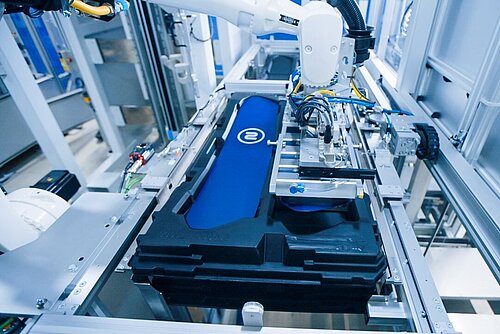
A good example of this development can already be seen in modern automotive display assembly projects, where precision, optical quality, and process stability play a critical role in production environments.
High-Precision Assembly for Automotive Displays
Engineering Challenges Behind Large Automotive Displays
While future cockpit concepts create new opportunities for user experience and vehicle design, they also introduce major engineering and manufacturing challenges.
As displays become larger, thinner, and increasingly curved, manufacturers must ensure:
- highly precise alignment
- stable optical bonding processes
- minimal visual distortion
- thermal expansion control
- vibration resistance
- cleanroom-compatible assembly conditions
- consistent optical quality across large surfaces
Even minimal deviations during assembly can directly impact perceived quality and functionality. This becomes particularly critical for panoramic display systems where multiple components must interact seamlessly.
At the same time, display technologies themselves are evolving rapidly. Flexible OLEDs, integrated touch layers, and high-brightness systems require increasingly sophisticated automation and inspection concepts.
These developments align closely with broader mobility trends such as software-defined vehicles and next-generation HMI systems.
Related Mobility Insights:
Mobility Automation Solutions
Precision Automation as a Key Enabler
The evolution of automotive cockpits is not only a design challenge — it is also a manufacturing challenge.
To scale advanced display concepts into high-volume production, manufacturers require automation systems capable of delivering:
- repeatable precision
- stable bonding quality
- automated inspection processes
- traceability
- cleanroom integration
- scalable manufacturing architectures
Highly automated assembly processes become essential for ensuring consistent quality while maintaining production efficiency.
This is particularly relevant for modern cockpit systems where display integration, sensor technologies, and electronic components must work together within extremely tight tolerances.
Automation expertise therefore becomes a critical success factor for the next generation of mobility display systems.
The Future of Automotive Cockpit Displays
The transformation of automotive cockpits is still accelerating.
Future mobility concepts are expected to introduce:
- transparent displays
- fully integrated digital surfaces
- AI-supported user interfaces
- immersive passenger experiences
- adaptive display environments
- augmented reality interaction concepts
As vehicles continue to evolve into software-defined platforms, displays will increasingly become the central interface between humans and mobility systems.
For automotive manufacturers and technology partners alike, this creates entirely new requirements for display integration, precision assembly, and scalable automation technologies.
The companies that successfully combine advanced display engineering with highly stable manufacturing processes will help shape the next generation of mobility experiences.
Looking for Advanced Automation Solutions for Automotive Display Assembly?
HAHN Automation Group supports highly precise assembly and automation solutions for demanding mobility applications — from complex display integration to scalable production concepts.
Get in touch with our team to discuss your project requirements: