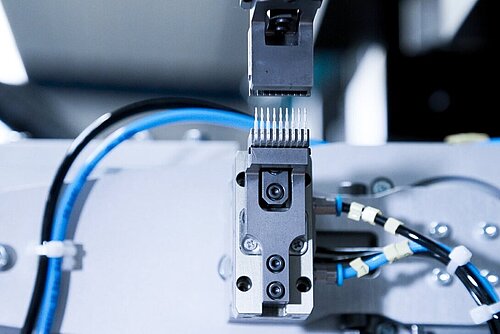
Connector manufacturers increasingly need to produce multiple product variants while responding to shorter product lifecycles, changing volumes and application-specific requirements. Separate production lines for every connector type are rarely economical, especially when individual variants differ only in their pin configuration, housing geometry, contact layout or test parameters.
A flexible production line can manufacture several connector variants without requiring extensive mechanical conversions between batches. Achieving this flexibility, however, requires more than interchangeable fixtures. Component feeding, product identification, assembly processes, tooling, inspection, software and material flow must all support reliable variant changes.
The objective is to create a production system that combines flexibility with the precision, throughput and quality assurance required for connector manufacturing.
Why Connector Variant Management Is Becoming More Important
Connectors are used in mobility, industrial electronics, energy infrastructure, automation technology and numerous other applications. Different products may require specific contact arrangements, electrical ratings, housing designs, locking mechanisms or sealing concepts.
Even connectors belonging to the same product family can differ in:
- Number and position of contacts
- Pin or terminal geometry
- Housing dimensions
- Plastic materials and colors
- Seals and secondary locking elements
- Electrical specifications
- Markings and identification
- Inspection and test requirements
- Packaging formats
Producing these variants on dedicated lines can lead to low equipment utilization, duplicated investment and high floor-space requirements. A multi-variant line makes it possible to use the same automation infrastructure for several products and adjust capacity according to demand.
This approach is particularly valuable when production volumes fluctuate or new connector generations must be introduced during the service life of the system.
Start with a Structured Variant Analysis
Before the production concept is defined, manufacturers should analyze which product characteristics are shared across the connector family and where the variants differ. This creates the foundation for deciding which processes can use standardized equipment and which require product-specific tooling or parameters.
A variant analysis should consider:
- Component dimensions and tolerances
- Contact and pin configurations
- Assembly sequence
- Required joining forces
- Housing and insert geometries
- Feeding and presentation formats
- Inspection criteria
- Electrical test parameters
- Cycle-time requirements
- Packaging and labeling
- Expected production volumes
- Potential future variants
The products do not need to be identical to run on the same line. However, their assembly sequences and process technologies must be sufficiently compatible. If one variant requires completely different joining, handling or testing processes, a separate module or production route may be more practical than forcing every operation into one universal station.
Grouping connectors into clearly defined product families helps avoid unnecessary complexity. The resulting automation system can then be flexible where flexibility creates value and product-specific where precision or process stability requires it.
Choose the Right Production Strategy
Several production strategies can support multiple connector variants. The appropriate approach depends on batch sizes, variant frequency, product differences and target output.
Batch Production
In batch production, the line manufactures a defined quantity of one connector variant before being converted to the next product. This approach is suitable when production orders are relatively large and changeovers occur only occasionally.
The main priority is reducing the time and effort required for conversion. Quick-change fixtures, automatic recipe selection and guided setup procedures can shorten downtime and reduce the risk of configuration errors.
Mixed-Variant Production
Mixed-variant production processes different connector types within the same production sequence. Individual products may follow one another without a complete line changeover.
This approach offers maximum responsiveness but places higher demands on product identification, automatic adjustment and process control. Each station must recognize the incoming variant and select the correct assembly and testing parameters before processing begins.
Parallel Product Routes
Some connector variants may share only part of the production process. In this case, the line can combine common stations with separate modules for variant-specific operations.
For example, different connector types may use the same contact preparation and electrical testing processes but require different housing assembly stations. Routing systems can direct each product to the appropriate module while maintaining a shared automation infrastructure.
Identify Each Connector Variant as Early as Possible
Reliable product identification is essential for automated variant management. The line must know which connector is being produced before components are selected or processes are performed.
Identification can be based on:
- Production order or batch information
- Barcode or Data Matrix code
- RFID-equipped workpiece carriers
- Component geometry
- Color or visual characteristics
- Mold cavity or machine signal
- Data transferred from an upstream process
Once the variant has been identified, this information should remain associated with the product throughout the line. A workpiece carrier can store or reference the product identity, while the control system manages the corresponding process recipe.
Every station can then verify whether it is prepared for the incoming product and automatically select the required parameters. This helps prevent incorrect components, tooling or test programs from being used.
Use Recipe-Based Process Control
Product recipes contain the parameters required to manufacture and test a specific connector variant. Instead of manually reconfiguring each station, the control system loads the correct settings based on the identified product.
A connector recipe may define:
- Required components
- Pin configuration
- Robot positions and movements
- Gripping parameters
- Insertion forces and distances
- Assembly sequence
- Vision inspection criteria
- Electrical test limits
- Marking information
- Sorting and packaging rules
Recipe-based control reduces manual intervention and makes changeovers more repeatable. It also ensures that changes to a process parameter can be documented and managed centrally.
Access controls and version management are important when recipes affect product quality. Only authorized changes should be released for production, and the system should record which recipe version was used for each batch or component.
Develop Flexible Component Feeding Concepts
Feeding systems are often one of the greatest challenges in multi-variant connector production. Different pins, housings, seals and locking elements may require individual methods of separation and orientation.
A flexible feeding concept may combine:
- Interchangeable feeding equipment
- Flexible bowl or surface feeders
- Tray-based component supply
- Reel-fed contacts
- Vision-guided robots
- Multiple dedicated feeding units
- Automatically selectable component channels
Not every feeder needs to handle every component. In many cases, several dedicated feeding units provide greater process reliability than a single highly complex universal feeder. The control system selects the appropriate material source based on the product recipe.
Poka-yoke functions should verify that the correct components are available. Vision systems, sensors or code readers can confirm component type, orientation and presence before assembly. This prevents a wrong pin, seal or housing from entering the production process.
Design Tooling for Fast and Reliable Changeovers
Fixtures, grippers and process tools must accommodate the relevant connector geometries without compromising positioning accuracy.
Different tooling concepts can be used:
- Common tooling for geometrically similar variants
- Adjustable fixtures
- Replaceable product nests
- Servo-controlled positioning elements
- Multi-purpose robot grippers
- Automatic gripper change systems
- Dedicated tools stored inside the line
Manual tool changes may be appropriate when batch sizes are large and conversion frequency is low. For frequent changes or mixed production, automatic adjustment or tool exchange can reduce downtime and prevent operator errors.
Tool identification is equally important. The control system should verify that the correct fixture, gripper or process insert is installed before production starts. Mechanical coding, sensors, RFID or data interfaces can support this verification.
Separate Product Flexibility from Process Stability
Maximum mechanical flexibility is not always the best solution. A universal tool designed for too many product geometries can become complex, difficult to maintain and less precise than several dedicated tools.
A robust multi-variant concept therefore separates the standardized system architecture from product-specific elements. Robots, transfer systems, controls and safety equipment can remain consistent, while replaceable fixtures, grippers or process modules are adapted to individual connector families.
The MasterCell platform from HAHN Automation Group provides a modular framework in which robots, vision systems, feeding equipment and test stations can be combined according to the application. This allows manufacturers to build a scalable system around proven structures while retaining the flexibility required for product-specific processes.
Balance Different Cycle Times and Variant Mixes
Different connector variants may require different assembly sequences or process durations. One product may contain more contacts, while another requires additional inspection or a longer electrical test.
If all products move through the line at a fixed pace, the slowest variant can determine the overall cycle time. Flexible production planning must therefore consider both the individual cycle times and the expected variant mix.
Possible strategies include:
- Parallel processing of time-intensive operations
- Multiple assembly or test positions
- Buffers between processes
- Bypass routes for unnecessary stations
- Dynamic product routing
- Separation of shared and variant-specific operations
- Production sequencing based on line capacity
A detailed cycle-time analysis should include component feeding, robot movements, tool changes, inspection, testing, rejected-part handling and packaging. Optimizing only the primary assembly process may simply move the bottleneck to another station.
Integrate Variant-Specific Quality Inspection
Each connector variant may have its own quality criteria. Pin positions, contact layouts, insertion depths and electrical limits can differ even when the products use the same basic housing design.
The inspection system must therefore load the correct test parameters automatically. Depending on the application, automated quality assurance can include:
- Contact presence and completeness checks
- Pin-position measurement
- Insertion-depth inspection
- Force-displacement monitoring
- Housing and locking-feature inspection
- Electrical continuity testing
- Resistance measurement
- High-voltage testing
- Verification of seals and secondary locks
- Product and marking inspection
Vision systems require variant-specific inspection programs or reference models. Electrical test stations must connect the correct contacts and apply the appropriate limits. The production recipe should coordinate these settings and prevent a component from being released if the required test program was not completed.
Learn from a Multi-Variant Connector Application
The HAHN Automation Group has implemented a fully automated production solution for six connector variants. The system manufactures 24-pin contact blocks with variant-specific EloPin configurations.
Six stamping and bending stations are synchronized within a 25-second cycle. The pins are automatically formed and positioned before being inserted into a four-cavity injection mold. After overmolding, the connectors undergo comprehensive mechanical and electrical testing.
The system combines several principles required for multi-variant production:
- Variant-specific pin configurations
- Synchronized contact preparation
- Automated loading of the injection molding machine
- 100-percent inline inspection
- Automated tray packaging
- Defect sorting by pattern and mold cavity
- Traceable production and quality data
The compact line produces up to 576 components per hour. This application demonstrates that high output and product flexibility can be combined when variant management is integrated into the complete process rather than added as a separate function.
Maintain Traceability Across All Variants
Mixed-variant production increases the importance of traceability. The system must reliably connect each product to its components, process recipe, assembly data and test results.
A production record may include:
- Product and variant identification
- Material and batch information
- Mold cavity
- Installed tool or fixture
- Recipe and software version
- Assembly forces and positions
- Vision inspection results
- Electrical measurement data
- Rejection reason
- Packaging assignment
This information supports quality documentation and helps manufacturers identify the source of recurring defects. If deviations occur only with one connector variant, pin type, cavity or tool, the data can narrow down the potential cause.
Traceability also supports production optimization. Comparing cycle times, inspection results and rejection rates across variants can show where processes or product designs create unnecessary complexity.
Plan Material Flow and Packaging by Variant
Variant management does not end after final testing. Finished connectors must be transferred to the correct trays, containers or packaging units without becoming mixed.
The end-of-line concept should consider:
- Variant-specific tray layouts
- Automatic container selection
- Batch separation
- Label and code generation
- Packaging verification
- Handling of partially filled trays
- Rejected-component separation
- Transfer to downstream logistics
In mixed production, the packaging system may need to sort products before placing them into variant-specific containers. Alternatively, production sequencing can create complete batches for direct packaging.
The product identity and quality status must remain linked throughout this process. Only approved connectors should be released for packaging, and the system should verify that the packaging format matches the product recipe.
Prepare the Line for Future Connector Generations
A multi-variant line should not be designed exclusively around the product portfolio available at the start of the project. Connector designs, production volumes and inspection requirements are likely to change during the service life of the equipment.
Future flexibility can be supported through:
- Modular machine architecture
- Standardized mechanical interfaces
- Expandable controls and software
- Additional space for feeding or process modules
- Accessible and replaceable fixtures
- Parameter-based robot and vision programs
- Scalable testing capacity
- Clearly structured product recipes
- Reusable engineering and software modules
Digital planning and virtual commissioning can help evaluate new product variants before they are introduced on the physical line. By simulating process sequences, robot movements and control logic, manufacturers can identify potential conflicts and reduce disruption during implementation.
HAHN Automation Group uses digitalization and virtual commissioning to support efficient planning, transparent processes and the optimization of automated manufacturing systems.
Avoid Unnecessary Complexity
Flexibility creates value only when it matches realistic production requirements. Designing a system for every theoretically possible connector variant can increase investment, cycle time and maintenance requirements without delivering a practical benefit.
Manufacturers should therefore distinguish between:
- Confirmed variants
- Likely future variants
- Product changes that can be accommodated through tooling
- Changes requiring an additional module
- Fundamentally different products better suited to a separate line
The automation concept should support the expected product family while preserving defined expansion options. This approach provides a better balance between current efficiency and future adaptability than attempting to make every station universally flexible.
A Flexible Production Line Starts with the Right Architecture
Automating multiple connector variants on one production line requires a coordinated concept for product identification, recipes, feeding, tooling, assembly, testing and packaging. Flexibility must be designed into the complete production architecture and supported by reliable software and data management.
Standardized modules provide a stable foundation, while product-specific tools and process parameters maintain the precision required for connector assembly. Automatic identification and recipe control reduce conversion errors, and integrated inspection ensures that every variant meets its individual quality requirements.
When these elements work together, manufacturers can respond more efficiently to fluctuating demand, introduce new connector generations and improve equipment utilization without compromising quality or throughput.
Plan Your Multi-Variant Connector Production
Are you planning to combine several connector variants on one production line or prepare an existing system for future product generations? Contact the HAHN Automation Group to discuss a flexible automation concept tailored to your connector portfolio, production volumes and quality requirements.