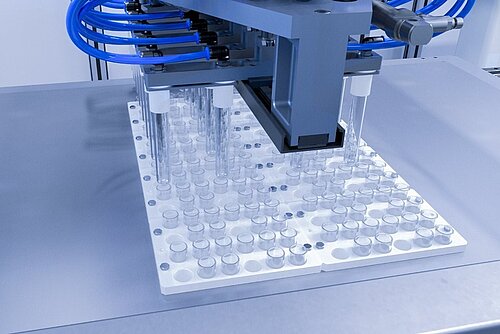
Quality is critical in blood tube production. Even minor defects can compromise diagnostic accuracy, patient safety, and regulatory compliance.
At the same time, manufacturers are under pressure to increase output while maintaining consistently high quality standards.
This creates a fundamental challenge:
How can production systems scale without introducing variability?
The answer lies in automation—but not just any automation. It requires a system-level approach to quality.
What Are the Main Quality Challenges in Blood Tube Production?
Blood tube manufacturing involves highly sensitive processes, where small deviations can lead to defects.
Common challenges include:
- Contamination risks
Exposure to particles or external influences can compromise product integrity. - Inconsistent process conditions
Variations in temperature, pressure, or timing affect quality. - Manual handling limitations
Human interaction increases variability and error risk. - Complex multi-step processes
Multiple stages increase the likelihood of defects.
In many cases, quality issues are not isolated—they are the result of system instability.
Why Traditional Production Setups Struggle with Consistency
Legacy systems often rely on a combination of manual steps and partially automated processes.
This leads to:
- inconsistent handling
- lack of repeatability
- higher risk of contamination
- limited process transparency
As production volumes increase, these weaknesses become more pronounced.
How Automation Improves Quality in Blood Tube Manufacturing
Modern automation systems enable manufacturers to control and stabilize every step of the production process.
Key advantages include:
- Controlled environments
Reduced exposure to external contamination sources. - Consistent process execution
Repeatable and precise operations. - Reduced human intervention
Lower variability and error rates. - Integrated quality control
Defects can be detected and addressed early.
Automation shifts quality from being reactive to proactive and built into the system.
Real-World Example: Increasing Quality Through Automation
A manufacturer of blood tubes faced challenges in maintaining consistent product quality at high production volumes.
The implemented solution focused on:
- automating critical process steps
- minimizing manual handling
- integrating quality control mechanisms
- ensuring stable and repeatable processes
The result:
- significantly improved product quality
- reduced defect rates
- higher process reliability
Learn more about this project in our case study:
Key Design Principles for High-Quality Production Systems
Based on practical experience, several principles are essential:
1. Minimize Human Interaction
Automation reduces variability and contamination risks.
2. Stabilize Process Conditions
Consistent parameters are critical for reliable output.
3. Integrate Quality Control Inline
Detect issues early, not at the end.
4. Design for Repeatability
Every cycle should produce the same result.
5. Ensure Clean Handling
Product integrity depends on controlled environments.
When Does Automation for Quality Improvement Make Sense?
Automation is particularly valuable when:
- quality requirements are high
- production volumes increase
- defect costs are significant
- regulatory pressure is strong
In these cases, improving quality is not optional—it is a competitive necessity.
Conclusion
Improving quality in blood tube production requires more than incremental improvements. It demands a shift toward automated, stable, and controlled production systems.
By reducing variability and integrating quality into the process, manufacturers can achieve:
- higher consistency
- lower defect rates
- improved compliance
Ultimately, quality is not inspected—it is engineered into the system.