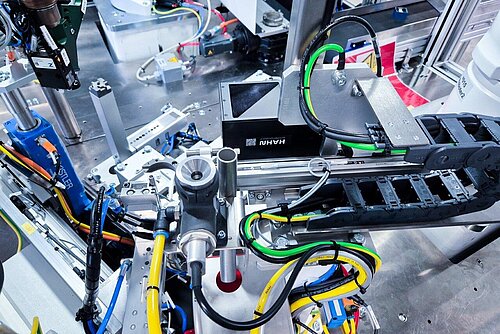
Accuracy is one of the most critical success factors in LiDAR sensor manufacturing. Even the smallest deviations in alignment or calibration can significantly impact sensor performance.
In Mobility applications such as ADAS and autonomous driving, this is not just a quality issue—it directly affects safety and system reliability.
As production volumes increase, maintaining this level of precision becomes increasingly challenging.
This raises a key question:
How can manufacturers ensure consistent accuracy in automated LiDAR sensor assembly?
Why Accuracy Is So Critical in LiDAR Assembly
LiDAR sensors rely on precise interaction between optical and electronic components. Small deviations can lead to:
- reduced detection accuracy
- signal distortion
- calibration errors
- inconsistent sensor performance
Unlike many traditional components, LiDAR systems require micron-level precision across multiple process steps.
What Limits Accuracy in Automated Assembly Systems?
Even in automated environments, accuracy can be compromised by several factors:
- Mechanical tolerances
Slight variations in positioning systems can affect alignment. - Process instability
Fluctuations in temperature or vibration can impact precision. - Component variability
Differences in incoming parts require adaptive processes. - Lack of inline measurement
Errors may only be detected too late.
In many cases, accuracy issues are not caused by a single factor, but by the interaction of multiple variables.
The Role of Measurement and Calibration in Ensuring Accuracy
To maintain consistent performance, LiDAR assembly systems must integrate measurement and calibration directly into the process.
Key elements include:
- Inline measurement systems
Continuous verification of positioning and alignment. - Automated calibration processes
Adjustment of components during assembly. - Feedback loops
Real-time corrections based on measurement data. - Data-driven process control
Continuous optimization based on performance data.
This ensures that accuracy is not only achieved—but actively maintained.
Case Example: Achieving High-Precision LiDAR Assembly
A manufacturer implemented a fully automated LiDAR assembly system with a strong focus on accuracy.
The solution included:
- high-precision positioning technology
- integrated optical measurement systems
- automated calibration steps
- controlled environmental conditions
The result:
- consistently high alignment accuracy
- reduced variation between units
- improved overall sensor performance
Key Strategies to Improve Accuracy in LiDAR Assembly
- Integrate Measurement into the Process
Avoid separating inspection from production. - Stabilize Environmental Conditions
Reduce temperature and vibration effects. - Use Adaptive Systems
Adjust to component variability in real time. - Minimize Process Variability
Standardize and synchronize all steps. - Enable Continuous Feedback
Use data to improve performance over time.
When Does Accuracy Become a Bottleneck?
Accuracy becomes a limiting factor when:
- production volumes increase
- tolerances become tighter
- manual adjustments are no longer feasible
- product performance depends on precision
In these situations, improving accuracy is essential for scaling production.
Conclusion
Ensuring accuracy in LiDAR sensor assembly requires more than precise equipment—it requires a fully integrated system approach.
By combining:
- measurement
- calibration
- process stability
manufacturers can achieve consistent, high-performance results at scale.
In the context of modern Mobility applications, this level of precision is a key competitive advantage.
Are You Interested in Improving Your LiDAR Sensor Production?
Get in touch with our automation experts today: