LiDAR sensors are a key technology in modern Mobility applications, particularly in advanced driver assistance systems (ADAS) and autonomous driving.
As demand continues to grow, manufacturers face increasing pressure to scale production while maintaining extremely high precision and reliability.
However, LiDAR sensor assembly is fundamentally different from many traditional automotive processes. It combines:
- high-precision optics
- sensitive electronic components
- complex multi-step assembly processes
This raises a critical question:
How can manufacturers automate LiDAR sensor assembly without compromising accuracy and process stability?
Why LiDAR Sensor Assembly Is More Complex Than Traditional Automotive Production
Unlike conventional automotive components, LiDAR sensors require a combination of mechanical, optical, and electronic precision.
Key challenges include:
- Optical alignment requirements
Even minimal deviations can significantly impact sensor performance. - High sensitivity of components
Optical and electronic elements must be handled with extreme care. - Tight tolerances
Assembly processes must meet strict precision requirements. - Multi-disciplinary integration
Mechanical, optical, and electronic processes must work seamlessly together.
These factors make LiDAR assembly one of the most demanding automation tasks in Mobility production environments.
The Limitations of Traditional Assembly Approaches
Many manufacturers initially rely on:
- manual or semi-automated assembly steps
- isolated production cells
- sequential process optimization
While this may work in early production phases, it often leads to:
- inconsistent quality
- limited scalability
- higher error rates
- inefficient production flow
As production volumes increase, these limitations become critical bottlenecks.
How Automation Enables High-Precision LiDAR Assembly
Advanced automation systems are designed to meet the unique requirements of LiDAR sensor production.
Key capabilities include:
- High-precision positioning systems
Enable accurate alignment of optical components. - Integrated measurement and calibration
Ensure consistent performance during assembly. - Controlled handling processes
Protect sensitive components from damage. - Synchronized multi-step processes
Reduce variability across the production line.
Automation allows manufacturers to achieve precision not just once—but consistently, at scale.
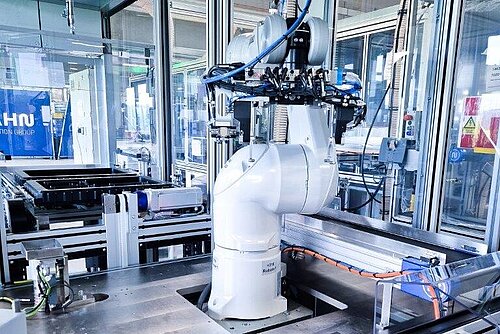
Case Example: Automated LiDAR Sensor Assembly Line
A manufacturer required a fully automated solution to assemble LiDAR sensors for Mobility applications.
The implemented system focused on:
- precise alignment of optical components
- integration of assembly and testing processes
- synchronization of all production steps
- stable and controlled material handling
The result:
- highly consistent product quality
- improved process reliability
- scalable production capacity
Discover further details in our full case study:
Key Design Principles for LiDAR Assembly Systems
Based on practical experience, several principles are critical:
- Prioritize Precision Over Speed
High accuracy is essential for functional performance. - Integrate Measurement and Assembly
Inline testing ensures early detection of deviations. - Stabilize the Entire Process Chain
Consistency across all steps is key. - Minimize Handling Risks
Sensitive components require controlled movement. - Design for Scalability
Systems must support increasing production volumes.
When Does Automation Become Essential?
Automation becomes a necessity when:
- production volumes increase
- precision requirements exceed manual capabilities
- consistency becomes critical for product performance
- scalability is required for market growth
In these cases, automation is not just an efficiency tool—it is a prerequisite for success.
Conclusion
Automating LiDAR sensor assembly is a complex challenge—but one that can be solved with the right system design.
By focusing on:
- precision
- process integration
- system stability
manufacturers can build production systems that deliver both accuracy and scalability.
In the context of modern Mobility applications, this capability is essential to remain competitive in a rapidly evolving market.