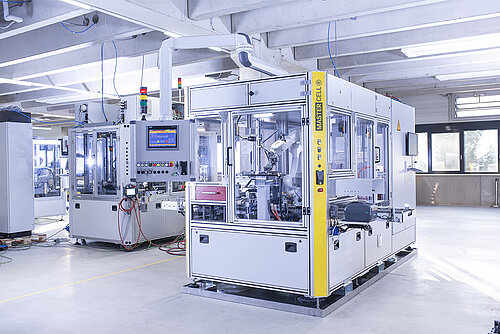
Modular automation systems are becoming increasingly important across industries—from Life Sciences to Mobility and Transformation Technologies.
As production requirements become more complex and product lifecycles shorter, manufacturers need systems that are:
- flexible
- scalable
- adaptable to change
Modular automation addresses these challenges by breaking down production systems into smaller, standardized units.
This raises a key question:
How are modular automation systems actually designed to deliver both flexibility and performance?
What Defines a Modular Automation System?
A modular automation system is built from independent yet interconnected units, often referred to as modules or cells.
Each module typically performs a specific function, such as:
- assembly
- testing
- handling
- inspection
These modules are combined into a larger system.
The key difference from traditional systems is that modular systems are designed for reconfiguration and scalability from the start.
Core Architecture: Cells, Interfaces, and System Integration
At the core of modular automation is a cell-based architecture.
A cell is a self-contained unit that includes:
- mechanical components
- control systems
- defined process steps
Cells can operate independently but are integrated into a larger system.
To enable flexibility, modules must connect through clearly defined interfaces:
- mechanical interfaces
- electrical connections
- communication protocols
Standardization ensures that modules can be added, removed, or replaced without redesigning the entire system.
The overall system is coordinated through:
- central control systems
- synchronized process flows
- unified data structures
Integration ensures that all modules operate as a cohesive production system.
Designing for Scalability and Flexibility
A key advantage of modular systems is their ability to scale.
This is achieved through:
- parallelization by adding identical modules to increase throughput
- reconfiguration by adapting the system layout for new products
- expansion by integrating additional process steps when needed
The Role of Material Flow
Material flow is a critical factor in modular system design.
Typical challenges include:
- synchronizing transport between modules
- avoiding bottlenecks
- maintaining consistent cycle times
Effective solutions include:
- buffer systems to decouple processes
- intelligent routing to balance throughput
- separation of process steps to increase stability
Common Mistakes in Modular Automation Design
Despite its advantages, modular automation is often implemented incorrectly.
Typical mistakes include:
- over-complicating the system with too many module variations
- poor interface definition, limiting flexibility
- focusing only on individual modules instead of the overall system
- underestimating the integration effort between modules
Quality issues or increased scrap rates are often caused by a lack of system integration.
Case-Based Insight: Modular Cell Concepts in Practice
In real-world applications, modular automation systems are often implemented using standardized cell concepts.
These approaches enable:
- rapid system configuration
- consistent performance across modules
- simplified scaling strategies
Cell-based automation platforms can be used to build flexible production systems that adapt to changing requirements while maintaining high efficiency.
For example, HAHN Automation Group applies modular cell-based concepts to develop scalable production systems that combine flexibility with process stability.
When Does Modular Automation Make Sense?
Modular systems are particularly beneficial when:
- product variants are increasing
- production volumes fluctuate
- future scalability is required
- time-to-market is critical
In these environments, flexibility becomes a key competitive advantage.
In MedTech applications such as the production of blood tubes or pipette tips, it is clear that modular systems are crucial for stable processes and high quality.
Conclusion
Designing modular automation systems requires a system-level approach that balances:
- flexibility
- scalability
- process stability
By focusing on:
- standardized modules
- clear interfaces
- integrated system design
manufacturers can build production systems that adapt to change without sacrificing performance.
Looking to design a modular automation system for your production?
Get in touch with our experts to explore scalable and flexible automation solutions tailored to your requirements.