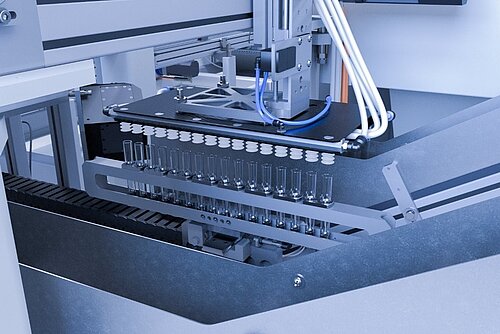
Contamination is one of the most critical risks in blood tube manufacturing. Even minimal exposure to particles or environmental influences can compromise product safety and reliability.
As production volumes increase, controlling contamination becomes more challenging—especially in complex, multi-step processes.
To ensure consistent product integrity, manufacturers need solutions that minimize risk at every stage of production.
What Causes Contamination in Blood Tube Manufacturing?
Contamination can originate from multiple sources:
- Manual handling
Human interaction introduces particles and variability. - Open process steps
Exposure to the environment increases risk. - Uncontrolled material flow
Inconsistent transport can lead to defects. - Insufficient system integration
Gaps between processes create vulnerability points.
These factors often interact, making contamination difficult to control in traditional setups.
Why Manual and Semi-Automated Systems Increase Risk
In partially automated environments, contamination risks are amplified due to:
- inconsistent handling
- lack of process isolation
- limited control over environmental conditions
As a result, even well-managed processes can produce inconsistent outcomes.
How Automated Systems Minimize Contamination
Automation enables manufacturers to create controlled and stable production environments.
Key benefits include:
- Closed system design
Reduced exposure to external influences. - Minimized human interaction
Lower risk of contamination. - Controlled material flow
Stable and predictable transport processes. - Integrated process monitoring
Early detection of deviations.
This approach significantly reduces contamination risks while improving overall process stability.
Case Example: Reducing Contamination Through Automation
A blood tube manufacturer implemented an automated production system to improve product integrity.
Key measures included:
- reducing manual handling
- implementing controlled environments
- integrating automated quality checks
The result:
- significantly lower contamination risk
- improved product consistency
- enhanced process reliability
For further details please read our full case study:
Case Study: Blood Tube Production
Best Practices for Contamination-Free Production
1. Use Closed System Architectures
Minimize exposure to external environments.
2. Reduce Handling Steps
Fewer interactions mean fewer risks.
3. Control Environmental Conditions
Ensure stable temperature, humidity, and cleanliness.
4. Implement Inline Monitoring
Detect issues early in the process.
5. Standardize Processes
Consistency reduces variability.
When Should Manufacturers Invest in Contamination Control?
Key indicators include:
- increasing defect rates
- strict regulatory requirements
- growing production volumes
- high product sensitivity
In these cases, proactive contamination control becomes essential.
Conclusion
Reducing contamination risks in blood tube production requires a systematic approach. Automation provides the tools needed to create stable, controlled, and reliable production environments.
By minimizing variability and exposure, manufacturers can ensure:
- higher product integrity
- consistent quality
- compliance with regulatory standards
If you want to reduce contamination in your production, feel free to reach out to our automation experts: