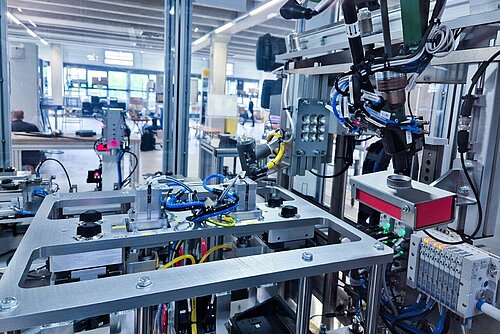
As LiDAR technology becomes increasingly important in Mobility applications such as ADAS and autonomous driving, manufacturers are under pressure to scale production efficiently.
However, scaling LiDAR sensor production is not simply a matter of increasing output. Unlike traditional components, LiDAR systems require:
- extremely high precision
- stable process conditions
- complex multi-step assembly
This leads to a critical challenge:
How can manufacturers scale LiDAR production systems without compromising accuracy and process stability?
Why Scaling LiDAR Production Is Particularly Challenging
Scaling production introduces new complexities that are often underestimated.
Key challenges include:
- Maintaining precision at higher volumes
Increased speed can negatively affect alignment accuracy. - Process synchronization
Multiple high-precision steps must remain perfectly coordinated. - System stability under load
Small deviations can escalate in high-throughput environments. - Integration of testing and calibration
Quality assurance must keep pace with production speed.
Without a robust system design, scaling can lead to reduced quality and increased inefficiencies.
The Limits of Conventional Scaling Approaches
Many manufacturers attempt to scale production by:
- increasing cycle speeds
- adding parallel production lines
- extending operating hours
While these methods may increase output in the short term, they often result in:
- inconsistent product quality
- higher system complexity
- increased maintenance requirements
- reduced overall efficiency
Scaling becomes inefficient if the system architecture is not designed for it.
How Integrated Automation Enables Scalable Production
Modern automation systems take a system-level approach to scaling.
Key advantages include:
- Synchronized process chains
Ensuring consistent timing across all steps. - Stable and controlled environments
Protecting precision during high-speed production. - Integrated testing and calibration
Maintaining quality at scale. - Optimized material flow
Reducing bottlenecks and disruptions.
Scaling is no longer about increasing speed—it is about maintaining control at higher volumes.
Case Example: Scaling LiDAR Sensor Production
A manufacturer needed to transition from low-volume production to high-volume manufacturing of LiDAR sensors.
The solution focused on:
- integrating all processes into a unified system
- stabilizing process conditions
- synchronizing assembly and testing steps
- optimizing throughput without compromising accuracy
The result:
- increased production capacity
- consistent product performance
- stable and efficient processes
Learn more about this project in our case study:
Key Principles for Scalable LiDAR Production Systems
- Design for Scalability from the Start
Systems must support future volume increases. - Maintain Process Stability
Stable processes are essential for consistent output. - Integrate All Process Steps
Avoid fragmented production systems. - Optimize Throughput Without Sacrificing Precision
Speed must not compromise accuracy. - Ensure Continuous Quality Control
Testing must keep up with production.
When Does Scaling Become a Critical Factor?
Scaling becomes essential when:
- demand increases rapidly
- pilot production transitions to series production
- system limitations become visible
- production efficiency must improve
In these situations, scaling is not optional—it is necessary for market competitiveness.
Conclusion
Scaling LiDAR sensor production is one of the most complex challenges in modern Mobility manufacturing.
By focusing on:
- integration
- process stability
- precision at scale
manufacturers can build production systems that support both growth and performance.
In a rapidly evolving market, scalable automation is a key success factor.