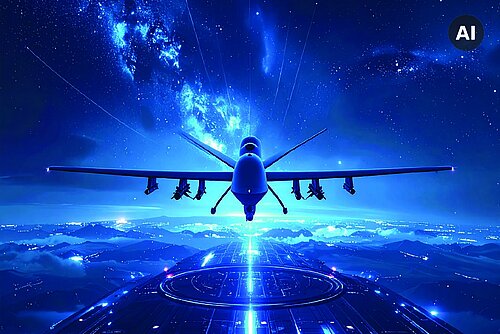
The global drone market is growing rapidly. Unmanned aerial vehicles (UAVs) are increasingly used in industries such as logistics, agriculture, surveying, infrastructure inspection, public safety, and defense. As applications become more sophisticated, manufacturers must deliver drones that are not only more capable but also more reliable and scalable to produce.
While drone technology often receives the spotlight, manufacturing these systems presents a unique set of challenges. Combining lightweight structures, advanced electronics, precision sensors, and stringent quality requirements into a compact airborne platform requires highly controlled production processes.
This article explores the key manufacturing challenges facing drone producers and how automation can help overcome them.
Balancing Lightweight Design and Structural Strength
One of the most important requirements in drone design is minimizing weight while maintaining structural integrity.
A lighter drone typically offers:
- Longer flight times
- Increased payload capacity
- Improved energy efficiency
- Enhanced maneuverability
To achieve these goals, manufacturers often use materials such as:
- Carbon fiber composites
- Lightweight aluminum alloys
- Engineering plastics
- Hybrid material structures
However, these materials can introduce additional manufacturing complexities. Precision machining, handling sensitive components, and maintaining consistent assembly quality all become critical factors in ensuring product performance.
Integrating Complex Electronics in Limited Space
Modern drones rely on a wide range of electronic systems operating within a compact footprint.
These systems often include:
- Flight controllers
- Electronic speed controllers (ESCs)
- GPS modules
- Communication hardware
- Power management systems
- Embedded computing platforms
As functionality increases, so does component density. Manufacturers must ensure reliable electrical connections, efficient cable routing, and proper thermal management without compromising accessibility or serviceability.
This challenge becomes even greater when production volumes increase and consistency across units becomes essential.
Managing Advanced Sensor Integration
Many commercial and industrial UAVs are equipped with sophisticated sensor technologies that enable navigation, mapping, inspection, and autonomous operation.
Typical examples include:
- High-resolution cameras
- Thermal imaging systems
- LiDAR sensors
- Radar systems
- Environmental monitoring sensors
These technologies often require highly accurate positioning, alignment, and calibration during assembly.
The challenges associated with integrating advanced sensing technologies are similar to those addressed in our Full Automatic LiDAR Sensor Assembly Line, where precision assembly and testing are essential to ensure reliable sensor performance.
Maintaining Product Quality at Scale
Building a successful prototype is one thing. Producing thousands of identical units with consistent quality is another.
As manufacturers scale production, they must control:
- Assembly accuracy
- Process repeatability
- Component variability
- Product performance
- Production throughput
Manual processes may work during early development phases but often become bottlenecks as demand grows.
To maintain quality while increasing output, manufacturers frequently introduce automation, standardized workflows, and in-line quality control systems.
Ensuring Full Traceability
Traceability has become increasingly important across high-tech manufacturing industries, and drone production is no exception.
Manufacturers need visibility into:
- Component origins
- Production parameters
- Assembly records
- Test results
- Quality data
Comprehensive traceability enables faster root-cause analysis, supports regulatory requirements, and helps improve overall product reliability.
As drone systems become more complex and are deployed in mission-critical applications, maintaining complete production records becomes even more important.
Testing Increasingly Sophisticated Systems
Every subsystem within a drone must function correctly before deployment.
Manufacturers typically perform validation of:
- Flight control systems
- Communication modules
- Sensors
- Battery systems
- Motor performance
- Software functionality
Because UAVs operate in dynamic environments, testing often extends beyond basic electrical verification and includes functional and performance-based validation.
Automated testing systems can significantly improve consistency while reducing inspection times and operator dependency.
Scaling from Prototype to Industrial Production
Many drone manufacturers begin with low-volume production focused on research, development, and market validation.
As demand grows, production requirements change dramatically.
Manufacturers must address questions such as:
- How can production capacity be increased efficiently?
- Which processes should be automated?
- How can quality be maintained during scaling?
- How can production data be captured and analyzed?
The transition from prototype manufacturing to serial production is often one of the most challenging phases in a company's growth journey.
The Automation Solutions for Advanced Drone Manufacturing case study demonstrates how scalable automation concepts can support manufacturers as production requirements evolve.
The Role of Automation in Solving Manufacturing Challenges
Automation is becoming a key enabler for modern drone production.
Automated systems can help manufacturers:
- Improve assembly precision
- Increase production throughput
- Standardize processes
- Enable full traceability
- Reduce quality deviations
- Support future scalability
Rather than replacing engineering expertise, automation allows manufacturers to apply it more effectively across larger production volumes.
As drone applications continue to expand, robust manufacturing systems will play an increasingly important role in ensuring product quality, reliability, and competitiveness.
Conclusion
The success of a drone does not depend solely on its design or flight capabilities. Manufacturing excellence is equally important.
From lightweight materials and electronics integration to traceability and testing, drone manufacturers face a range of complex production challenges. Companies that invest in scalable manufacturing strategies and advanced automation technologies will be better positioned to meet growing market demand while maintaining consistent product quality.
Further Reading
- Automation Solutions for Advanced Drone Manufacturing
- Full Automatic LiDAR Sensor Assembly Line
- How Are Drones Manufactured? Key Production Steps for Modern UAV Systems
Looking to Scale Drone Production?
Whether you are developing a new UAV platform or preparing for higher production volumes, the right automation strategy can help improve quality, efficiency, and scalability.
Contact our experts to discuss your drone manufacturing project.