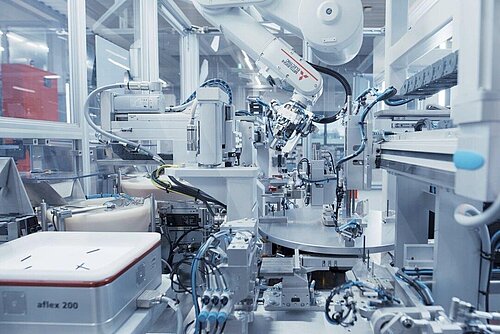
The medical device industry is under increasing pressure to deliver higher-quality products, meet stricter regulatory requirements, and scale production efficiently. For manufacturers of endoscopes, these demands are particularly challenging.
Modern endoscopes combine miniature components, sophisticated optics, electronics, and precision mechanical assemblies in increasingly compact designs. As product complexity grows, manufacturers are finding that traditional manual assembly methods are no longer sufficient to ensure consistent quality and competitive production performance.
Automation is therefore becoming a critical enabler for companies looking to increase output, improve process reliability, and maintain compliance in highly regulated manufacturing environments.
The Growing Complexity of Endoscope Manufacturing
Over the past decade, endoscope technology has evolved rapidly. Devices have become smaller, more capable, and more integrated, while customer expectations for performance and reliability continue to rise.
Manufacturers must now manage production processes that require:
- Precise handling of miniature components
- Consistent assembly of optical and electronic systems
- High-quality inspection and testing procedures
- Complete process documentation
- Full product traceability
Meeting these requirements consistently becomes increasingly difficult when production relies heavily on manual operations.
As discussed in our article on The Hidden Manufacturing Challenges Behind Modern Endoscopes, miniaturization and quality assurance are creating new demands for manufacturers across the medical device industry.
Why Manual Assembly Reaches Its Limits
Manual assembly remains an important part of many medical device production environments. Skilled operators provide flexibility and can efficiently support lower-volume manufacturing.
However, as production volumes increase and product designs become more complex, several challenges emerge:
- Variability between operators
- Longer training and qualification periods
- Increased risk of assembly errors
- Limited scalability
- Growing quality control requirements
Even highly trained personnel may struggle to maintain the same level of consistency across thousands of production cycles.
For manufacturers seeking to increase throughput while maintaining quality standards, automation offers a way to reduce process variation and improve repeatability.
Improving Product Quality Through Automation
One of the most significant advantages of automation is the ability to create stable and repeatable production processes.
Automated systems can execute critical assembly steps with consistent accuracy while continuously monitoring process parameters and product quality.
Typical applications include:
- Precision component handling
- Automated joining and bonding processes
- Vision-guided assembly
- In-line inspection systems
- Automated functional testing
These technologies help manufacturers reduce defects, identify process deviations early, and maintain consistent product quality across large production volumes.
For medical device manufacturers, this consistency is particularly valuable because product quality directly impacts patient safety and regulatory compliance.
Traceability and Regulatory Compliance
Regulatory requirements for medical devices continue to evolve worldwide. Manufacturers are expected to document every critical production step and maintain detailed records throughout the product lifecycle.
Automation supports these requirements by enabling the automatic collection of manufacturing data, including:
- Process parameters
- Inspection results
- Component identification
- Batch and serial number information
- Production history
Instead of relying on manual documentation, manufacturers can create digital records that support compliance, audits, and continuous improvement initiatives.
Comprehensive traceability has become a key requirement for modern medical device manufacturing and is increasingly expected by customers and regulators alike.
Increasing Production Capacity Without Compromising Quality
Many medical device manufacturers face a common challenge: increasing demand combined with ongoing labor shortages and rising quality expectations.
Simply adding more operators is often not a sustainable solution.
Automated production systems help manufacturers scale output by:
- Reducing cycle times
- Improving process consistency
- Minimizing manual interventions
- Supporting multi-shift operation
- Increasing overall equipment effectiveness
This allows manufacturers to expand production capacity while maintaining the quality standards required for medical devices.
Which Endoscope Manufacturing Processes Can Be Automated?
Not every process requires full automation. Successful projects typically focus on production steps where automation delivers the greatest value.
Common examples include:
- Component feeding and handling
- Precision assembly operations
- Optical alignment processes
- Inspection and quality control
- Leak testing and functional testing
- Packaging and traceability processes
The most effective solutions combine automation with carefully designed manual operations where flexibility remains important.
Building a Scalable Production Strategy
Automation is not simply about replacing manual labor. It is about creating a production system that can adapt to future growth, changing product requirements, and increasing regulatory expectations.
Manufacturers that invest strategically in automation are often better positioned to:
- Launch new products faster
- Scale production efficiently
- Improve product quality
- Strengthen compliance processes
- Reduce long-term manufacturing costs
Successful automation projects begin with a clear understanding of both current production challenges and future business objectives.
Our article What Makes an Automation Project Fail? 7 Common Risks in Industrial Automation Projects highlights important considerations when planning complex automation initiatives.
From Manufacturing Challenge to Automated Solution
As endoscope manufacturing continues to evolve, automation is becoming less of a competitive advantage and more of a necessity.
Manufacturers must balance increasing product complexity with stringent quality requirements and growing production volumes. Automated production systems help create the consistency, traceability, and scalability required to meet these demands.
A practical example can be found in our Automatic Single-Purpose Endoscope Production Case Study, which demonstrates how a customized automation solution helped address demanding production and quality requirements within medical device manufacturing.
Companies that invest in scalable and validated manufacturing systems today will be better prepared to meet the challenges of tomorrow's medical device market.