Automotive Displays Are No Longer Just Screens
For many years, automotive displays served a primarily functional purpose. Instrument clusters, navigation screens, and infotainment systems were designed to provide drivers with essential information while remaining secondary to the driving experience itself.
Today, that role has fundamentally changed.
As vehicles become increasingly electrified, connected, and software-defined, displays have evolved into the central interface between occupants and the vehicle. In many modern vehicles, the display system is now one of the first features customers notice when evaluating a new model.
From large central touchscreens to immersive pillar-to-pillar displays, automotive displays are transforming how drivers and passengers interact with mobility.
The Rise of the Digital Cockpit
Modern vehicle interiors are becoming digital ecosystems. Instead of relying on multiple physical controls, manufacturers are integrating a growing number of vehicle functions into sophisticated display environments.
Today's automotive displays commonly manage:
- Navigation and route planning
- Infotainment and media functions
- Climate control settings
- Vehicle diagnostics
- Advanced Driver Assistance Systems (ADAS)
- Connectivity and smartphone integration
- Charging and energy management for electric vehicles
As a result, displays have become a key component of the overall user experience and brand perception.
The shift toward digital cockpits is particularly visible in electric vehicles, where manufacturers often use innovative display concepts to create a distinctive and modern interior design.
User Experience Has Become a Competitive Advantage
In a market where vehicle performance, range, and safety technologies are increasingly comparable, user experience is emerging as a major differentiator.
Consumers have become accustomed to intuitive digital interfaces through smartphones, tablets, and consumer electronics. They now expect the same seamless interaction inside their vehicles.
Automotive displays influence how users perceive:
- Ease of use
- Vehicle quality
- Technological innovation
- Brand identity
- Overall driving experience
This is one reason why many OEMs are investing heavily in large-format displays, curved screens, haptic feedback technologies, and next-generation Human-Machine Interfaces (HMIs).
Display Technology Is Evolving Rapidly
The growing importance of automotive displays is driving significant technological innovation throughout the industry.
Current developments include:
- OLED displays
- Mini-LED technology
- Curved displays
- Transparent displays
- Passenger displays
- Augmented reality head-up displays
- AI-supported user interfaces
At the same time, display systems are becoming larger, thinner, and more complex to manufacture.
This creates new challenges not only for product development but also for industrialization and production.
Related Case Study:
High-Precision Assembly for Automotive Displays
Manufacturing Excellence Becomes Critical
As display systems evolve into larger and more integrated cockpit architectures, manufacturing precision becomes increasingly important.
OEMs and Tier 1 suppliers must ensure:
- Precise display positioning
- Consistent optical quality
- Reliable bonding processes
- Tight manufacturing tolerances
- Long-term durability
- Scalable production concepts
Even minor deviations during assembly can impact visual appearance, touch performance, or overall customer perception.
This is particularly relevant for curved displays and seamless cockpit concepts, where multiple components must function as one integrated system.
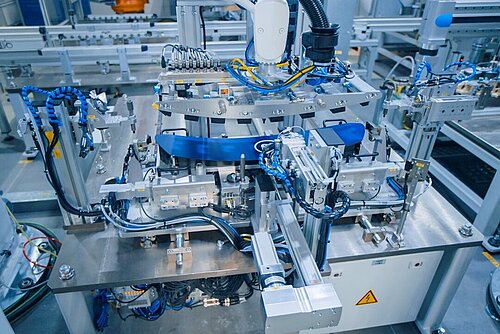
As a result, advanced automation technologies play a critical role in enabling the next generation of automotive display production.
Automotive Displays and the Future of Mobility
The importance of displays will continue to grow as vehicles become increasingly software-driven and connected.
Future mobility concepts are expected to incorporate:
- Pillar-to-pillar display architectures
- Personalized user interfaces
- AI-driven cockpit assistants
- Adaptive display environments
- Augmented reality experiences
- Fully integrated digital surfaces
In this environment, displays become far more than information screens. They become the primary interface through which drivers and passengers experience the vehicle.
Manufacturers that successfully combine innovative display technologies with robust production and automation strategies will be well positioned to differentiate themselves in an increasingly competitive mobility market.
Learn more about our Mobility expertise:
Mobility Solutions
Precision Automation Enables Next-Generation Display Manufacturing
As automotive displays continue to evolve, production processes must evolve alongside them.
High-precision assembly, optical quality control, automated inspection, and scalable manufacturing concepts are becoming essential for bringing advanced display systems into series production.
At HAHN Automation Group, we support manufacturers with automation solutions for demanding mobility applications where precision, repeatability, and process reliability are critical to success.
Automated Assembly Systems for Mobility Applications
Planning Your Next Automotive Display Production Project?
Whether you are developing next-generation cockpit systems, large-format displays, or advanced HMI concepts, HAHN Automation Group supports manufacturers with scalable automation and high-precision assembly solutions.
Contact our experts to discuss your project requirements: