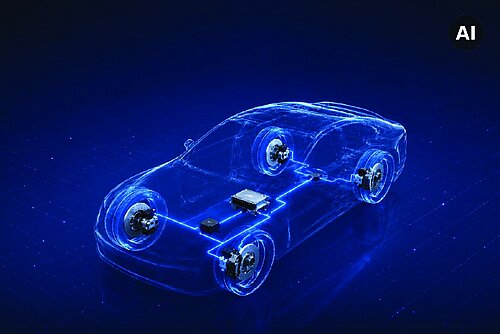
Brake-by-wire systems combine mechanical components with sensors, actuators, electronic control units and software. Manufacturing these products therefore requires more than a series of individual assembly stations.
Each process must be connected to the next. Components need to be identified, positioned and assembled precisely. Sensors and actuators must be calibrated, relevant functions tested and quality data assigned to the correct product.
A coordinated automation concept brings these requirements together and creates the foundation for reliable, traceable and scalable brake-by-wire production.
Understanding Different Brake-by-Wire Architectures
Brake-by-wire is an umbrella term for different braking concepts. The required manufacturing processes depend on the specific system architecture and component design.
Electrohydraulic systems use electronic control while retaining hydraulic actuation at the wheel. Electromechanical or dry brake-by-wire systems generate the braking force directly through electrically controlled actuators. Other products include pedal modules, brake pedal simulators, sensors and electronic control units.
These systems require different assembly and testing processes. An electrohydraulic unit may involve filling, leakage and pressure testing, while an electromechanical actuator places greater emphasis on motor assembly, electrical connections and mechanical force generation.
Production concepts must therefore be adapted to the product instead of following a single standard design. The article Brake-by-Wire: How Electronic Braking Is Transforming Vehicle Architecture provides a broader introduction to the technology and its role in future vehicle platforms.
A Typical Brake-by-Wire Manufacturing Process
Although individual products vary, an automated manufacturing process can include the following stages:
- Component feeding and identification
- Positioning and pre-assembly
- Pressing, joining and screwdriving
- Integration of sensors and electronic components
- Dispensing, sealing and, where required, filling
- Software flashing and parameterization
- Calibration of sensors and actuators
- Process-integrated quality inspections
- End-of-line functional testing
- Product marking and storage of production data
The exact sequence depends on the component, the required production volume and the level of automation. Some manufacturers may initially combine manual and automated processes before expanding the system as the product reaches a higher level of maturity.
The key objective is to connect the individual production stages. Information generated during assembly, calibration and testing should remain assigned to the product throughout the entire manufacturing process.
Automated Component Handling and Assembly
Brake-by-wire manufacturing involves components with different sizes, materials and levels of sensitivity. Robust housings and mechanical parts may need to be handled alongside electronic modules, sensors and delicate contacts.
Automated handling systems can identify, orient and position these components for the next process. Vision systems help verify that the correct variant is present and that the part has been positioned properly.
Typical assembly processes include:
- Pressing and joining
- Controlled screw driving
- Installation of seals and bearings
- Adhesive and sealant dispensing
- Assembly of sensors and actuators
- Creation of electrical connections
- Camera-based presence and position checks
Quality-relevant parameters can be monitored directly during these processes. Force-displacement curves, torque values or dispensing results provide immediate information about whether the assembly step has been completed within the defined limits.
The interaction between assembly, inspection and quality documentation is covered in more detail in Brake-by-Wire Manufacturing: Assembly, Testing and Quality Assurance.
Integrating Sensors, Electronics and Software
The integration of electronics distinguishes brake-by-wire production from the manufacturing of purely mechanical braking components.
Sensors must be installed accurately to provide reliable measurements. Actuators require precise mechanical assembly as well as electrical testing. Control units and communication interfaces must be connected without damaging sensitive components.
Depending on the product, the manufacturing process may also include:
- Software flashing
- Product-specific parameterization
- Sensor calibration
- Actuator calibration
- Electrical continuity and insulation testing
- Verification of communication interfaces
These steps require close coordination between production equipment, test systems and product software. Calibration values and software versions should also be included in the product’s digital manufacturing history.
Traceability and Production Data Management
Brake-by-wire components are safety-critical products. Manufacturers must therefore be able to demonstrate that each relevant assembly and testing step was completed correctly.
A unique serial number or data matrix code can identify the product from the first station onwards. During production, the system can record information such as:
- Component and material data
- Assembly parameters
- Force-displacement curves
- Torque and angle values
- Software versions
- Calibration results
- Inspection and functional test results
- Rework information
Connecting the production system with MES or ERP platforms enables the consistent management of this information. If a deviation occurs, manufacturers can trace the affected product, process step and production conditions.
The collected data can also support process optimization. Recurring deviations may indicate tool wear, material variations or changes in equipment performance. This makes traceability valuable not only for documentation but also for maintaining stable production.
Scaling from Pilot Production to Series Manufacturing
Many brake-by-wire products are introduced gradually. During development and pilot production, flexibility and access to individual processes are often more important than maximum output. As the product matures, production volumes and cycle-time requirements increase.
A modular automation concept supports this transition. Manual or semi-automated stations can be used during early production phases and later supplemented or replaced by automated processes.
Scalable production concepts may include:
- Modular assembly and testing stations
- Flexible fixtures for different product variants
- Configurable process and testing software
- Expandable material handling systems
- Additional stations for increasing production volumes
- Integration of new functions and product generations
This approach allows manufacturers to adjust the level of automation to the current product maturity and production demand. It also reduces the risk of designing a highly specialized system before the final product and process requirements have been established.
Building a Connected Brake-by-Wire Production Concept
Reliable brake-by-wire manufacturing requires a connected view of the entire production process. Component handling, mechanical assembly, electronics integration, calibration, functional testing and data management must work together.
The appropriate solution depends on the system architecture, product maturity, number of variants and required output. Planning these factors together from the beginning helps avoid isolated processes and creates a consistent flow of products and information.
HAHN Automation Group combines experience in assembly automation, testing technology and production data management to develop concepts for future braking applications. The Brake-by-Wire Systems case study presents relevant capabilities across different production stages.
By using modular equipment and connected process data, manufacturers can establish a production concept that supports current requirements while remaining adaptable to new brake-by-wire architectures and future production volumes.
Further Reading
Brake-by-Wire Systems: Automation Expertise for Future Production
Brake-by-Wire: How Electronic Braking Is Transforming Vehicle Architecture
Brake-by-Wire Manufacturing: Assembly, Testing and Quality Assurance
Automation Solutions for the Mobility Industry
Ready to Prepare Your Brake-by-Wire Production?
Whether you are planning a pilot line, scaling an existing process or developing a production concept for a new brake-by-wire component, we can support you with flexible assembly, testing and traceability solutions.
Contact the HAHN Automation Group to discuss your production requirements: