The rapid expansion of digital services, cloud computing and artificial intelligence is increasing demand for reliable data center infrastructure. Behind every data center is a complex network of cooling, power distribution and control technologies that must operate continuously and efficiently.
While much of the public discussion focuses on data processing and computing capacity, the physical infrastructure behind these systems is equally important. Heat exchangers, pumps, valves, cooling units, electronic assemblies and power distribution components must be manufactured to demanding quality and performance standards.
As demand increases and product designs evolve, manufacturers must scale production without compromising reliability. Automation can help transform manual or semi-automated manufacturing processes into stable, repeatable and traceable production systems.
What Is Data Center Infrastructure Manufacturing?
Data center infrastructure manufacturing covers the production of components and systems required to operate data processing facilities safely, reliably and efficiently.
Depending on the data center design, these components may support:
- Cooling and thermal management
- Fluid distribution
- Airflow management
- Power supply and distribution
- Monitoring and control
- Backup and safety systems
- Mechanical infrastructure
The HAHN Automation Group addresses this market within its strategic Transformation Technologies focus. Our expertise includes automation solutions for heat exchangers, pumps, valves, cooling technologies and other infrastructure components.
Learn more about our automation solutions for Transformation Technologies.
Which Components Are Required for Data Center Infrastructure?
Data centers rely on a broad range of mechanical, electrical and mechatronic components. The exact equipment depends on the size, cooling architecture, computing density and redundancy requirements of the facility.
Heat Exchangers
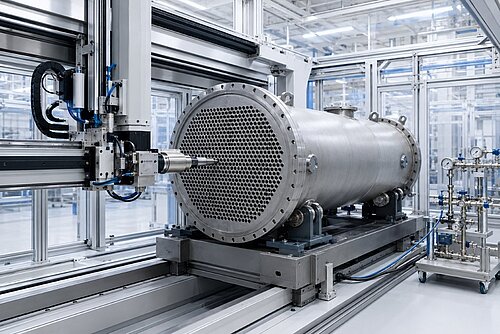
Heat exchangers transfer thermal energy from one medium to another and are an important part of many cooling systems. Their performance depends on factors such as material quality, tube geometry, connection integrity and heat transfer efficiency.
Manufacturing processes may include:
- Tube insertion
- Tube expansion or rolling
- Welding and brazing
- Sealing
- Dimensional inspection
- Pressure and leakage testing
When large numbers of tubes and connections must be processed, manual production can become slow and inconsistent. Automated process control helps manufacturers achieve repeatable results across every connection.
Case Study: Tube Rolling for Heat Exchangers
Pumps and Valves
Pumps and valves control the movement and distribution of cooling fluids. Their reliability is critical because a leakage, flow restriction or actuator failure can affect the performance of the cooling system.
Typical manufacturing processes include:
- Housing and component assembly
- Seal insertion
- Bearing and shaft assembly
- Greasing and lubrication
- Controlled screwing
- Actuator integration
- Leakage and flow testing
- Electrical and functional testing
Electronic valve actuators add another level of complexity because mechanical assemblies must interact reliably with motors, sensors, electronics and software.
Cooling and Fluid Distribution Components
Modern data center cooling systems may contain manifolds, pipe connections, cold plates, distribution units and other fluid-handling components. These products require accurate assembly and reliable sealing to prevent leakage and maintain stable cooling performance.
Depending on the product, manufacturers may need to automate:
- Connector assembly
- Seal and O-ring insertion
- Dispensing
- Tube and hose assembly
- Welding or joining
- Pressure testing
- Leakage testing
Electrical and Electronic Components
Data center infrastructure also includes components for power distribution, monitoring and control. These can range from connectors and electronic housings to bus bars, sensors and mechatronic control assemblies.
Their production may require:
- Precision component handling
- Contact and connector assembly
- Insert molding
- Bus bar integration
- PCB handling
- Electrical testing
- Vision inspection
- Marking and traceability
Combining mechanical and electronic processes within one production system requires coordinated handling, assembly and testing concepts.
Case Study: Multi-Variant Connector Manufacturing
Key Manufacturing Challenges
Although data center infrastructure includes many different product types, manufacturers often face similar production challenges.
Increasing Demand and Production Volumes
Growing investment in digital infrastructure creates demand for higher manufacturing capacity. Processes that were previously performed manually may no longer provide the required throughput or consistency.
Simply adding more manual workstations is not always a sustainable solution. It may increase space requirements, make quality more dependent on individual operators and complicate production planning.
Automation enables manufacturers to increase output through:
- Parallel processing
- Shorter cycle times
- Automated component handling
- Consistent process sequences
- Integrated quality inspection
- Reduced manual intervention
The appropriate level of automation should be based on production volume, product complexity and expected future demand.
High Product Variety
Data center components are often adapted to different capacities, layouts or customer specifications. Manufacturers may need to produce several sizes, connection types or performance classes on the same equipment.
A production system designed for only one fixed product can become inefficient when new variants are introduced. Flexible automation concepts can address this challenge through:
- Recipe-controlled production
- Automated format selection
- Interchangeable tooling
- Flexible feeding systems
- Product-specific process parameters
- Modular production stations
The objective is to balance flexibility with process stability. Not every step needs to be fully reconfigurable, but likely product changes should be considered during system development.
Reliable Sealing and Leakage Prevention
Leakage is one of the most critical quality risks in liquid cooling and fluid distribution components. A defective connection may not only reduce product performance but also create risks for surrounding electrical equipment.
Reliable sealing depends on several factors:
- Component tolerances
- Seal condition and position
- Surface quality
- Joining force
- Assembly alignment
- Process temperature
- Controlled torque
- Connection geometry
Automation can monitor relevant process parameters and verify whether each assembly step remains within its defined limits. Leakage or pressure testing can then confirm the integrity of the completed product.
Consistent Joining Processes
Heat exchangers, cooling units, valve assemblies and electrical components require a wide range of joining technologies. These may include rolling, pressing, screwing, welding, brazing, gluing and dispensing.
Each process introduces its own quality requirements. An automated production system can control and document parameters such as:
- Force and distance
- Torque and angle
- Temperature
- Pressure
- Welding energy
- Dispensing volume
- Process time
Monitoring these values helps identify deviations early and creates a more transparent manufacturing process.
Integrated Testing and Quality Assurance
Visual inspection alone is not sufficient for many infrastructure components. Manufacturers must also verify whether the completed product performs according to its technical requirements.
Depending on the component, automated testing may include:
- Leakage testing
- Pressure testing
- Flow measurement
- Electrical testing
- Resistance measurement
- Sensor calibration
- Actuator testing
- Communication testing
- Functional end-of-line testing
Integrating testing directly into production reduces additional handling and allows measurement results to be linked to the individual product.
Traceability Across the Manufacturing Process
Traceability is becoming increasingly valuable as components become more complex and production volumes increase. A digital production record may include:
- Component and batch information
- Process parameters
- Inspection results
- Leakage or pressure test data
- Electrical test results
- Software versions
- Product identification
- Production date and station data
This information supports quality analysis and helps manufacturers identify the source of recurring deviations. It also creates a basis for continuous process improvement.
From Manual Tube Rolling to Automated Heat Exchanger Production
Heat exchanger production demonstrates how a previously manual process can be transformed through automation.
In one customer project, the traditional pneumatic tube rolling process was slow, labor-intensive and associated with high leakage rates. The manufacturer also needed to process different product variants while increasing production output.
HAHN Automation Group developed an automated tube rolling solution that improved process precision, reduced defects and supported a wider range of product variants. The automated system can complete a vessel containing approximately 3,000 tubes in around half the time required for the previous manual process.
Explore the complete Automated Tube Rolling Process for Heat Exchangers case study.
This example highlights several principles that are relevant across data center infrastructure manufacturing:
- Replace operator-dependent processes with controlled automation
- Monitor critical process parameters
- Adapt equipment for multiple product variants
- Integrate quality assurance into production
- Scale capacity without proportionally increasing manual labor
Automating Complex Valve Actuator Production
Valve actuators illustrate another common manufacturing challenge. These products combine housings, mechanical components, seals, motors, electronics and software within a compact assembly.
A scalable automation concept may integrate:
- Injection molding
- Component feeding
- Housing pre-assembly
- Greasing
- Controlled screwing
- Plastic laser welding
- Electrical testing
- Functional end-of-line testing
HAHN Automation Group has implemented these processes within a multi-site production solution for electronic valve actuators.
Learn more about the High-Speed Assembly of Valve Actuators.
Although component designs and applications vary, the underlying manufacturing principles are also relevant to valves and actuators used in HVAC, cooling and infrastructure environments.
Building a Scalable Automation Strategy
Manufacturers should evaluate more than the current production volume when planning automation for data center infrastructure components. The system should also consider future variants, capacity requirements and quality expectations.
Important questions include:
- Which processes currently depend heavily on manual experience?
- Where do defects or leakage most frequently occur?
- Which parameters determine product quality?
- Which inspection and testing steps are required?
- How many product variants must the system process?
- Could future capacity be added through modular expansion?
- Which production data must be documented?
- How will the system connect with existing manufacturing infrastructure?
Answering these questions early helps define the appropriate automation level and reduces the risk of expensive modifications later.
Conclusion
Data center infrastructure manufacturing covers a broad range of mechanical, electrical and mechatronic products. Heat exchangers, pumps, valves, cooling components and power distribution systems must deliver reliable performance in demanding operating environments.
Manufacturers therefore need production processes that combine:
- Precise component handling
- Controlled assembly and joining
- Reliable sealing
- Integrated inspection
- Functional testing
- Digital traceability
- Flexible variant management
- Scalable production capacity
Automation helps transform manual and operator-dependent processes into repeatable manufacturing systems. By integrating process control, testing and production data, manufacturers can improve quality while preparing their operations for growing demand.
Scale Your Data Center Infrastructure Production
HAHN Automation Group supports manufacturers of HVAC and data center infrastructure components with customized solutions for assembly, handling, joining, testing and traceability.
Whether you are automating an existing process, developing a new product or scaling production capacity, our experts help create manufacturing solutions tailored to your technical and operational requirements.