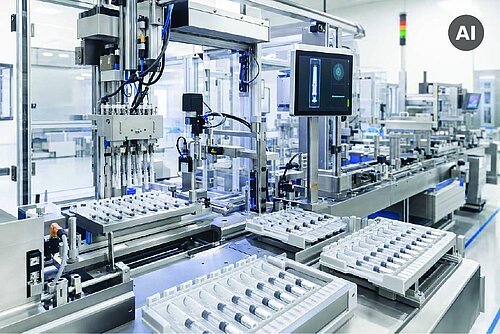
Pharmaceutical devices play an increasingly important role in modern healthcare. Prefilled syringes, injection systems, autoinjectors, pens, cartridges, and other drug delivery devices make therapies safer, more accessible, and easier for patients to use.
However, manufacturing these products presents significant challenges.
Pharmaceutical devices often combine sensitive drug-contact components, precision-molded parts, mechanical assemblies, and quality-critical functions. Manufacturers must ensure that every component is handled correctly, every process is controlled, and every finished product meets defined quality requirements.
At the same time, growing demand for biologics, injectable therapies, and patient-centric drug delivery systems is increasing production volumes. Manufacturers therefore need to scale their operations without compromising quality, traceability, or regulatory compliance.
Advanced automation helps address these requirements by creating stable, repeatable, and data-driven manufacturing processes.
Why Pharmaceutical Device Manufacturing Is So Demanding
Pharmaceutical devices sit at the intersection of pharmaceutical production and medical device manufacturing. Depending on the product and application, manufacturers may need to consider requirements relating to product safety, drug compatibility, cleanroom production, process validation, documentation, and device functionality.
Typical pharmaceutical device manufacturing challenges include:
- Strict quality and compliance requirements
- Sensitive and transparent components
- High demands on dimensional accuracy
- Complex assembly sequences
- Complete production traceability
- Cleanroom-compatible equipment
- Reliable functional testing
- Increasing production volumes
- Multiple product variants
- Shorter time to market
These requirements cannot be addressed through throughput alone. Production systems must combine speed with precision, process stability, documentation, and flexibility.
This is why automation is becoming a central part of modern Life Sciences manufacturing.
Consistent Quality Through Controlled Processes
Quality in pharmaceutical device manufacturing depends on the stability of every individual production step.
Components may need to be positioned, assembled, joined, inspected, tested, marked, and packaged. Even small deviations can affect the functionality, integrity, or safe use of the finished device.
Automated production systems reduce this risk by controlling critical process parameters and executing operations with consistent accuracy.
Depending on the product, automated processes may include:
- Component feeding and orientation
- Precision handling
- Assembly and joining
- Dispensing and dosing
- Pressing and force monitoring
- Laser marking
- Vision inspection
- Leak and flow testing
- Electrical and functional testing
- Packaging and tray loading
Integrated sensors and monitoring systems can verify whether each operation has been completed within its defined process window. Components that do not meet the specified criteria can be identified and separated before they reach the next production stage.
This makes quality assurance an integral part of manufacturing rather than a separate inspection at the end of the line.
The Importance of Inline Inspection
Pharmaceutical device components often have demanding optical, dimensional, and cosmetic requirements. Transparent polymers, small geometries, reflective surfaces, and complex component shapes can make reliable inspection especially challenging.
Machine vision systems can inspect components and assemblies for characteristics such as:
- Correct component presence
- Position and orientation
- Surface defects
- Dimensional deviations
- Contamination or particles
- Color and material variations
- Assembly completeness
- Marking quality
Inspection concepts must be developed specifically for the component, material, and defect criteria. Camera selection, lighting, component presentation, and image-processing parameters all influence inspection reliability.
The HAHN Automation Group case study on the handling and inspection of transparent pharmaceutical device components demonstrates how precise handling and 100 percent inline inspection can be combined in a compact, high-volume production environment.
Traceability Across the Entire Production Process
Traceability is essential for pharmaceutical device manufacturing. Manufacturers need to understand how, when, and under which conditions each product was produced.
A modern traceability system can connect product identification with process and quality data from individual manufacturing steps.
Depending on the application, recorded data may include:
- Component and material batches
- Machine and tool identification
- Process parameters
- Inspection results
- Test values
- Time and date information
- Product variants
- Reject reasons
- Operator or production order data
- Equipment status
Individual components, carriers, trays, batches, or finished devices can be identified using technologies such as Data Matrix codes, barcodes, RFID tags, or laser markings.
Throughout the production process, the automation system connects this identification with the relevant manufacturing data. The resulting production record provides transparency across the entire process chain.
This supports quality management, root-cause analysis, documentation, and continuous process improvement.
Connecting Automation with MES and ERP Systems
Production traceability becomes even more valuable when automation systems are connected to higher-level manufacturing platforms.
Interfaces to manufacturing execution systems and enterprise resource planning systems can allow production equipment to exchange information such as:
- Production orders
- Product recipes
- Batch information
- Material data
- Quality results
- Equipment status
- Production quantities
- Downtime information
This creates a connected production environment in which manufacturing data is available beyond the individual machine.
Manufacturers can use this information to identify trends, compare production batches, analyze rejects, monitor equipment performance, and improve production planning.
Digital connectivity also reduces manual documentation effort and the risk of incomplete or inconsistent data.
Scaling Production Without Losing Process Stability
A production concept that works during product development or initial market launch may not be suitable for high-volume manufacturing.
Early production stages often rely on manual or semi-automated processes. These approaches provide flexibility but can become difficult to control as production volumes increase. Additional operators, manual documentation, and repeated handling can introduce variability and limit output.
Automation creates the repeatability required for systematic scale-up.
However, scaling does not always mean moving directly from manual assembly to a fully automated high-speed line. The appropriate automation level depends on factors such as:
- Expected production volume
- Product maturity
- Number of variants
- Process complexity
- Quality requirements
- Launch schedule
- Available investment
- Future market uncertainty
A modular automation strategy allows manufacturers to introduce capacity gradually. Individual process modules can be validated and expanded as demand increases.
This reduces investment risk while creating a defined path from pilot production to industrial-scale manufacturing.
Designing for Product Variants and Future Changes
Pharmaceutical device markets continue to evolve. Manufacturers may need to introduce new dosage formats, component designs, delivery mechanisms, or product variants.
Production equipment should therefore be designed with future changes in mind.
Flexible manufacturing concepts may include:
- Modular process stations
- Interchangeable tooling
- Recipe-controlled parameters
- Automated format changes
- Flexible feeding systems
- Reconfigurable inspection programs
- Scalable conveyor systems
- Standardized software modules
The goal is not to make every system universally flexible. Excessive flexibility can increase complexity and investment costs.
Instead, manufacturers should identify the product features that are most likely to change and design the automation architecture around these realistic scenarios.
Validation-Oriented Engineering
Pharmaceutical device production equipment must be designed with validation and documentation requirements in mind from the beginning.
A validation-oriented engineering approach can include:
- Clearly defined user requirements
- Documented functional specifications
- Risk-based design decisions
- Traceable software development
- Defined test protocols
- Calibration concepts
- Controlled user access
- Audit-relevant data management
- Support for IQ and OQ activities
Considering these requirements early helps avoid costly changes during commissioning and qualification.
It also creates a clear relationship between product requirements, equipment functions, process controls, and test results.
Automation as the Foundation for Sustainable Growth
Automation in pharmaceutical device manufacturing is not only about increasing output. It creates the controlled production environment required to combine quality, traceability, and scalability.
Well-designed automation systems help manufacturers:
- Improve process consistency
- Reduce manual handling
- Increase production capacity
- Strengthen quality control
- Generate complete production records
- Support validation activities
- Respond to product changes
- Reduce scrap and rework
- Improve manufacturing transparency
The growing importance of polymer-based drug delivery systems illustrates these requirements. The article Why COC Syringes Are Transforming Modern Drug Delivery explores how new materials and device concepts are changing pharmaceutical manufacturing.
Conclusion
Pharmaceutical device manufacturers must balance increasing production demand with strict quality, traceability, and regulatory requirements.
Advanced automation provides the process control needed to manufacture complex drug delivery devices consistently and at scale. Integrated inspection, functional testing, product identification, and production data management make it possible to verify quality throughout the manufacturing process.
At the same time, modular and flexible automation concepts give manufacturers a reliable path from initial production to high-volume manufacturing.
By considering automation, inspection, traceability, validation, and scalability as part of one integrated production strategy, manufacturers can create robust processes for the next generation of pharmaceutical devices.
Looking to Scale Pharmaceutical Device Production?
HAHN Automation Group develops automation solutions for the assembly, inspection, testing, and traceable production of pharmaceutical devices and drug delivery systems.
Contact our experts to discuss your next pharmaceutical manufacturing project.