The pharmaceutical and medical technology industries are evolving rapidly. As biologics, vaccines, and advanced injectable therapies become increasingly important, manufacturers are looking for drug delivery systems that combine product safety, scalability, and precision.
One material gaining significant attention is cyclic olefin copolymer (COC).
COC syringes are becoming an attractive alternative to conventional glass syringes because they offer excellent optical properties, high break resistance, and strong compatibility with sensitive drug formulations. At the same time, the production of these syringe systems requires advanced manufacturing expertise, precise automation, and reliable quality control.
For pharmaceutical manufacturers, this creates new opportunities — but also new technical challenges.
What Are COC Syringes?
COC syringes are syringe systems manufactured from cyclic olefin copolymer, a high-performance polymer known for its purity, dimensional stability, and transparency.
Compared to traditional glass syringes, COC syringes offer several advantages:
- high optical clarity
- low moisture absorption
- strong chemical resistance
- reduced breakage risk
- low interaction with sensitive drugs
- excellent dimensional precision
These properties make COC particularly suitable for:
- biologics
- vaccines
- ophthalmic drugs
- high-value injectable therapies
- self-administration devices
As the pharmaceutical market increasingly shifts toward patient-centric therapies and advanced drug delivery systems, polymer-based syringe technologies are becoming more relevant across the industry.
Why Pharmaceutical Manufacturers Are Looking Beyond Glass
Glass has been the standard material for syringes for decades. However, modern pharmaceutical applications are creating new demands that traditional glass systems cannot always meet efficiently.
Glass syringes can be sensitive to breakage during transportation, handling, and automated production processes. In high-volume manufacturing environments, this can affect both process stability and cost efficiency.
COC syringes provide a more robust alternative while also enabling greater design flexibility for modern drug delivery devices such as autoinjectors and combination products.
At the same time, manufacturing polymer-based syringe systems requires highly stable production processes. Precision molding, controlled handling, and automated assembly become essential for maintaining consistent product quality.
This is where advanced injection molding technologies play a critical role in enabling repeatable and scalable production.
Automation Is Essential for COC Syringe Manufacturing
Producing COC syringes at industrial scale requires much more than material expertise alone.
Manufacturers must combine:
- precise component handling
- automated assembly
- inline quality inspection
- cleanroom-compatible production
- traceability
- reliable process control
Even small deviations in dimensions or surface quality can affect the performance of sensitive pharmaceutical products.
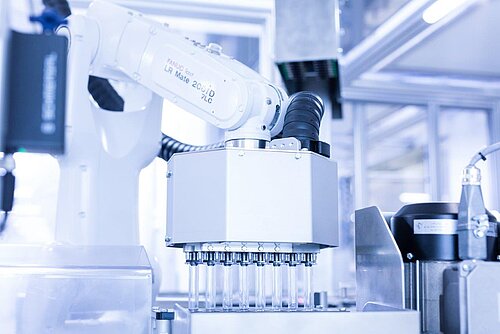
Modern automated assembly solutions in medical technology help manufacturers achieve the precision and repeatability required for high-quality syringe production.
Automation also supports:
- higher throughput
- reduced contamination risks
- stable process repeatability
- scalable production capacities
For pharmaceutical and MedTech manufacturers, automation has therefore become a key factor for competitive and regulatory-compliant production.
Why Inspection and Quality Control Matter
COC syringes require extremely high optical and dimensional quality standards.
Because the material is highly transparent, manufacturers must be able to detect even the smallest defects during production. This includes:
- scratches
- particles
- molding defects
- contamination
- dimensional deviations
- assembly errors
Reliable testing technologies are therefore essential for ensuring pharmaceutical quality standards and minimizing defective products.
Machine vision systems also play an increasingly important role in automated syringe inspection. Especially for transparent components, modern vision inspection systems can help improve inspection accuracy and process reliability.
Increasing Demand for Smart and Scalable Manufacturing
The demand for biologics and injectable therapies continues to grow worldwide. Manufacturers therefore need production systems that are not only precise, but also scalable and future-ready.
Modern pharmaceutical manufacturing increasingly combines automation with digital technologies such as:
- real-time process monitoring
- traceability systems
- AI-supported inspection
- predictive maintenance
- connected production environments
These technologies help manufacturers improve efficiency while maintaining strict quality requirements.
A recent HAHN Automation Group case study on transparent pharmaceutical components demonstrates how advanced automation and inspection technologies can support highly sensitive production environments and stable manufacturing processes in the MedTech sector:
Case Study: Transparent Pharma Device Components
Conclusion
COC syringes are becoming an important part of modern drug delivery systems. Their material properties make them highly attractive for biologics, advanced injectable therapies, and patient-centric healthcare applications.
At the same time, manufacturing these syringe systems reliably at scale requires precision injection molding, automated assembly, advanced inspection technologies, and stable quality control processes.
By combining expertise in injection molding, automated assembly, testing technology, and vision inspection, manufacturers can build scalable production systems for the next generation of pharmaceutical devices.