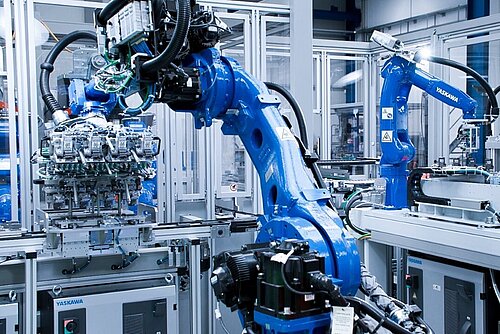
Connectors are essential components in vehicles, industrial equipment, energy systems and electronic devices. Although they are often relatively small, their production involves demanding processes that require high precision, reliable quality control and efficient handling of numerous product variants.
Automated connector assembly can increase throughput and repeatability while reducing the risk of manual errors. However, the combination of delicate contacts, tight tolerances, short cycle times and changing product requirements makes connector manufacturing particularly challenging. Successful automation therefore requires more than fast component handling. Every process, from feeding and insertion to testing and packaging, must work together as part of a stable production system.
Why Is Connector Assembly So Demanding?
A connector typically consists of a housing, pins or contacts, seals and, depending on the application, additional locking or shielding elements. Each component must be correctly oriented, positioned and assembled without causing mechanical damage.
Even small deviations can compromise electrical performance or prevent the connector from fitting correctly during final installation. Bent pins, incomplete insertions, damaged seals or contaminated contacts may not always be visible without automated inspection. At the same time, manufacturers must often produce several variants on the same line while meeting strict requirements for cycle time, traceability and process reliability.
These conditions create several challenges that must be considered when developing an automated assembly system.
Precise Handling of Small and Sensitive Components
Connector contacts and pins are often thin, lightweight and easily deformed. Conventional feeding and gripping methods may damage the components or fail to position them with sufficient accuracy.
The automation system must control forces and movements throughout the handling process. Depending on the connector design, this can require:
- Component-specific grippers
- Flexible feeding systems
- Vision-guided positioning
- Force and displacement monitoring
- Precise robotic or linear handling
- Controlled transfer between process stations
Reliable feeding is particularly important. Components supplied as bulk material can overlap, become entangled or arrive in an incorrect orientation. Flexible feeders and vision systems help identify component positions and enable automatic correction before assembly.
The HAHN Automation Group combines different handling, assembly and inspection technologies to match the component geometry, required cycle time and available production space.
Maintaining Tight Assembly Tolerances
Electrical performance depends on the accurate positioning of every contact. Pins must be inserted to the correct depth, aligned within narrow tolerances and securely fixed inside the housing. Excessive insertion force can deform the pin or damage the plastic component, while insufficient force may result in an incomplete connection.
Force-displacement monitoring is therefore an important part of automated connector assembly. It allows the system to evaluate the entire insertion process rather than checking only the final position. Deviations in the force curve can indicate:
- Incorrect component alignment
- Deformed or damaged contacts
- Obstructions inside the housing
- Incomplete insertion
- Variations in component dimensions
Combining process monitoring with dimensional inspection makes it possible to identify defects immediately and prevent non-conforming components from moving to subsequent production stages.
Managing a Growing Number of Connector Variants
Connector manufacturers increasingly need to produce multiple variants with different pin configurations, housing geometries or electrical specifications. Dedicated production lines for every variant are often neither economical nor flexible enough.
An automated system must therefore support fast and reliable changeovers. This can involve recipe-based process settings, automatically adjustable tooling, product identification and modular fixtures. The control system must ensure that the correct assembly and testing parameters are applied to every variant.
A practical example is the HAHN Automation Group solution for multi-variant connector manufacturing. The fully automated system produces six variations of 24-pin contact blocks. Each variant requires a specific EloPin configuration, while the manufacturing process includes synchronized stamping, bending, insertion, overmolding, testing and packaging.
This example demonstrates that variant flexibility cannot be treated as an isolated machine function. It must be integrated across the complete production process, including component feeding, tooling, quality inspection, data management and end-of-line handling.
Synchronizing Multiple Processes Within the Cycle Time
Connector manufacturing may combine several complex operations in a single automated line. These can include stamping, bending, insertion, joining, overmolding, electrical testing, visual inspection and packaging.
Each station has its own process time and technical limitations. The slowest or least stable operation can affect the output of the entire system. Manufacturers must therefore balance all processes carefully and provide appropriate buffers where necessary.
The multi-variant connector system developed by HAHN Automation Group synchronizes six stamping and bending stations within a 25-second production cycle. It achieves an output of up to 576 components per hour while maintaining integrated quality control.
Achieving this level of performance requires more than increasing robot speed. Cycle-time optimization must also address:
- Parallel processing of components
- Efficient component transfer
- Early preparation of subsequent production steps
- Reduced robot travel distances
- Stable feeding and replenishment
- Fast communication between machines and control systems
- Controlled handling of process interruptions
The objective is not simply the shortest possible cycle. A reliable and repeatable process usually delivers greater overall productivity than a faster process with frequent interruptions.
Integrating Reliable Quality Inspection
Connector defects can affect both mechanical fit and electrical function. Quality assurance must therefore cover several characteristics rather than relying on a single inspection method.
Typical automated inspections include:
- Contact presence and completeness checks
- Pin position and insertion-depth measurement
- Electrical continuity testing
- High-voltage testing
- Resistance measurement
- Visual inspection of housing and locking features
- Force-displacement analysis
- Verification of seals or secondary locks
Inspection should be integrated directly into production wherever possible. Inline testing detects deviations at the station where they occur, helping manufacturers reduce scrap and identify process drift before it affects larger quantities.
The connector manufacturing solution referenced above performs 100-percent inline inspection, including high-voltage testing, contact presence verification and pin-position checks. This combination verifies both the mechanical condition and electrical integrity of the finished component.
The broader testing capabilities of HAHN Automation Group support the integration of visual, electrical and process-based quality controls into automated manufacturing systems.
Handling Defects Without Disrupting Production
Detecting a defective connector is only one part of quality assurance. The automation system must also remove and classify the component without interrupting the production flow or mixing it with compliant parts.
Simple good-part and bad-part separation may not provide enough information for complex production processes. Classifying rejected components according to defect type, tool cavity or process station creates valuable data for troubleshooting and continuous improvement.
In the HAHN Automation Group application, non-conforming components are automatically sorted by cavity and defect pattern. This approach makes it easier to identify recurring issues and determine whether a defect is related to a specific tool, material batch or production step.
Well-designed defect management should ensure that:
- Defective components are securely removed
- Rejected parts cannot re-enter production
- The reason for rejection is documented
- Quality data remain linked to the relevant component or batch
- Repeated defects trigger warnings or corrective actions
- Good parts continue through the process whenever possible
Ensuring Complete Traceability
Connector production generates data at many stages, including component feeding, assembly, inspection and electrical testing. Connecting these data points creates a complete production record and helps manufacturers understand how each component was produced.
Depending on the application, traceability may include:
- Material and batch information
- Product variant and process recipe
- Tool or mold cavity
- Assembly forces and positions
- Inspection images and measurement values
- Electrical test results
- Time stamps and machine identification
- Final quality status
Traceability supports root-cause analysis and makes it possible to narrow down affected production quantities if a quality issue occurs. It also provides the foundation for data-driven process optimization. Trends in insertion force, pin position or electrical performance can reveal gradual changes before they lead to failures.
Digital production records are therefore not only a documentation requirement. They are an important tool for maintaining stable connector manufacturing processes.
Combining Assembly, Injection Molding and Testing
Many connector designs combine metallic contacts with plastic housings produced through overmolding. Integrating injection molding with upstream contact preparation and downstream inspection can reduce handling steps and create a more consistent production flow.
However, the interaction between these processes introduces additional complexity. Contacts must be positioned precisely inside the mold, and the automation must coordinate with the injection molding machine without extending the cycle unnecessarily. After molding, components may require cooling, visual inspection and electrical testing before they can be packaged.
HAHN Automation Group integrates injection molding, assembly, testing and packaging into connected automation solutions. This reduces interfaces between separate systems and enables coordinated process control from the individual contact to the packaged connector.
Designing Connector Automation for Future Requirements
Connector markets continue to evolve as products become more compact, powerful and application-specific. Automation systems must therefore accommodate changing volumes, new variants and additional quality requirements.
Modular system concepts make it easier to add processes, increase capacity or adapt tooling. Standardized interfaces and scalable controls also help manufacturers introduce new connector generations without replacing the entire production system.
When planning an automated connector assembly line, manufacturers should consider:
- Expected product variants and future connector generations
- Required production volume and scalability
- Component presentation and feeding concepts
- Assembly tolerances and process forces
- Required mechanical and electrical inspections
- Traceability and data-storage requirements
- Changeover procedures
- Interfaces with injection molding and packaging
- Accessibility for maintenance and tool replacement
The Transformation Technologies expertise of HAHN Automation Group combines automation, testing, software and engineering to support the industrialization of advanced electronic and mechatronic components.
Building a Reliable Connector Assembly Process
Automated connector assembly requires a coordinated approach to handling, precision, variant management, quality inspection and production data. Addressing only individual operations is rarely enough. The complete process must be designed as an integrated system in which every station supports stable production and verifiable product quality.
The right automation concept enables manufacturers to increase output without compromising accuracy. Flexible tooling and recipe management support multiple variants, while inline testing and traceability make quality transparent throughout the process.
By combining high-precision assembly, intelligent handling, integrated testing and automated defect management, manufacturers can establish connector production systems that are efficient, scalable and prepared for future requirements.
Discuss Your Connector Manufacturing Project
Are you planning a new connector assembly line or looking to increase the flexibility, quality or output of an existing production process? Contact our Team of Experts to discuss your application and automation requirements.