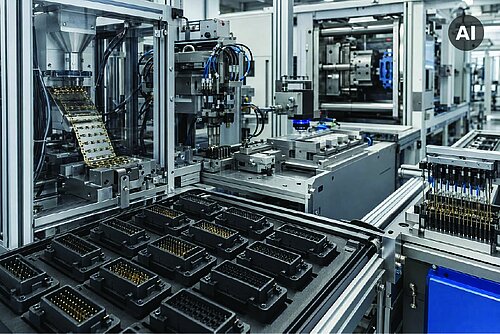
Electrical connectors are becoming smaller, more complex, and increasingly application-specific. Manufacturers may need to produce several connector variants that differ in pin configuration, housing geometry, electrical properties, or testing requirements. At the same time, every component must meet strict standards for dimensional accuracy, electrical performance, and traceability.
These requirements make multi-variant connector manufacturing particularly challenging. A production system optimized for a single product configuration may achieve a high output, but it can become difficult or expensive to adapt when new variants are introduced. Conversely, flexibility must not compromise cycle time, process stability, or quality.
Flexible automation provides a way to combine both objectives. By integrating adaptable handling systems, variant-specific process control, configurable tooling, inline testing, and automated product identification, manufacturers can produce several connector variants efficiently within one production concept.
Why Connector Manufacturing Requires Flexibility
Connectors are used in automotive electronics, industrial equipment, energy systems, data infrastructure, and many other applications. Although their designs vary considerably, they frequently combine molded plastic housings with metallic pins, terminals, contact elements, or busbars.
A single connector family may include several variants based on:
- Number of contacts
- Pin geometry
- Contact arrangement
- Housing design
- Material combination
- Electrical rating
- Sealing requirements
- Mechanical interfaces
- Coding features
- Testing specifications
- Packaging format
Some differences are immediately visible, while others involve only the arrangement of individual contacts or the process parameters used during production. This creates a significant risk of mixing components, applying incorrect recipes, or performing the wrong inspection sequence.
The production system must therefore recognize each variant, select the appropriate processes, and verify that the correct components have been used. This assignment must remain consistent throughout manufacturing, testing, and packaging.
The Main Challenges in Multi-Variant Connector Production
Producing several connector variants on one automation system affects nearly every part of the manufacturing process. Feeding equipment, fixtures, handling devices, software, test systems, and packaging processes must all support the planned product range.
The most important challenges include:
- Handling small and sensitive contacts
- Managing different pin configurations
- Preventing component mix-ups
- Maintaining precise positioning
- Changing between product variants
- Coordinating multiple process stations
- Integrating insert-molding processes
- Performing variant-specific inspections
- Maintaining short cycle times
- Recording product and process data
- Separating non-conforming parts
- Preparing the system for future variants
These challenges cannot be solved by an individual robot or station alone. They require a coordinated production concept in which product identification, mechanics, controls, tooling, inspection, and data management work together.
Start with a Clearly Defined Variant Strategy
Before designing the automation system, manufacturers should define which differences exist between the connector variants and how these differences affect production.
Relevant questions include:
- Which components are identical across all variants?
- Which pins, terminals, or inserts change?
- Does the contact arrangement vary?
- Are different housing geometries required?
- Which assembly processes remain unchanged?
- Which process parameters are variant-specific?
- Do the inspection criteria differ?
- How frequently will variant changes occur?
- What production volume is expected for each variant?
- Will additional variants be introduced later?
A variant matrix can be used to compare products, components, processes, tools, and test requirements. This makes it easier to identify common operations and isolate those production steps that require a changeover or flexible equipment.
The objective is not to make every station universally adaptable. Excessive flexibility can increase system complexity, investment costs, and validation effort. Instead, flexibility should be introduced where it provides a clear technical or economic benefit.
Reliable Feeding of Pins, Terminals, and Inserts
Component feeding is one of the first challenges in automated connector manufacturing. Pins and terminals can be small, thin, easily deformed, or difficult to distinguish from similar variants. Their packaging and delivery format have a major influence on the automation concept.
Depending on the component, inserts may be supplied as:
- Continuous strips
- Reels
- Trays
- Blister packaging
- Bulk material
- Preassembled carriers
- Stamped intermediate products
Each format requires a suitable method for separation, orientation, and transfer. A stamped strip may be processed continuously before individual contacts are separated. Sensitive or geometrically complex components may instead be delivered in trays to protect their position and shape.
The feeding system must not only provide the required output. It should also detect incorrect, missing, damaged, or misaligned components before they enter a subsequent process. Early detection reduces the risk of defective parts progressing through insert molding, assembly, and testing.
For multiple connector variants, feeding concepts may require interchangeable tracks, recipe-controlled adjustments, flexible grippers, or separate supply systems for variant-specific components.
Preparing Contact Elements for Insert Molding
Many connector designs use metallic contact elements that are inserted into an injection mold and overmolded with plastic. Before this can happen, the contacts may need to be stamped, cut, bent, oriented, or preassembled.
These processes require high precision. Even small deviations can affect:
- Contact position
- Insertion depth
- Pin spacing
- Electrical connection
- Sealing performance
- Mold loading
- Final connector geometry
When variants use different contact patterns, the production system must prepare and place the correct arrangement for each product. Variant-specific programs can control the stamping, bending, and positioning processes, while sensors and vision systems verify the result.
TheHAHN Automation Group’s production expertise for electronic components covers the complete process chain from feeding and preparing metallic inserts to injection molding, assembly, inspection, marking, and packaging.
Integrating Injection Molding into the Automation Concept
Insert molding connects two traditionally separate production areas: the preparation of metallic inserts and the manufacture of plastic components. Efficient automation requires precise coordination between both processes.
A connector production system may perform the following sequence:
- Feed the metallic contacts
- Stamp, cut, or bend the inserts
- Verify the contact configuration
- Place the inserts in a workpiece carrier
- Load the injection mold
- Overmold the inserts
- Remove the finished components
- Cool or straighten the parts
- Inspect the mechanical and electrical properties
- Transfer conforming parts to packaging
The handling system must synchronize with the injection-molding machine and mold cycle. It must load inserts accurately, remove finished components without damaging them, and keep the process stable across all cavities.
When a multi-cavity mold is used, cavity information should remain assigned to each manufactured component. This supports more detailed quality analysis and allows deviations to be traced back to the relevant cavity or upstream process.
Flexible Handling for Different Connector Variants
Handling systems transport contacts, housings, molded components, and finished connectors between production steps. The more variants a line produces, the more important it becomes to design these systems around the actual range of component geometries.
Flexible handling can be achieved through:
- Servo-controlled movements
- Adjustable guides
- Interchangeable gripper fingers
- Multi-purpose grippers
- Automatic tool changes
- Variant-specific fixtures
- Vision-guided positioning
- Recipe-controlled robot programs
- Standardized mechanical interfaces
A single universal gripper is not always the best solution. If product geometries differ significantly, interchangeable or dedicated gripping elements may provide greater process stability. The appropriate concept depends on changeover frequency, available cycle time, product sensitivity, and the number of variants.
Fixtures and workpiece carriers also play an important role. They must hold each product securely while maintaining access for assembly, inspection, and transfer. Replaceable inserts can allow a common carrier structure to support several related connector geometries.
Product Identification as the Basis for Variant Control
Every connector must be assigned to the correct variant before variant-specific processes begin. Depending on the product and production concept, identification can be based on:
- Data matrix codes
- Barcodes
- RFID technology
- Workpiece carrier identification
- Production orders
- Manufacturing execution system data
- Machine-readable component features
Once the variant has been identified, the production system can load the corresponding recipe. This recipe may define process parameters, robot positions, tooling, inspection criteria, labeling content, and packaging instructions.
The product identity should remain consistent throughout the line. Each station must know which connector variant it is processing and whether the preceding operations were completed successfully.
This digital assignment reduces the risk of incorrect processing and forms the foundation for product-specific traceability.
Recipe-Controlled Processes for Efficient Changeovers
Manual adjustments increase the risk of errors during variant changes. Recipe-controlled automation allows defined parameters to be stored and activated for each product configuration.
Depending on the process, a recipe may include:
- Robot positions
- Gripper settings
- Pressing forces
- Insertion depths
- Movement profiles
- Tool selections
- Camera inspection programs
- Electrical test limits
- Labeling information
- Packaging patterns
Automatic recipe selection reduces operator intervention and can shorten changeover times. However, recipe management must be carefully controlled. Only approved parameter sets should be available for production, and changes should be documented.
Physical changeovers may still be required for fixtures, gripper components, feeding tracks, or test adapters. Clear guidance and verification functions help ensure that the correct equipment has been installed before production resumes.
Inline Inspection of Mechanical Connector Features
Mechanical deviations can compromise assembly, sealing, or the subsequent use of the connector. Inline inspection helps identify these defects directly after the relevant production process.
Typical mechanical inspections include:
- Pin presence
- Pin position
- Pin height
- Contact orientation
- Housing geometry
- Insertion depth
- Terminal alignment
- Connector coding
- Surface defects
- Overmolding quality
- Deformation
- Completeness
Vision systems are particularly useful for checking features that differ between product variants. The inspection program can be selected automatically based on the product recipe.
However, reliable vision inspection requires clearly defined tolerances, suitable component presentation, stable lighting, and accessible inspection features. The inspection concept should therefore be developed together with the handling and fixture design rather than added after the mechanical equipment has already been completed.
Electrical Testing for Every Connector Variant
A connector can appear mechanically correct while still failing to provide the required electrical performance. Electrical testing is therefore a critical part of connector manufacturing.
Depending on the application, test processes may include:
- Continuity testing
- Insulation testing
- High-voltage testing
- Resistance measurement
- Short-circuit detection
- Contact presence testing
- Pin assignment verification
Different connector variants may require different test adapters, contact patterns, voltage levels, or acceptance limits. Flexible test systems use recipe-controlled programs and adaptable interfaces to perform the correct test for each product.
Test duration must also be considered when balancing the line. If electrical testing takes longer than stamping, molding, or handling, multiple test positions or parallel processes may be required to achieve the target output.
Test results should be assigned to the corresponding component or production batch. This creates evidence that every connector has passed the defined quality checks.
Traceability Across the Complete Manufacturing Process
Traceability is more than recording a final test result. In a multi-variant production environment, it should connect the finished connector with the components, processes, parameters, and inspections used during manufacturing.
Relevant traceability data can include:
- Product variant
- Production order
- Timestamp
- Component batch
- Mold cavity
- Machine recipe
- Process parameters
- Vision inspection results
- Electrical test results
- Rework status
- Defect category
- Packaging assignment
The required level of traceability depends on the connector application and customer specifications. Some products may be tracked individually, while batch-level documentation may be sufficient for others.
A well-designed data concept helps manufacturers investigate deviations, compare variants, identify recurring defects, and improve production processes. It also provides greater transparency when quality issues must be traced back to a specific station, material batch, or mold cavity.
Intelligent Handling of Non-Conforming Parts
Simply rejecting defective components into a common container limits the information available for process improvement. A more detailed defect-management concept can classify rejected products according to the detected fault.
Possible sorting criteria include:
- Defect type
- Production station
- Product variant
- Mold cavity
- Inspection result
- Rework potential
This allows production teams to identify patterns more quickly. If defects repeatedly occur in one cavity or after a particular bending process, the cause can be investigated more efficiently.
Non-conforming parts should be removed through controlled paths to prevent them from accidentally returning to production. The system should also document whether a component was rejected, approved for rework, or permanently scrapped.
Maintaining High Output Across Multiple Variants
Flexibility is valuable only if the production system still reaches the required performance. Manufacturers must therefore consider how variant handling affects cycle time, line balance, changeovers, and equipment availability.
Important factors include:
- Frequency of variant changes
- Batch size per variant
- Duration of mechanical changeovers
- Recipe loading time
- Feeding-system adjustments
- Test duration
- Packaging changes
- Restart and verification procedures
Where possible, changeover activities can be performed while the line is still producing another variant. Tools and fixtures can be prepared offline, while automated verification confirms the correct setup before the next batch begins.
Line balancing should consider every process, from component feeding and insert preparation to injection molding, inspection, and packaging. Increasing the speed of one station provides little benefit if another process remains the production bottleneck.
Planning for Future Connector Variants
Connector families frequently evolve during the lifetime of an automation system. New pin arrangements, housing geometries, materials, electrical requirements, or customer specifications may need to be introduced.
A production system prepared for future variants can include:
- Expandable controls architecture
- Reserve input and output capacity
- Additional space for future stations
- Accessible fixtures
- Replaceable tooling
- Parameter-based software
- Adaptable test equipment
- Standardized interfaces
- Flexible data structures
It is impossible to predict every future connector design. Nevertheless, manufacturers can define a realistic flexibility corridor based on expected product developments.
This corridor specifies which dimensions, contact configurations, processes, and test requirements the system should support. It creates a practical basis for future adaptation without making the initial system unnecessarily complex.
When Is One Flexible Line Better Than Dedicated Equipment?
A single multi-variant production line is not automatically the best solution for every manufacturing case. Dedicated systems may be more efficient when a product is produced in very high volumes and is unlikely to change.
A flexible line can be advantageous when:
- Several related variants are required
- Batch sizes vary
- Product lifecycles are shorter
- Demand is difficult to forecast
- New variants are expected
- Production space is limited
- Processes and components are largely shared
- Fast product changeovers are necessary
Manufacturers should compare the investment, output, floor-space requirements, changeover effort, maintenance strategy, and expected product mix of both approaches.
In some cases, a hybrid concept is appropriate. High-volume standard processes can use dedicated equipment, while variant-specific assembly, inspection, or packaging steps remain flexible.
Flexible Connector Manufacturing in Practice
The HAHN Automation Group developed a fully automated system for six variants of 24-pin electrical contact blocks. Each variant requires a specific EloPin configuration, with the pins automatically stamped, bent, and inserted into the injection mold.
Six stamping and bending stations operate within a coordinated 25-second cycle. After overmolding, the components undergo comprehensive mechanical and electrical testing. Conforming products are placed in trays, stacked, and transferred out of the line. Non-conforming parts are sorted by defect type and mold cavity.
The compact system produces up to 576 components per hour on an area of approximately 65 square meters. It demonstrates how variant management, high-precision handling, insert molding, inline testing, and traceable defect sorting can be combined within one integrated production concept.
Read the complete case study: Advanced Automation Enhances Multi-Variant Connector Manufacturing.
Flexible Automation Solutions for Connector Production
Multi-variant connector manufacturing requires more than adaptable machinery. Product identification, feeding, insert preparation, handling, injection molding, inspection, electrical testing, traceability, and packaging must operate as one coordinated system.
The HAHN Automation Group develops integrated automation solutions for electronic components and connectors. Depending on the application, these systems can combine material feeding, contact preparation, insert molding, assembly, inspection, electrical testing, laser marking, traceability, and packaging.
By defining the required variant range early and introducing flexibility where it creates measurable value, manufacturers can achieve reliable production while remaining prepared for new products and changing demand.
Further Reading
See how a fully automated production system manufactures six electrical connector variants with high-precision EloPin handling, integrated insert molding, comprehensive testing, and automated defect sorting: Advanced Automation Enhances Multi-Variant Connector Manufacturing.
For an overview of production technologies for connectors, electronic housings, busbars, and other electrical components, visit our Transformation Technologies page.
Discuss Your Connector Manufacturing Requirements
Are you planning a new connector production line, introducing additional variants, or looking to integrate insert molding and automated testing into an existing process?
The HAHN Automation Group develops automation concepts tailored to your connector designs, production volumes, quality requirements, and future variant strategy.
Contact our experts to discuss your connector manufacturing application.