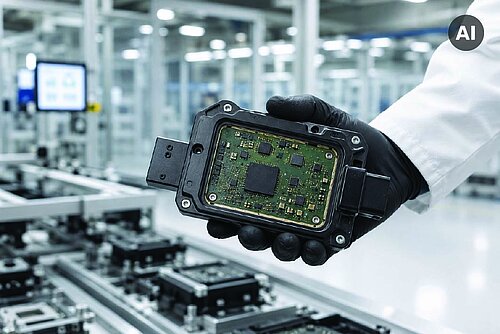
Radar sensors have become a key technology for modern vehicle safety and assistance systems. They detect objects, measure distances and determine relative speeds, providing reliable environmental data even in darkness or challenging weather conditions.
These capabilities are relevant for passenger cars and commercial vehicles alike. However, differences in vehicle dimensions, operating environments and safety risks create distinct requirements for sensor integration, validation and manufacturing.
Radar Applications Across Different Vehicle Types
Passenger cars and commercial vehicles use radar sensors for many similar functions:
- Adaptive cruise control
- Automatic emergency braking
- Blind spot detection
- Lane change assistance
- Cross-traffic detection
- Parking and maneuvering assistance
- Support for automated driving functions
In passenger cars, radar sensors typically monitor the areas in front of, beside and behind the vehicle. Depending on the required function, short-, medium- or long-range sensors can provide information about surrounding vehicles, pedestrians, cyclists and other objects.
Commercial vehicles use many of the same principles. However, the size and geometry of trucks, buses and vehicle combinations require larger and more complex monitoring areas. Radar-supported functions can help detect road users alongside the vehicle, monitor the area behind a trailer or identify obstacles when moving off and maneuvering.
Why Commercial Vehicles Have Different Requirements
Commercial vehicles have large blind spots, long braking distances and complex vehicle geometries. A tractor and trailer combination, for example, creates monitoring areas that change during turning and maneuvering.
Typical operating conditions add further challenges:
- Long operating hours and high mileage
- Changing trailers and load conditions
- Exposure to dirt, moisture and temperature fluctuations
- Strong vibration and mechanical stress
- Restricted visibility during turning or reversing
- Frequent operation in congested urban environments
Radar-based blind spot detection, turn assistance and moving-off assistance can help identify pedestrians, cyclists or vehicles in critical areas. Front radar sensors can also support adaptive cruise control, collision warning and emergency braking.
Regulatory requirements for blind spot information, moving-off information and advanced emergency braking systems are increasing the importance of reliable environmental detection in commercial vehicles. Radar sensors are therefore becoming an essential part of integrated vehicle safety concepts.
Different Vehicles Require Different Sensor Concepts
The number, position and technical characteristics of the sensors depend on the vehicle and the intended function. Front radar sensors typically require a long detection range and accurate object tracking. Corner and side radar sensors focus on nearby road users and objects across wider angles.
Commercial vehicles may require several sensors to monitor areas around the cab, along the vehicle sides and behind the trailer. Sensor placement must consider not only detection performance but also vehicle structure, installation space and protection from environmental influences.
The sensor concept may therefore differ in terms of:
- Detection range and field of view
- Housing and connector design
- Installation position
- Environmental protection
- Software and parameter sets
- Communication interfaces
- Calibration and validation requirements
Radar is often combined with cameras, ultrasonic sensors or other technologies. The resulting sensor data can provide a more complete representation of the vehicle environment and support reliable system decisions.
What Different Applications Mean for Manufacturing
Different vehicle platforms and assistance functions lead to multiple radar sensor variants. Manufacturers must be able to assemble, configure and test these products reliably without creating unnecessary production complexity.
Relevant manufacturing requirements include:
- Precise assembly of sensitive electronic and mechanical components
- Flexible handling of different sensor variants
- Recipe-controlled flashing and parameterization
- Customer-specific calibration and testing
- Reliable housing assembly and sealing
- Complete process and test data traceability
- Scalable production capacity
The article on key challenges in radar sensor manufacturing provides further information about precision assembly, calibration and end-of-line testing.
HAHN Automation Group’s concept for the high-precision assembly and EOLT of automotive radar sensors demonstrates how controlled processes, flexible production concepts and functional validation can be combined. These capabilities also provide a foundation for adapting automation solutions to related sensor variants and different mobility requirements.
Flexible Production for Modern Mobility
Radar sensors perform similar fundamental tasks across passenger cars and commercial vehicles, but the conditions in which they operate can differ significantly. Vehicle geometry, detection zones, environmental exposure and safety functions all influence the sensor design and its validation requirements.
Flexible automation concepts help manufacturers manage this variety. Modular stations, automated variant identification, adaptable tooling and configurable test sequences allow production systems to support different radar sensor versions and evolving product requirements.
The broader HAHN Automation Group Mobility portfolio combines expertise in assembly, testing, inspection and scalable production solutions for Automotive, EV Technologies and Commercial Vehicles.
Preparing Radar Sensor Production for Different Mobility Applications?
Whether you are industrializing a radar sensor for passenger cars or developing a robust solution for commercial vehicle applications, HAHN Automation Group supports you with scalable concepts for precision assembly, testing and complete process traceability.