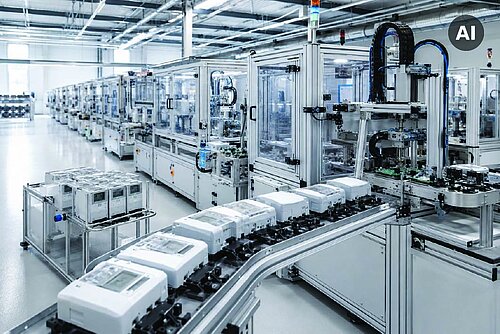
Smart meter manufacturers may need to produce initial pilot batches, introduce multiple product variants, increase output, or transfer production to additional locations. A manufacturing concept designed exclusively for one volume or one product configuration can make these changes difficult and expensive.
Scaling smart meter manufacturing is therefore not simply a matter of making an existing line run faster. Higher production volumes affect component feeding, assembly processes, variant management, testing capacity, material flow, data handling, and packaging. Processes that work reliably during pilot production may need to be redesigned or automated before they can support stable series production.
A modular production concept helps manufacturers select an appropriate initial automation level while preparing the system for future products and volumes. The goal is to create a manufacturing architecture that can grow without requiring the entire production process to be rebuilt at every stage.
Why Scaling Smart Meter Production Is Challenging
Smart meters combine molded components, sensors, printed circuit boards, electrical contacts, firmware, housings, and product-specific identification. Depending on the application, additional processes such as flow testing, leak testing, electrical testing, or high-voltage testing may be required.
When production volume increases, manufacturers must coordinate several areas:
- Component supply and feeding
- Assembly capacity
- Firmware flashing
- Variant handling
- Functional testing
- Quality control
- Product identification
- Material flow
- Packaging
- Production data
A bottleneck in any of these areas can limit the output of the entire production system. A faster assembly station alone does not increase overall capacity if firmware flashing, testing, or packaging cannot process the same number of products.
Successful scaling therefore requires a complete view of the production process.
Start with a Clear Production Roadmap
Before selecting an automation concept, manufacturers should define both current requirements and realistic future scenarios. This does not require every future detail to be known. However, the system architecture should account for likely changes in volumes, variants, and process requirements.
Important questions include:
- Which smart meter types will be produced?
- How many product variants are expected?
- What are the planned production volumes?
- How could demand develop over time?
- Which processes are already stable?
- Which operations still require development or validation?
- Which tests are required for each product type?
- Will existing equipment be integrated?
- Could production be expanded to additional lines or locations?
- Which product and process data must be recorded?
The answers help determine which operations should initially remain manual, which processes benefit from partial automation, and where full automation is technically and economically appropriate.
Phase 1: Flexible Pilot Production
Pilot production is used to manufacture initial quantities under realistic conditions. At this stage, the product design, assembly sequence, test strategy, or component supply may still change.
A highly rigid automation system can restrict the flexibility needed during this phase. Manual or semi-automated workstations may therefore be suitable for selected processes. They allow operators and engineers to evaluate assembly steps, identify product-related challenges, and refine the production sequence.
Typical priorities during pilot production include:
- Establishing a repeatable assembly sequence
- Evaluating component accessibility
- Defining suitable fixtures
- Testing feeding and handling concepts
- Verifying joining processes
- Developing the firmware-flashing sequence
- Establishing functional tests
- Collecting initial process data
- Identifying potential bottlenecks
Digital work instructions, controlled tools, identification systems, and integrated inspection functions can support quality even when processes are not yet fully automated.
The LeanCell platform from HAHN Automation Group provides a modular framework for manual and semi-automated processes. Such a concept can support early production while creating controlled workflows that can later be transferred into a higher level of automation.
Phase 2: Moving into Series Production
As production volumes increase and the product design becomes more stable, manufacturers can automate selected operations. The decision should be based on process requirements rather than on volume alone.
Processes may be suitable for automation when they:
- Are sufficiently stable and repeatable
- Require precise positioning
- Involve consistent handling sequences
- Need controlled force or torque
- Include repetitive inspection tasks
- Create ergonomic challenges for operators
- Require reliable data collection
- Limit the output of the current process
A semi-automated production system can combine manual loading or assembly with automated joining, flashing, testing, inspection, or unloading. This approach allows manufacturers to retain flexibility where human handling remains beneficial while automating quality-critical or repetitive processes.
The transition into series production should also include a review of the complete line balance. Each station must have sufficient capacity to support the target output without creating unnecessary waiting time or work in progress.
Phase 3: High-Volume Smart Meter Manufacturing
In high-volume production, individual stations must operate as part of a coordinated manufacturing system. Automated handling connects component preparation, module assembly, firmware flashing, housing assembly, testing, marking, and packaging.
A fully automated smart meter production line may include:
- Automated component feeding
- Robot-based or mechanical handling
- Sensor and PCB module assembly
- Controlled pressing or screwdriving
- Firmware flashing
- Housing assembly
- Integrated functional testing
- Machine vision inspection
- Product marking and serialization
- Automated sorting
- End-of-line handling and packaging
Full automation is most effective when the product design, processes, components, and quality criteria are sufficiently stable. Automating an unstable process can reproduce existing problems at a higher speed rather than resolve them.
Before increasing the automation level, manufacturers should therefore confirm that component tolerances, feeding behavior, assembly forces, process parameters, test limits, and rejection criteria are clearly defined.
Modular Automation as a Foundation for Growth
A modular production architecture divides the manufacturing process into clearly defined functional units. Each module performs a specific task, such as component feeding, assembly, flashing, testing, inspection, or packaging.
This approach can make it easier to:
- Add capacity
- Integrate new processes
- Replace individual stations
- Adapt fixtures for new variants
- Reconfigure the production sequence
- Connect existing equipment
- Expand testing capabilities
- Transfer proven concepts to additional lines
Modularity does not mean that every station is identical. Smart meter designs and processes still require product-specific engineering. The advantage lies in combining standardized system structures with individually configured processes.
The MasterCell automation platform provides a scalable framework for integrating robots, vision systems, test stations, feeding equipment, and other production technologies. It can be configured as an individual cell or as part of a larger automated line.
Plan Interfaces from the Beginning
Interfaces are critical when a production system is expected to grow. Mechanical, electrical, software, data, and material-flow connections should be considered before additional modules are required.
Relevant interfaces can include:
- Component feeding systems
- Injection-molding equipment
- Transfer systems
- Robot cells
- Test equipment
- Firmware and configuration systems
- Marking systems
- Production databases
- Packaging equipment
- Higher-level manufacturing systems
Clearly defined interfaces reduce the effort required to connect future stations or replace individual technologies. They also help ensure that modules exchange the necessary product status, variant information, process parameters, and test results.
Existing injection-molding equipment can also be integrated into the overall manufacturing concept. This allows molded housings or hybrid components to be transferred into downstream assembly and testing processes according to the specific application.
Scale Material Flow Alongside Assembly
Material flow becomes increasingly important as production volumes grow. Manual component supply may be sufficient during pilot production but can become a bottleneck in a high-volume line.
Manufacturers should evaluate:
- How components arrive at the production site
- Which packaging formats are used
- How parts are identified
- How components are separated and oriented
- How sensitive electronic parts are handled
- How empty containers are removed
- How rejected parts are separated
- How finished products are transferred to packaging
The feeding concept must match the component geometry, required output, product sensitivity, and number of variants. Trays may be suitable for delicate electronic modules, while other components may be supplied through reels, containers, or dedicated feeding systems.
Material buffers can help separate processes with different cycle times. However, they must be sized carefully. Excessive buffering increases work in progress and space requirements, while insufficient buffering can cause frequent production interruptions.
Manage Product Variants Without Losing Efficiency
Smart meter manufacturers may need to produce different meter types, housing designs, electronic configurations, firmware versions, or connection variants. Increasing output while maintaining this flexibility is a central scaling challenge.
A scalable variant-management concept may use:
- Product identification
- Recipe-controlled process parameters
- Flexible fixtures
- Automated tool changes
- Adaptable feeding systems
- Variant-specific firmware
- Automated component verification
- Product-specific test sequences
The production system should identify the product variant as early as possible and maintain this assignment throughout the manufacturing process. Each station can then select the required parameters and verify that the correct components and processes are used.
Variant flexibility must be designed into the equipment from the beginning. Retrofitting it later may require significant changes to fixtures, feeding systems, software, and test equipment.
Increase Testing Capacity with Production Volume
Testing is often one of the most important factors when scaling smart meter production. A test process may require considerably more time than an individual assembly operation. If testing capacity does not grow with assembly output, it can become the main production bottleneck.
Depending on the type of smart meter, the test concept may include:
- Flow testing
- Leak testing
- Electrical testing
- High-voltage testing
- Functional testing
- Firmware verification
- Communication testing
- Visual inspection
Not every test applies to every smart meter. Flow and leak testing may be relevant for water or gas meter applications, while electrical and high-voltage tests may apply to suitable electricity meter designs.
Testing capacity can be increased through several approaches:
- Parallel test stations
- Multiple test positions
- Separation of individual test steps
- Inline testing during assembly
- Optimized product handling
- Automated loading and unloading
- Early detection of assembly errors
The best solution depends on test duration, required accuracy, product design, variant mix, and target output. Testing should therefore be included in the line concept from the beginning rather than added after the assembly process has already been defined.
Maintain Quality During Production Ramp-Up
Higher output should not reduce process control. When a smart meter production line is scaled, the quality strategy must develop alongside the automation concept.
Relevant measures can include:
- Monitoring force and distance during pressing
- Recording torque and angle during screwdriving
- Verifying component presence
- Inspecting orientation and position
- Confirming firmware-flashing results
- Recording functional test results
- Identifying non-conforming products
- Assigning process data to the product
- Controlling rework and rejection paths
Inline inspections help detect errors close to the process in which they occur. This can prevent defective products from moving through further value-adding steps. End-of-line testing then verifies the completed product according to the defined test strategy.
During ramp-up, process data can also help identify recurring deviations, unstable operations, or stations that do not yet reach the required performance.
Balance Cycle Time Across the Complete Line
The maximum output of a production system is determined by its slowest relevant process. When scaling production, manufacturers must therefore consider more than the cycle time of the main assembly station.
The analysis should include:
- Component feeding time
- Robot and transfer movements
- Joining processes
- Firmware-flashing duration
- Test duration
- Marking and identification
- Handling of rejected parts
- Packaging
- Planned operator activities
Longer operations may need to be divided across multiple stations or performed in parallel. Other processes can potentially be combined within one station if this does not reduce accessibility, maintainability, or process reliability.
The objective is not to make every station identical in cycle time. It is to create a coordinated process flow that meets the required output without unnecessary complexity.
Prepare the Production System for New Variants
Smart meter designs may evolve during the lifetime of a manufacturing system. New electronic modules, firmware versions, housing geometries, connectors, or test requirements can affect several stations.
A production line designed for future adaptation should consider:
- Accessible and replaceable fixtures
- Flexible gripper concepts
- Parameter-based process control
- Additional space for future modules
- Expandable electrical and software architecture
- Adaptable test equipment
- Standardized mechanical interfaces
- Clearly structured product recipes
Not every future product change can be predicted. However, an expandable architecture can reduce the effort required to respond when new requirements arise.
When Should Smart Meter Manufacturers Increase Automation?
There is no single production volume at which full automation automatically becomes the right choice. The decision depends on the complete manufacturing case.
An increase in automation may be appropriate when:
- Production volumes are growing
- Manual processes are limiting output
- Quality-critical operations require greater control
- Repetitive handling creates ergonomic challenges
- Test capacity must be increased
- Process data needs to be captured consistently
- Several product variants must be managed reliably
- The production concept is being transferred to additional locations
Manufacturers should evaluate the expected benefits together with product maturity, investment requirements, available floor space, technical risk, and future demand.
The most scalable solution is often not the system with the highest possible automation level from the beginning. It is the system that supports the current production phase while providing a structured path for expansion.
Scalable Automation Solutions for Smart Meter Production
Scaling smart meter manufacturing requires a coordinated approach to assembly, material flow, firmware flashing, testing, variant management, quality control, and packaging. Each process must support the required production volume while remaining adaptable to product and market changes.
HAHN Automation Group develops modular automation solutions for smart meter manufacturing, ranging from manual workstations to fully automated production lines. Depending on the application, the systems can integrate existing injection-molding equipment, hybrid component production, module assembly, firmware flashing, variant handling, functional testing, final inspection, serialization, and packaging.
By combining an appropriate initial automation level with modular system architecture and clearly defined interfaces, manufacturers can create a production concept that supports pilot builds, series production, and future capacity expansion.
Plan Your Next Production Stage
Are you moving from pilot production into series manufacturing, expanding an existing smart meter line, or preparing for additional product variants? HAHN Automation Group develops scalable automation concepts tailored to your production volumes, processes, and testing requirements.
Contact our experts to discuss the next stage of your smart meter manufacturing project.