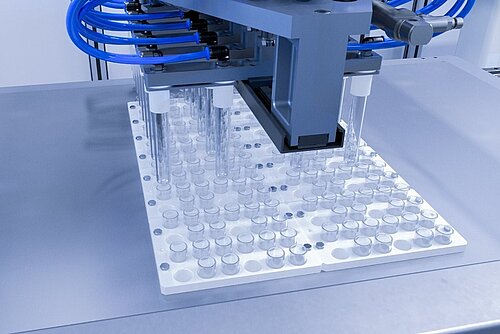
Laboratory consumables such as pipette tips, cuvettes, reaction vessels, sample containers and filter components are often produced in very large quantities. Despite their low unit cost, these products must meet demanding requirements for dimensional accuracy, cleanliness and functional reliability.
Automating their production therefore requires more than increasing machine speed. Small, lightweight and thin-walled components must be removed from the injection mold, transported, inspected and packaged without damage or contamination.
At the same time, manufacturers need to maintain stable cycle times, control every mold cavity and minimize scrap across millions of parts.
Successful high-volume production connects injection molding, handling, downstream processes, quality control, traceability and packaging within one coordinated automation concept. The HAHN Automation Group develops automation solutions for laboratory consumables as part of its broader Life Sciences and Lab Automation portfolio.
Why Laboratory Consumables Are Challenging to Automate
Laboratory consumables may appear simple, but their production involves several technical challenges.
Typical requirements include:
- Very high production volumes
- Short injection molding cycles
- Tools with a large number of cavities
- Small and lightweight components
- Thin walls and sensitive geometries
- Tight dimensional and functional tolerances
- Clean production conditions
- Low unit costs
- Reliable separation of conforming and non-conforming parts
Minor variations can affect how the product performs in the laboratory. A pipette tip, for example, must fit the intended liquid-handling system and transfer liquids accurately. A cuvette must maintain its required geometry and remain leak-tight.
At high production volumes, even a small defect rate can create significant material waste. The production system must therefore combine high speed with stable processes and reliable quality control.
Connect Injection Molding with Downstream Automation
Automation should begin directly at the injection molding machine. The way parts are removed from the mold affects the speed, quality and traceability of all subsequent processes.
A suitable removal system must coordinate its movement with the molding cycle and minimize the time spent inside the mold. It must also handle all parts consistently, even when the tool contains dozens of cavities.
Important functions include:
- Fast and synchronized part removal
- Stable orientation of every component
- Gentle handling of sensitive geometries
- Separation according to mold cavity
- Controlled transfer to downstream processes
- Buffering between processes with different cycle times
Additional handling steps and uncontrolled intermediate storage can increase the risk of damage, contamination or product mixing. Direct integration creates a more consistent material flow and reduces manual intervention.
HAHN Automation Group provides integrated injection molding automation from part removal through downstream processing and packaging. The VarioTIP® system is specifically designed for laboratory consumables and other medical plastic components, supporting high productivity, modular expansion and complete cavity sorting.
Integrate Assembly and Secondary Processes
Many laboratory consumables are not complete when they leave the injection molding machine. Depending on the product, additional operations may be required before inspection and packaging.
These processes can include:
- Inserting filters or barriers
- Joining multiple components
- Cutting or punching
- Printing or marking
- Closing and sealing
- Surface treatment
- Leak testing
The capacity of each process must be aligned with the output of the injection molding machine. A fast molding cycle provides little benefit if filter assembly, inspection or packaging creates a bottleneck.
Some downstream operations take longer than the molding process. Manufacturers can address this through parallel stations, multiple process nests or temporary buffering. The objective is to maintain a continuous production flow without sacrificing process quality.
Critical parameters should be monitored directly during assembly. Depending on the operation, these may include force, position, temperature, pressure or process time. This makes it possible to identify deviations before the product reaches final inspection.
The system must also react correctly to interruptions. If one station stops, controlled buffering or product routing can prevent the complete production line from shutting down immediately.
Inspect Every Part Without Limiting Output
High-volume production requires quality controls that keep pace with the manufacturing process. Manual sampling alone cannot verify every product or provide cavity-specific information.
Inline inspection can evaluate characteristics such as:
- Dimensions
- Roundness and concentricity
- Surface defects
- Deformation
- Component presence
- Filter or barrier position
- Assembly completeness
- Leakage
- Contamination or visible particles
The inspection concept should be positioned as close as possible to the process that creates the relevant characteristic. This helps identify deviations before additional value is added to a defective product.
Inspection equipment must also distinguish reliably between actual defects and acceptable variation. Lighting, part presentation, camera configuration and stable positioning are particularly important for small, transparent or reflective components.
The case study on high-volume cuvette production demonstrates how part removal and inline leak testing can be integrated into a redesigned production process. Feasibility studies, simulations and practical testing were used to validate the relevant processes before implementing the final system.
The purpose of inline inspection is not only to reject defective parts. The results should also help manufacturers understand where and why deviations occur.
Maintain Cavity Traceability Through Packaging
Multi-cavity injection molding tools can produce large numbers of parts within a single cycle. If a defect repeatedly occurs in one cavity, manufacturers need to identify the affected products and investigate the specific source.
A traceable production record can connect each product or packaging unit with:
- Injection molding machine
- Tool and mold cavity
- Product and variant
- Production time
- Process parameters
- Inspection results
- Rejection reason
- Batch or packaging unit
Maintaining this relationship becomes more difficult as parts move through assembly, inspection and packaging. The automation concept must therefore preserve product order or use another reliable identification and tracking method.
Cavity-specific sorting allows manufacturers to separate conforming products, non-conforming products and parts intended for quality analysis. It also provides valuable information for monitoring the condition of the mold and identifying recurring defect patterns.
Packaging is part of this traceability concept. Depending on the product and its later use, laboratory consumables may be placed into:
- Trays
- Racks
- Tubs
- Bags
- Boxes
- Stacked packaging units
The system must prevent conforming and non-conforming parts from being mixed. It should also avoid discarding a complete packaging unit because one position contains a defective or missing component.
Automated replacement, controlled tray management or dedicated quality containers can help maintain complete and correctly documented packaging units.
Scale Output While Maintaining Flexibility
High-volume production does not necessarily mean that an automation system can manufacture only one product. Laboratory consumables are frequently available in different sizes, formats, filter configurations or packaging types.
Flexible automation can support this variety through:
- Exchangeable format sets
- Recipe-controlled processes
- Adjustable handling systems
- Modular inspection stations
- Product-specific packaging programs
- Scalable production modules
The required degree of flexibility should reflect the actual product portfolio. Designing a system for every theoretical product variant can increase complexity and reduce process stability. Manufacturers should identify which variants are planned, which changes are likely and which functions can remain product-specific.
The HAHN Automation Group solution for high-volume pipette tip automation combines the production of five injection molding machines within one flexible system. Different format sets support multiple products, while high-speed part removal, filter assembly, visual inspection, cavity-specific sorting and automated packaging are integrated into the production flow.
The system achieves outputs of up to 1,650 parts per minute and supports configurations with up to 128 cavities. At the same time, the automation concept reduced scrap to less than one percent and increased OEE to 97 percent.
This example shows that flexibility and high output do not have to be conflicting objectives. The production architecture must, however, be designed around clearly defined products, processes and capacity requirements.
Plan the Complete Production Flow
High-volume laboratory consumables cannot be automated by optimizing individual stations in isolation. The complete production flow must be considered from the injection mold to the finished packaging unit.
During the concept phase, manufacturers should clarify:
- Which products and variants must be supported?
- How many cavities will the molding tool contain?
- How quickly must parts be removed?
- Which assembly and secondary processes are required?
- Which characteristics need 100 percent inspection?
- How will cavity traceability be maintained?
- What packaging format is required?
- Where are buffers or parallel processes needed?
- How will the system respond to interruptions?
- Can production capacity be expanded later?
Process feasibility should be evaluated before the complete line is designed. Testing critical handling, inspection or assembly operations reduces technical risk and provides realistic information about cycle time and process capability.
Close cooperation between product development, injection molding, quality management, packaging specialists and automation engineering creates the foundation for a stable production concept.
Conclusion
Automating laboratory consumables for high-volume production requires more than fast part removal from an injection molding machine.
The complete system must coordinate handling, assembly, inline inspection, cavity traceability and packaging. Each process must support the required output without creating additional quality risks or bottlenecks.
Reliable cavity tracking and structured quality data help manufacturers identify recurring defects and stabilize the molding process. Modular equipment and controlled format changes can provide flexibility for different product variants without compromising production performance.
By planning these elements as one connected production system, manufacturers can increase output, reduce manual handling, minimize scrap and maintain consistent quality across very large production volumes.
Scale Your Laboratory Consumables Production
HAHN Automation Group develops customized automation solutions for the high-volume production of laboratory consumables.
Our experts combine injection molding automation, high-speed handling, assembly, inline inspection, traceability and packaging to create reliable production systems for your products and volume requirements.