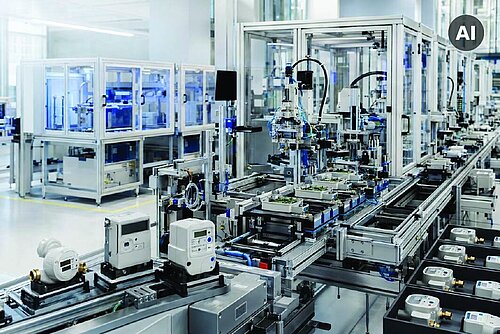
Demand for smart meters can change quickly. Regulatory programs, infrastructure investments, utility modernization, and regional rollouts may move a product from pilot production to significantly higher volumes within a relatively short period. At the same time, manufacturers must continue supporting different meter types, product generations, firmware versions, and market-specific configurations.
This creates a central manufacturing challenge: how can smart meter production be scaled without building a system that is only efficient for one product and one forecast?
Increasing capacity is not simply a matter of adding more machines. Every additional station affects material flow, cycle time, testing capacity, production data, operator requirements, and line control. If the initial production concept was not designed for growth, later expansion can result in long interruptions, duplicated equipment, inefficient processes, or a loss of product flexibility.
A scalable smart meter production system takes future development into account from the beginning. Modular equipment, standardized interfaces, flexible handling, recipe-controlled processes, and expandable testing capacity make it possible to increase output while continuing to support changing products and production volumes.
Why Scaling Smart Meter Production Is Particularly Challenging
Smart meters combine mechanical components, electronic modules, sensors, software, communication functions, and product-specific testing requirements. The exact production sequence differs depending on whether electricity, water, or gas meters are manufactured.
Typical processes include:
- Component feeding and preparation
- Sensor and electronic module assembly
- Printed circuit board handling
- Firmware flashing
- Housing assembly
- Sealing and joining
- Functional testing
- Flow or leak testing
- Electrical or high-voltage testing
- Communication testing
- Product identification
- Serialization
- Final inspection
- Packaging
When production volume increases, each of these processes must deliver the required output. Accelerating the assembly process alone provides little benefit if firmware flashing, functional testing, or packaging remains the bottleneck.
Manufacturers must also consider the number of product variants. Higher demand does not necessarily mean that one standard product will be produced continuously. Capacity may need to be distributed across several meter configurations, regional versions, communication standards, housing designs, and firmware packages.
Scaling therefore requires a production concept that increases output without limiting the ability to manufacture different products.
Start with Realistic Volume Scenarios
Production forecasts are rarely certain, particularly when new smart meter platforms are introduced. A system designed only around the maximum forecast may require excessive initial investment and operate below capacity during the early production phase. A system designed only for the initial demand may become a constraint as volumes increase.
A more resilient approach is to define several production scenarios:
- Pilot production
- Initial market launch
- Medium-volume series production
- High-volume production
- Peak demand
- Additional product variants
- Future product generations
For each scenario, manufacturers should evaluate the required cycle time, number of shifts, equipment availability, staffing level, testing capacity, and floor-space requirements.
This analysis helps determine which production functions are required from the beginning and which modules can be added later. It also provides a basis for deciding whether capacity should be increased through faster stations, parallel processes, additional production cells, or a second line.
The objective is not to predict the future perfectly. It is to create a manufacturing architecture that can respond to several realistic developments without requiring a complete redesign.
Select the Right Initial Level of Automation
Fully automated production is not always the best starting point. During pilot production or an early market launch, product design, firmware, components, and test specifications may still change. A highly dedicated production line can make such changes expensive and time-consuming.
Manual or semi-automated workstations may provide greater flexibility during this phase. Guided assembly instructions, controlled tools, product identification, and integrated testing can establish consistent processes while allowing operators to handle changing product configurations.
As volumes increase, selected processes can be automated based on their technical and economic impact.
Processes are particularly suitable for automation when they:
- Require high repeatability
- Determine the production cycle
- Involve quality-critical parameters
- Create ergonomic challenges
- Generate important process data
- Are difficult to perform consistently by hand
- Are largely identical across product variants
- Require continuous inspection
A staged automation strategy allows manufacturers to invest in capacity as demand develops. However, the early production equipment must be designed so that later automation modules can be integrated efficiently.
The previous article, How Are Smart Meters Manufactured? A Step-by-Step Production Overview, provides a detailed explanation of the individual assembly, flashing, testing, serialization, and packaging stages.
Use Modular Equipment as the Foundation for Growth
Modularity makes it possible to separate the production system into clearly defined functional units. Each module performs a specific process and connects to the rest of the production environment through standardized mechanical, electrical, software, and data interfaces.
A modular smart meter production concept may include separate units for:
- Component loading
- Electronic module assembly
- Printed circuit board insertion
- Firmware flashing
- Housing assembly
- Screwdriving or joining
- Leak or flow testing
- Electrical testing
- Communication testing
- Labeling and serialization
- Final inspection
- Packaging
If demand increases, individual modules can be duplicated or expanded without replacing the complete line. A testing station that becomes a bottleneck can be supplemented with an additional test position. A manual loading process can be replaced by automated feeding. A new assembly process can be integrated between existing stations.
Modularity also supports different production layouts. Individual cells may initially operate independently and later be connected through automated handling, conveyors, or workpiece carriers.
However, modularity requires more than physically separating the equipment. Interfaces must be defined from the start. Module dimensions, transfer heights, control standards, safety concepts, product data, communication protocols, and material-flow rules should support future expansion.
Standardize What Remains Constant
Scalable production benefits from standardization, but the product-specific processes must still receive the necessary flexibility.
Standardized elements can include:
- Machine frames
- Safety concepts
- Control hardware
- Operator interfaces
- Robot platforms
- Workpiece carrier interfaces
- Data structures
- Communication protocols
- Identification systems
- Software architecture
- Maintenance components
- Documentation formats
Using the same basic platform across production modules can shorten engineering time, simplify operator training, reduce spare-parts requirements, and make later expansion easier.
Product-specific tooling, fixtures, grippers, test adapters, and process programs can then be integrated into this standardized framework.
The result is not a universal machine for every possible smart meter. It is a stable production platform that supports clearly defined product families and expansion scenarios.
Preserve Variant Flexibility as Volumes Increase
High-volume equipment is often optimized for speed. This can lead to dedicated fixtures, fixed feeding systems, and process sequences designed for a single product. While such a concept may achieve short cycle times, it can make product changes difficult.
Smart meter manufacturers should therefore define a realistic flexibility corridor. This specifies which differences the system must support, such as:
- Meter type
- Housing geometry
- Sensor configuration
- Printed circuit board version
- Display or operating element
- Connection interface
- Seal configuration
- Firmware version
- Communication standard
- Test specification
- Label content
- Packaging format
Products within this corridor can be processed using adaptable equipment. Depending on the application, flexibility can be created through interchangeable tooling, replaceable fixture inserts, adjustable guides, servo-controlled movements, flexible robots, vision-guided positioning, and recipe-controlled processes.
Not every difference requires fully automatic adjustment. If a variant is changed only occasionally, a controlled manual tooling change may be more economical. Frequently changing parameters should generally be selected automatically through the production recipe.
The appropriate solution depends on variant frequency, batch size, cycle time, product geometry, and the risk associated with incorrect setup.
Control Variants Through Product Identification and Recipes
As production volumes and product variants increase, manual selection becomes a growing source of risk. The system must ensure that every meter receives the correct components, firmware, process parameters, tests, marking, and packaging.
This begins with reliable product identification. Depending on the manufacturing concept, the product or its workpiece carrier may be identified through:
- Data matrix codes
- Barcodes
- RFID
- Workpiece carrier IDs
- Production order data
- MES information
- Machine-readable product features
The identification triggers the corresponding production recipe. This recipe can define:
- Required components
- Robot positions
- Fixture settings
- Joining parameters
- Screwdriving torque
- Firmware package
- Flashing parameters
- Test sequence
- Acceptance limits
- Label information
- Packaging instructions
Recipe-controlled automation reduces manual adjustments and helps maintain consistent processes across different production volumes.
Recipe management must nevertheless be controlled. Only approved versions should be available for production. Changes to firmware, process parameters, or test limits should be documented and assigned to the corresponding products.
Scale Capacity at the Actual Bottleneck
When demand increases, manufacturers often focus first on the visible assembly processes. In practice, testing, flashing, curing, or data transfer may require more time than mechanical assembly.
A detailed cycle-time analysis should include:
- Component loading
- Robot handling
- Assembly operations
- Joining processes
- Firmware flashing
- Functional testing
- Leak or flow testing
- Electrical testing
- Product data transfer
- Labeling
- Final inspection
- Packaging
- Changeovers
- Planned maintenance
- Fault recovery
The slowest process determines the output of a sequential production line. If a functional test requires twice as long as the assembly cycle, the system may need two parallel test positions.
Capacity can be increased through several approaches:
- Reducing process time
- Running processes in parallel
- Adding duplicate stations
- Testing several products simultaneously
- Separating long processes from the main line
- Creating buffers between production stages
- Increasing equipment availability
- Adding shifts
- Installing an additional production cell
The best solution depends on process stability, floor space, investment, product flow, and future demand. Increasing the speed of every station is rarely necessary. Targeted expansion at the actual bottleneck is generally more efficient.
Plan Testing Capacity from the Beginning
Testing is one of the most important factors when scaling smart meter production. The meter type determines which tests are required.
Depending on the product, the test strategy may include:
- Flow testing
- Leak testing
- Electrical testing
- High-voltage testing
- Functional testing
- Communication testing
- Interface testing
- Firmware verification
- Visual inspection
- Assembly verification
Some tests require longer cycle times, specialized equipment, calibration routines, or controlled environmental conditions. They may therefore be more difficult to expand than standard assembly operations.
A scalable test concept should answer the following questions:
- Can additional test positions be added?
- Can several meters be tested in parallel?
- Can test adapters be exchanged for new variants?
- Can test software support additional product configurations?
- Can new acceptance limits be added through recipes?
- Can test results be assigned to individual products?
- Can calibration and maintenance be performed without stopping the entire line?
- Can rejected products be retested through a controlled process?
Testing should not be treated as a final addition to the automation concept. Test duration, accessibility, product interfaces, data requirements, and future expansion must be considered during the initial line design.
Integrate Existing Equipment into the Scale-Up Strategy
Manufacturers may already have injection-molding machines, test systems, manual workstations, or packaging equipment in operation. Scaling production does not always require replacing these assets.
Existing equipment can potentially be connected to a new production system if suitable interfaces and material-flow concepts are available.
Possible integration scenarios include:
- Connecting injection molding with downstream assembly
- Feeding molded housings directly into the line
- Integrating hybrid-component manufacturing
- Linking existing test equipment
- Automating material transfer between manual processes
- Connecting standalone cells through product identification
- Transferring production data to a common system
Before integration, manufacturers should assess the equipment’s cycle time, availability, controls architecture, data interfaces, safety concept, and remaining service life.
An existing machine may perform its individual process reliably but still limit the overall production output. Buffers, parallel material paths, or technical upgrades may be required to integrate it effectively into a scalable production environment.
Design Material Flow for Higher Output
A production line can only achieve its target cycle if components, workpiece carriers, and finished products move through the system reliably.
When volumes increase, material flow must prevent:
- Starved production stations
- Excessive intermediate inventory
- Incorrect component supply
- Mixed product variants
- Blocked transfer systems
- Uncontrolled accumulation
- Damage to sensitive components
- Delays in packaging
Component supply should be evaluated for every production scenario. Manual replenishment may be sufficient at low volumes but become a constraint during high-volume production. Larger magazines, automatic feeding, tray handling, reel-based supply, or automated material delivery may then be required.
Buffers can separate processes with different cycle times and prevent short interruptions from stopping the complete line. However, excessive buffering increases floor-space requirements and work in progress.
Material flow should therefore be planned together with cycle times, shift models, component packaging, and expansion scenarios.
Maintain Traceability Across Every Expansion Stage
During pilot production, product information may be captured through individual stations or separate databases. As production grows, disconnected data structures can make it difficult to maintain complete traceability.
A scalable data concept should connect the product identity with relevant manufacturing information, including:
- Product type
- Product variant
- Component batches
- Firmware version
- Production recipe
- Assembly parameters
- Joining results
- Test results
- Rework status
- Production date
- Packaging assignment
When new stations are added, they should use the same product identification and data structure. This prevents information gaps and ensures that traceability grows together with the physical production system.
Production data can also support the scale-up itself. Manufacturers can compare cycle times, downtime, defect patterns, station utilization, and test results to identify where additional capacity or process improvement is required.
Prepare the Software Architecture for Expansion
Mechanical space alone does not make a production line scalable. The controls and software architecture must also accommodate additional stations, products, and process data.
A future-ready architecture can include:
- Expandable control capacity
- Standardized machine interfaces
- Parameter-based process programs
- Modular software functions
- Additional recipe capacity
- Flexible product data structures
- Interfaces to MES or ERP systems
- Centralized user management
- Version-controlled production recipes
- Expandable data storage
- Standardized alarm and status messages
If every new station requires extensive changes to the central software, physical modularity provides only limited value.
Clear software interfaces allow new equipment to exchange product identity, production status, process results, and fault information with the existing system. This reduces integration effort and helps maintain consistent operation as the line grows.
Compare Line Expansion with Replication
At a certain production volume, manufacturers must decide whether to expand an existing line or install an additional system.
Expanding an existing line can be beneficial when:
- The current processes remain suitable
- Additional modules can be integrated
- Sufficient floor space is available
- Production interruption can be managed
- Existing controls support expansion
- Material flow can handle the additional output
Replicating a production cell or complete line may be preferable when:
- Capacity must increase significantly
- Redundancy is important
- Different product families should be separated
- Expansion would disrupt current production
- The existing line has reached its technical limit
- Production is required at another location
Replication can also reduce operational risk. If one line stops, another may continue production. However, multiple systems require additional space, maintenance resources, tooling, data connections, and operator support.
A hybrid strategy is also possible. Standardized production cells can be replicated, while centralized testing, packaging, or material supply supports several cells.
Protect Production During the Scale-Up
Expanding an active production environment requires careful planning. Installing new equipment can affect access, safety, material flow, utilities, and software interfaces.
A controlled scale-up plan should define:
- Installation sequence
- Production interruption
- Temporary material flow
- Software integration
- Equipment qualification
- Process validation
- Operator training
- Ramp-up quantities
- Quality release
- Contingency measures
Where possible, new modules can be assembled and tested outside the active production area. Offline testing, virtual commissioning, and standardized interfaces can reduce the time required for on-site integration.
The new equipment should also be ramped up in stages. Initial production batches allow manufacturers to verify cycle time, process capability, test performance, and data integrity before the additional capacity is fully released.
Scalable Smart Meter Manufacturing in Practice
The HAHN Automation Group develops modular production concepts for electricity, water, and gas meters. Depending on the production phase, these concepts can range from manual workstations and semi-automated cells to fully automated manufacturing lines.
Individual solutions can integrate:
- Molded and hybrid components
- Existing injection-molding equipment
- Sensor and module assembly
- Printed circuit board handling
- Firmware flashing
- Flexible variant management
- Flow and leak testing
- Electrical and high-voltage testing
- Final quality control
- Serialization
- Traceability
- Packaging
The modular architecture allows the level of automation, production capacity, and test equipment to be adapted to the specific application. Manufacturers can begin with the processes required for current demand while establishing a technical foundation for future growth.
The case study Modular Automation Solutions for Smart Meter Manufacturing shows how flexible production concepts, integrated testing, and scalable automation can support different meter types and production volumes.
Building a Flexible Foundation for Future Growth
Scaling smart meter production successfully requires more than increasing machine speed. Production capacity, product flexibility, testing, material flow, software, and traceability must develop as one coordinated system.
Manufacturers should define realistic volume scenarios, identify potential bottlenecks, standardize interfaces, and decide which functions should be automated at each production stage. Modular equipment makes it possible to add stations, duplicate processes, and integrate additional testing technologies as demand grows.
At the same time, variant flexibility must remain part of the production strategy. Recipe-controlled processes, adaptable fixtures, expandable test systems, and consistent product identification allow manufacturers to increase output without committing the entire system to one fixed product configuration.
As part of its focus on Transformation Technologies, HAHN Automation Group supports manufacturers in transferring innovative energy and infrastructure technologies into reliable industrial production.
Further Reading
See how mechanical assembly, electronics integration, firmware flashing, testing, serialization, and packaging come together in How Are Smart Meters Manufactured? A Step-by-Step Production Overview.
Discover how modular production systems support different automation levels, smart meter variants, and testing requirements in the case study Modular Automation Solutions for Smart Meter Manufacturing.
Explore how HAHN Automation Group supports the industrialization of energy, infrastructure, electronics, and other emerging applications through automation for Transformation Technologies.
Discuss Your Smart Meter Scale-Up Strategy
Are you preparing to move from pilot production to higher volumes, expand an existing smart meter line, or introduce additional product variants?
HAHN Automation Group develops modular automation concepts tailored to your current production requirements and future capacity scenarios. Our solutions can combine assembly, firmware flashing, integrated testing, product identification, traceability, and packaging within a scalable manufacturing architecture.
Contact our experts to discuss how your smart meter production can grow without losing the flexibility required for future products and market demands.