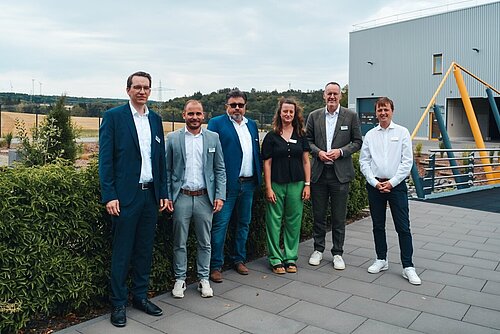
Rheinböllen, August 6, 2026 – As part of his summer tour, Rhineland-Palatinate’s Minister of Economic Affairs Michael Ebling visited HAHN Automation Group at its headquarters in Rheinböllen. The discussions focused on the future of industrial value creation in Rhineland-Palatinate, research and innovation, the development of the Life Sciences market, as well as apprenticeships and workforce development.
Following a company presentation, the visit continued with an open discussion on current challenges and opportunities for the region as an industrial hub. Particular emphasis was placed on the importance of engineering expertise and technological innovation in maintaining the competitiveness of the manufacturing industry. HAHN emphasized its commitment to continuing to invest in new technologies, research, and their implementation in industrial applications.
In-House Research and Strong Partnerships
One focus of the visit was the HAHN Automation Group’s research and development activities. The R&D department collaborates with universities, research institutions, and industry partners to identify and develop emerging technologies for industrial application. The discussion also emphasized the importance of fostering knowledge and technology transfer between academia and innovative midsized companies.
“We are ready to continue investing in technology and development. To do so, we need a strong innovation ecosystem in which companies, universities, and research institutions collaborate closely. For a technology-driven midsized company like ours, this exchange is essential for turning new ideas into industrial applications,” emphasized Frank Konrad, CEO of HAHN Automation Group.
Two current research projects, DemoRec and FENI-X, provide tangible examples of this approach. DemoRec focuses on automating and industrializing the disassembly of lithium-ion batteries to recover valuable raw materials and return them to the material cycle as efficiently as possible. In the FENI-X project, HAHN is developing approaches for more resilient production systems. These include a digital “health pass” that provides transparency into the condition of machines and components, supporting predictive maintenance.
Life Sciences as a Growth Market
During a subsequent tour of the assembly floor, the delegation gained first-hand insights into HAHN’s engineering and implementation capabilities through three automation systems currently under construction. A particular focus was on Life Sciences applications—ranging from highly automated assembly and packaging processes to complex production solutions for medical technology products.
The visit also provided an opportunity to discuss the continued development of Rhineland-Palatinate as a Life Sciences hub. HAHN sees itself as a link between innovation and industrial production: New products and processes must not only be developed, but also transferred into series production in a reliable, repeatable, and economically viable way. Process development, automation, inspection technology, and validation are key elements in making this transition possible.
Apprenticeships as a Long-Term Investment
The final part of the visit focused on apprenticeships and attracting skilled professionals. Around 50 young people are currently completing their apprenticeships at the Rheinböllen site, with HAHN offering up to 20 new apprenticeship positions each year. Many former apprentices continue to develop their careers within the company after graduation, later taking on roles in areas such as engineering or project management.
“We have always been committed to developing our own talent through apprenticeships. Providing young people with the skills they need, creating opportunities for them, and inspiring them to pursue long-term careers in technical fields is an investment in the future of our company and our region,” said Pascal Tailliar, Head of People & Culture.
During a tour of the Training & Education Center, Minister Ebling and his delegation gained direct insight into hands-on training at HAHN. The discussion also highlighted that attracting qualified professionals, particularly for skilled technical and manufacturing roles, remains a shared challenge for both companies and the region as an industrial hub.
The visit demonstrated how closely workforce development, research, and industrial implementation are connected. HAHN will continue to contribute its expertise and work together with policymakers, academia, and industry to further strengthen Rhineland-Palatinate as an innovative and competitive industrial location.