Curved Automotive Displays Are Raising the Bar for Manufacturing
Modern vehicle interiors are becoming increasingly digital. As discussed in our previous article, Pillar-to-Pillar Displays: Engineering Challenges Behind Seamless Automotive Screens, large-format display systems are transforming the cockpit into an integrated digital experience.
At the same time, display technologies themselves continue to evolve. Curved OLED displays, panoramic screens, and seamlessly integrated HMIs are becoming standard features in premium vehicles and are gradually moving into higher production volumes.
While these displays offer significant advantages for user experience and vehicle design, they also introduce new manufacturing challenges. One of the most critical is achieving precise and reliable bonding throughout the assembly process.
Pillar-to-Pillar Displays: Engineering Challenges Behind Seamless Automotive Screens
What Is Precision Bonding?
Precision bonding refers to the controlled joining of display components using highly accurate adhesive application and positioning processes.
In automotive display manufacturing, bonding is far more than simply joining two components. It directly influences:
- Optical quality
- Display readability
- Mechanical stability
- Touch performance
- Long-term durability
- Overall product quality
As displays become larger, thinner, and increasingly curved, maintaining consistent bonding quality becomes significantly more challenging.
Why Curved Displays Increase Manufacturing Complexity
Unlike flat displays, curved automotive screens introduce additional variables that must be carefully controlled throughout production.
Manufacturers must compensate for:
- Complex three-dimensional geometries
- Variable bonding gaps
- Material expansion during temperature changes
- High positioning accuracy requirements
- Large bonding surfaces
- Sensitive glass and OLED components
Even slight variations in adhesive thickness or component positioning can result in visible defects or reduced product performance.
For premium automotive interiors, these tolerances are measured in fractions of a millimeter.
Precision Bonding Directly Impacts Display Performance
The quality of the bonding process affects much more than appearance.
Reliable bonding contributes to:
- Improved optical clarity
- Reduced internal reflections
- Better touch sensitivity
- Increased mechanical strength
- Enhanced vibration resistance
- Long-term environmental durability
At the same time, stable bonding processes help manufacturers reduce scrap rates while improving process consistency across high-volume production.
For OEMs, this means higher product quality and lower manufacturing costs.
Automation Ensures Repeatable Bonding Quality
Manual assembly can no longer meet the precision requirements of today's automotive display systems.
Modern automation solutions enable manufacturers to achieve repeatable bonding quality by combining:
- Precision dispensing systems
- Automated adhesive monitoring
- High-accuracy component positioning
- Vision-guided alignment
- Inline inspection systems
- Process monitoring and traceability
By integrating these technologies into automated production lines, manufacturers can ensure that every display meets the same demanding quality standards.
Quality Control Starts Before the Bonding Process
Achieving reliable bonding begins long before adhesive is applied.
Every process step influences the final result, including:
- Component handling
- Surface preparation
- Cleaning processes
- Positioning accuracy
- Environmental conditions
- Process validation
Automated inspection systems verify critical parameters throughout production, helping manufacturers identify deviations before they affect product quality.
This systematic approach improves process stability while reducing costly rework.
Precision Assembly for Advanced Automotive Displays
As automotive display technologies continue to evolve, manufacturing precision becomes a strategic advantage.
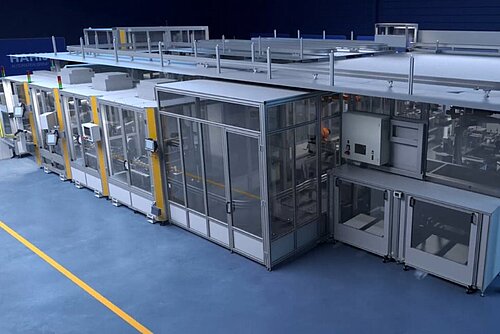
HAHN Automation Group supports manufacturers with high-precision automation solutions for demanding display assembly applications.
Our experience includes automated assembly processes for automotive display systems where accuracy, repeatability, and process reliability are essential for successful series production.
High-Precision Assembly for Automotive Displays
The Future of Display Manufacturing
Future cockpit concepts will continue to push the limits of display technology.
Larger display surfaces, curved geometries, transparent displays, and integrated touch functionality will further increase manufacturing complexity.
As these innovations become mainstream, manufacturers will require automation solutions capable of delivering:
- Higher precision
- Greater process stability
- Automated quality assurance
- Scalable production
- Full traceability
- Flexible manufacturing concepts
Precision bonding will therefore become one of the key enabling technologies behind next-generation automotive displays.
Looking Beyond Automotive
Although precision bonding has become particularly important for automotive displays, the same manufacturing principles apply across many high-tech industries.
Applications such as medical devices, industrial HMIs, consumer electronics, and other precision assemblies all require reliable joining processes, consistent optical quality, and repeatable automation.
This is why expertise developed for demanding automotive applications increasingly benefits manufacturers in other industries as well.
Discover our Mobility Solutions
Precision Matters at Every Micron
Whether you are developing curved automotive displays, advanced cockpit systems, or other high-precision assemblies, HAHN Automation Group supports manufacturers with scalable automation solutions designed for maximum accuracy, repeatability, and production reliability.
Contact our experts to discuss your automation project.