The Rise of Pillar-to-Pillar Displays in Modern Vehicles
In our previous article, From Instrument Clusters to Pillar-to-Pillar Displays: The Evolution of Automotive Cockpits, we explored how vehicle interiors have evolved from traditional gauges to fully digital cockpit environments.
As displays become larger and more integrated, automotive manufacturers are moving beyond conventional infotainment screens toward seamless cockpit architectures that span the entire dashboard.
One of the most significant developments is the rise of pillar-to-pillar displays. These large-format display systems extend across the vehicle interior, combining multiple functions into a single digital interface.
Instead of separate screens for instrument clusters, infotainment, navigation, and passenger interaction, pillar-to-pillar displays create one continuous digital environment that enhances both functionality and user experience.
For OEMs, these display concepts offer an opportunity to differentiate their vehicles through innovative interior design, advanced connectivity, and highly intuitive Human-Machine Interfaces (HMIs).
Why Pillar-to-Pillar Displays Are More Than a Design Trend
While pillar-to-pillar displays create a striking visual impression, their importance goes far beyond aesthetics.
As discussed in our article Why Automotive Displays Are Becoming the New Differentiator in Mobility, displays are increasingly shaping brand perception, user experience, and vehicle differentiation.
Modern vehicle users increasingly expect digital experiences similar to those provided by smartphones, tablets, and consumer electronics. Large seamless displays allow manufacturers to create highly interactive and customizable cockpit environments.
These systems support:
- Digital instrument clusters
- Infotainment and entertainment functions
- Navigation systems
- Passenger displays
- Advanced Driver Assistance Systems (ADAS)
- Vehicle diagnostics and status information
- Personalized user interfaces
As vehicles become increasingly software-defined, displays are evolving into the primary interface between occupants and the vehicle.
Engineering Challenges Behind Seamless Automotive Screens
The larger and more integrated a display system becomes, the more demanding the engineering and manufacturing processes become.
Unlike traditional displays, pillar-to-pillar systems require exceptional precision throughout the entire production process.
Manufacturers must address challenges such as:
- Tight alignment tolerances across large display surfaces
- Consistent optical quality across multiple display zones
- Thermal expansion management
- Curved and complex geometries
- Precise bonding and adhesive application
- Vibration resistance and long-term durability
- Integration of sensors and touch functionality
- Cleanroom-compatible assembly processes
Even small deviations can become visible across large display areas and negatively impact both appearance and functionality.
Optical Quality and Precision Assembly Become Critical
One of the biggest challenges in pillar-to-pillar display manufacturing is maintaining a flawless visual appearance across the entire display surface.
To achieve this, manufacturers must ensure:
- Accurate component positioning
- Uniform gap dimensions
- Reliable optical bonding
- Stable adhesive processes
- Minimal distortion and reflections
- High process repeatability
As display dimensions increase, maintaining these quality standards becomes increasingly difficult.
This is where automation and precision assembly technologies become essential.
Related Case Study:
High-Precision Assembly for Automotive Displays
Automation Enables Scalable Production
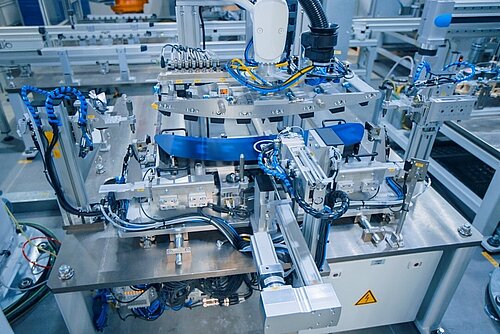
Producing pillar-to-pillar displays at automotive volumes requires much more than engineering expertise. It requires manufacturing systems capable of delivering consistent quality at scale.
Modern automation solutions help manufacturers achieve:
- High process stability
- Repeatable assembly accuracy
- Automated inspection and quality control
- Traceability throughout production
- Reduced scrap rates
- Scalable production concepts
Without highly automated manufacturing processes, achieving the required quality levels for next-generation cockpit systems would be extremely challenging.
The Future of Automotive Cockpit Displays
Pillar-to-pillar displays represent an important milestone in the evolution of automotive Human-Machine Interfaces.
Future cockpit concepts are expected to integrate:
- Curved OLED displays
- Transparent display technologies
- AI-driven interfaces
- Augmented reality functionality
- Adaptive display environments
- Personalized digital experiences
As these technologies continue to evolve, the demands placed on manufacturing, assembly, and quality assurance will increase accordingly.
Manufacturers that successfully combine innovative display concepts with robust automation strategies will be best positioned to deliver the next generation of mobility experiences.
Precision Automation for Advanced Display Manufacturing
The transition toward larger, more integrated automotive displays is creating new requirements for production technology.
HAHN Automation Group supports manufacturers with automation solutions for demanding mobility applications where precision, repeatability, and process reliability are essential.
By combining advanced assembly technologies with scalable manufacturing concepts, we help enable the production of next-generation automotive display systems.
Developing the Next Generation of Automotive Display Systems?
Whether you are working on pillar-to-pillar displays, digital cockpit architectures, or advanced HMI concepts, HAHN Automation Group can support your production goals with high-precision automation solutions.
Contact our experts to discuss your project requirements.