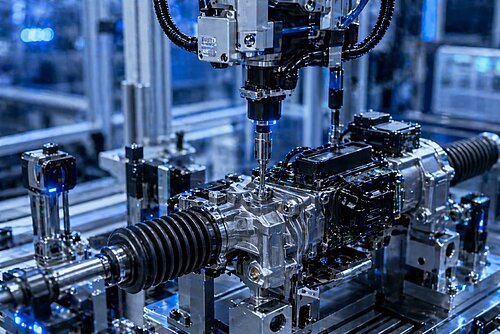
Steer by wire (SbW) is one of the most significant innovations shaping the next generation of vehicle architectures. By replacing the traditional mechanical connection between the steering wheel and the road wheels with electronic sensors, control units, and actuators, steer by wire enables new levels of flexibility, integration, and functionality.
As the automotive industry moves toward electrification, advanced driver assistance systems (ADAS), and software defined vehicles (SDVs), steering is becoming part of a highly connected electronic ecosystem. This transformation not only changes how vehicles are designed but also how steering systems are manufactured, tested, and validated.
For automotive manufacturers and suppliers, this evolution creates new opportunities while increasing the demands on precision assembly, functional testing, digital traceability, and scalable automation.
This article provides a comprehensive overview of steer by wire technology, explains how these systems work, explores the manufacturing challenges behind them, and highlights why automation is becoming increasingly important for next-generation mobility.
What Is Steer by Wire?
Steer by wire is an electronically controlled steering system that transmits steering inputs without relying on a permanent mechanical connection between the steering wheel and the road wheels during normal vehicle operation.
Instead of a steering column transferring the driver's input mechanically, sensors measure steering angle and steering torque. These signals are processed by electronic control units (ECUs), which calculate the required steering movement and send commands to electric actuators responsible for turning the wheels.
Depending on the vehicle architecture, manufacturers may implement different system concepts, including varying redundancy strategies and safety mechanisms.
A typical steer by wire system may include:
- Steering wheel module with steering angle and torque sensors
- Electronic control units (ECUs)
- Electric steering actuators
- Vehicle communication networks
- Power supply systems
- Redundant safety functions
Unlike conventional steering systems, steer by wire combines mechanical engineering, electronics, embedded software, and intelligent control algorithms into one integrated system.
Why the Automotive Industry Is Moving Toward Steer by Wire
Vehicle architectures are changing rapidly.
Electrification, increasing software integration, and growing expectations for driver assistance functions are driving manufacturers to rethink traditional vehicle systems.
Steer by wire supports this transformation by enabling:
- Greater freedom in vehicle interior design
- Flexible packaging of vehicle components
- Easier integration with advanced driver assistance systems
- Software adjustable steering characteristics
- New opportunities for future mobility concepts
For electric vehicles, steer by wire can also simplify vehicle packaging because the traditional steering column no longer defines interior layout in the same way as conventional steering systems.
As software defined vehicles continue to evolve, electronically controlled steering systems are expected to play an increasingly important role in future vehicle platforms.
Steer by Wire and Software Defined Vehicles
Software defined vehicles represent a fundamental shift in automotive engineering.
Instead of developing steering, braking, powertrain, infotainment, and driver assistance systems independently, manufacturers are increasingly integrating these functions into centralized electronic architectures.
Software becomes a key differentiator throughout the vehicle lifecycle by enabling updates, optimization, and feature enhancements.
Steer by wire fits naturally into this approach because steering becomes part of the overall electronic vehicle architecture rather than an isolated mechanical subsystem.
As more vehicle functions become software controlled, manufacturers must also rethink how these systems are produced and validated.
To learn more about this development, read How Steer by Wire Is Shaping the Future of Software Defined Vehicles.
How Does a Steer by Wire System Work?
Although technical implementations differ between manufacturers, the basic operating principle is similar.
Steering Input Detection
Sensors continuously measure:
- Steering angle
- Steering torque
- Driver steering inputs
These measurements are transmitted to the vehicle's electronic control units.
Electronic Signal Processing
The ECUs evaluate steering inputs together with additional vehicle information.
Depending on the vehicle architecture, this may include data from:
- Vehicle speed
- Driver assistance systems
- Stability control systems
- Other vehicle dynamics functions
The control software determines the required steering response.
Actuator Control
Electric actuators receive commands from the control units and generate the steering movement required to turn the wheels.
Their movement must remain highly precise under all operating conditions.
Steering Feedback
Since the driver is no longer directly connected to the steering rack during normal operation, steering feedback can be generated electronically to provide an intuitive driving experience.
Depending on the vehicle concept, steering feel can even be adapted to different driving modes.
Supporting Advanced Driver Assistance Systems
Steer by wire is closely linked with modern ADAS technologies.
Electronically controlled steering allows closer interaction between multiple vehicle systems and can support functions such as:
- Lane centering assistance
- Automated parking
- Highway driving assistance
- Emergency steering support
- Future automated driving concepts
The exact capabilities depend on the complete vehicle architecture, but steer by wire creates greater flexibility than purely mechanical steering systems.
Manufacturing Challenges
The transition from mechanical steering to electronically controlled steering significantly increases manufacturing complexity.
Compared with conventional steering systems, production typically involves:
- Precision assembly of electronic and mechanical components
- Sensor integration
- Software validation
- Calibration processes
- Functional testing
- Digital traceability
Manufacturers must ensure that every production step delivers consistent quality while maintaining high throughput.
Small deviations during assembly or calibration can directly influence system performance, making process stability a key success factor.
To better understand the production process, read How Steer by Wire Systems Are Manufactured.
Precision Assembly Is Essential
Modern steer by wire systems combine components from different engineering disciplines.
Production may include:
- Assembly of electronic modules
- Sensor positioning
- Actuator integration
- Mechanical joining processes
- Electrical connections
- Calibration procedures
These manufacturing steps require high repeatability and precise process control.
Automated assembly solutions help manufacturers achieve the consistency required for safety-critical automotive systems.
Flexible Automation for Future Vehicle Platforms
Vehicle platforms evolve continuously.
Manufacturers therefore require production systems capable of adapting to:
- Product variants
- Engineering changes
- New software versions
- Future steering technologies
- Changing production volumes
Modular automation concepts provide the flexibility needed to support future vehicle programs while maintaining production efficiency.
Learn more about our MasterCell.
Why Testing Becomes Even More Important
As steering systems become increasingly software-driven, testing is no longer a final quality gate. It has become an integral part of the entire manufacturing process.
Depending on the product design and manufacturing strategy, testing may verify:
- Sensor functionality
- Actuator performance
- Electronic communication
- Software versions and parameters
- Selected safety-related functions
- Production data for complete traceability
Automated testing helps manufacturers achieve repeatable quality, reduce process variation, and support efficient high-volume production.
To learn more about testing strategies, read Why 100% End of Line Testing Is Critical for Steer by Wire Systems.
The Importance of End of Line Testing
End of line (EOL) testing is typically one of the final validation steps before a steer by wire system leaves production.
Although the exact test sequence varies depending on the product and manufacturer, automated EOL testing may include:
- Electrical inspection
- Software verification
- Functional steering tests
- Communication validation
- Selected redundancy checks
- Recording of production and quality data
These tests help verify that the assembled system performs according to its specified production requirements before shipment.
Digital Manufacturing Enables Better Quality
Steer by wire production generates large amounts of manufacturing, inspection, and testing data.
When assembly systems, vision inspection, testing stations, and traceability solutions are connected, manufacturers gain much greater visibility into production performance.
Digital manufacturing can help manufacturers:
- Improve process stability
- Detect deviations earlier
- Reduce scrap
- Optimize production parameters
- Support continuous improvement
- Enable data-driven quality management
For safety-critical automotive products, connected manufacturing environments also simplify documentation and product traceability.
Learn more about our Digitalization solutions.
Traceability Throughout the Production Process
Modern automotive production increasingly relies on complete traceability.
Each manufactured product can be linked to production parameters, inspection results, calibration data, and testing records.
Depending on customer requirements, manufacturers may document:
- Component identification
- Assembly parameters
- Calibration values
- Inspection results
- Test data
- Product serialization
This information supports quality management throughout the product lifecycle and enables manufacturers to analyze production performance more effectively.
Functional Safety and Manufacturing
Steer by wire systems are designed for safety-critical applications.
Although standards such as ISO 26262 primarily define requirements for the development of automotive electrical and electronic systems, manufacturing processes also play an important role in supporting consistent product quality.
Manufacturers therefore focus on:
- Stable production processes
- High repeatability
- Automated inspection
- Comprehensive testing
- Controlled calibration
- Digital documentation
Together, these processes help reduce manufacturing variation and support reliable system performance.
Future Trends in Steer by Wire Manufacturing
As vehicle architectures continue to evolve, manufacturing technologies are evolving alongside them.
Current industry trends include:
- Higher levels of software integration
- Increasing electronics content
- More centralized vehicle architectures
- AI-assisted quality inspection
- Connected manufacturing environments
- Greater production flexibility
Manufacturers are also investing in scalable automation concepts that can adapt to future vehicle platforms without requiring complete production line redesigns.
Why Automation Will Continue to Grow in Importance
The transition toward software defined vehicles is increasing production complexity across the automotive industry.
Manufacturers need automation solutions capable of combining:
- Precision assembly
- Flexible production
- Automated calibration
- Inline inspection
- End of line testing
- Digital traceability
Rather than treating these processes separately, modern production systems increasingly integrate them into one connected manufacturing environment.
This integrated approach helps improve efficiency while supporting consistently high product quality.
Frequently Asked Questions
What is steer by wire?
Steer by wire is an electronically controlled steering technology that replaces the permanent mechanical connection between the steering wheel and the road wheels during normal vehicle operation with electronic sensors, control units, and actuators.
Why is steer by wire important?
Steer by wire supports future vehicle architectures by enabling greater design flexibility, closer integration with advanced driver assistance systems, and software-controlled steering characteristics.
Does steer by wire eliminate mechanical steering completely?
System architectures differ between manufacturers. Depending on the vehicle concept, some designs may incorporate additional mechanical backup concepts or other redundancy strategies to meet safety and regulatory requirements.
Why is manufacturing steer by wire systems more complex?
Compared with conventional steering systems, steer by wire combines precision mechanics, electronics, sensors, embedded software, and calibration processes. This increases manufacturing, testing, and quality assurance requirements.
Why is automation important for steer by wire production?
Automation helps manufacturers achieve the precision, repeatability, traceability, and production efficiency required for safety-critical automotive components.
Conclusion
Steer by wire is transforming automotive steering from a predominantly mechanical system into an intelligent electronic technology that supports the evolution of software defined vehicles.
As steering systems become increasingly connected, manufacturers face growing demands for precision assembly, automated testing, digital traceability, and flexible production concepts.
Companies that combine advanced manufacturing technologies with scalable automation will be well positioned to support the next generation of automotive steering systems.
If you would like to explore specific aspects of steer by wire manufacturing in more detail, we recommend the following articles:
- How Steer by Wire Systems Are Manufactured
- Why 100% End of Line Testing Is Critical for Steer by Wire Systems
- How Steer by Wire Is Shaping the Future of Software Defined Vehicles
Driving the Next Generation of Automotive Manufacturing
As vehicle technologies continue to evolve, manufacturers require automation solutions that are as flexible as the products they build.
The HAHN Automation Group supports automotive manufacturers and suppliers with solutions for:
- Precision assembly
- Automated testing and inspection
- Digital traceability
- Modular production concepts
- Scalable manufacturing systems
Whether launching a new product or expanding production capacity, intelligent automation helps improve quality, efficiency, and manufacturing flexibility.
Learn more about our automation solutions for the mobility industryor contact our experts to discuss your next automation project.