Manufacturers are responding to shorter product lifecycles, increasing variant diversity, skilled labor shortages and growing pressure to improve production performance. At the same time, products and manufacturing processes are becoming more complex.
These developments are changing how industrial automation systems are designed and operated. The focus is no longer limited to automating individual manual tasks. Modern production concepts connect modular equipment, software, production data and digital engineering across the complete automation lifecycle.
The following six trends are shaping advanced manufacturing and influencing investment decisions across Life Sciences, Mobility and Transformation Technologies.
Modular and Scalable Automation Architectures
Traditional production lines were often designed around a fixed product and a clearly defined output. This approach remains suitable for stable high-volume applications, but many manufacturers now require systems that can adapt to changing products, volumes and processes.
Modular automation architectures use standardized cells, interfaces and system components as a technical framework. Product-specific processes, fixtures and tools are then integrated according to the application.
This approach can help manufacturers:
- Begin with individual production cells
- Add processes as requirements develop
- Increase capacity through additional modules
- Reuse proven hardware and software
- Introduce new product variants
- Transfer production concepts to other sites
Modularity does not mean that every station must be universally configurable. The objective is to standardize the system architecture while customizing the technologies that directly affect the product.
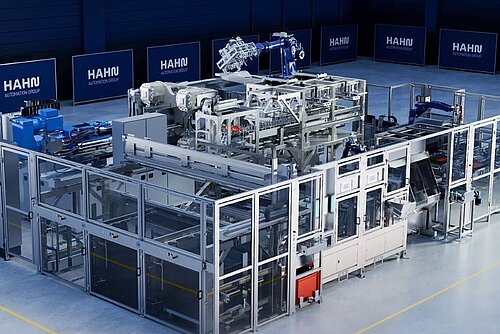
The MasterCell automation platform provides a modular framework for integrating robots, feeding systems, machine vision, testing technologies and application-specific manufacturing processes. Systems can range from individual cells to connected multi-process production lines.
Software-Defined and Connected Production
Mechanical design remains fundamental to automation. However, an increasing number of production functions are now controlled through software, recipes and connected data.
A production system can identify the incoming product, select the correct parameters and adjust the process sequence automatically. This reduces manual settings and supports the production of multiple variants on the same equipment.
Relevant technologies include:
- Product and carrier identification
- Recipe-controlled processes
- Parameter-based robot programs
- Configurable vision applications
- Automated format changes
- MES and SCADA connectivity
- Standardized production data
- Centralized recipe and version management
Connected systems also create transparency across individual stations. Production teams can relate cycle times, machine states and quality results to specific products, variants or production periods.
Connectivity alone, however, does not improve production. Manufacturers need to define which information is required, how systems exchange it and which decisions the data should support.
The trend is therefore moving from isolated machines with local data storage towards coordinated production systems with clearly structured digital interfaces.
AI-Supported Vision and Process Optimization
Artificial intelligence is becoming more relevant in applications where fixed rules cannot describe every acceptable product or possible defect.
Traditional image-processing systems remain highly effective for clearly defined tasks such as presence checks, position verification and dimensional inspection. AI-supported methods can complement them when features vary or defect patterns are difficult to define.
Potential applications include:
- Classification of complex surface defects
- Inspection of variable or reflective components
- Recognition of unusual production patterns
- Analysis of process and quality data
- Identification of recurring error combinations
- Support for root-cause analysis
- Detection of gradual changes in process behavior
AI should not be treated as an automatic solution for every inspection or optimization task. Its value depends on suitable data, clearly defined objectives and reliable integration into the production process.
The purpose is not to replace engineering knowledge. AI-supported systems can help specialists evaluate larger data volumes and identify relationships that may be difficult to recognize through manual analysis.
HAHN Automation Group combines machine vision, analytics and connected production solutions within its portfolio for digitalization in manufacturing. These technologies support product identification, inspection, production transparency and process optimization.
Digital Twins and Virtual Engineering
Digital models are increasingly used throughout the engineering and operating lifecycle of automation systems.
A digital twin represents a machine, production system or process within a virtual environment. When engineering disciplines work with one consistent model, mechanical design, controls, robotics and process planning can be coordinated more closely.
Digital twins and virtual engineering can support:
- Cross-disciplinary design reviews
- Simulation of machine and robot movements
- Evaluation of process sequences
- Preparation of control software
- Virtual operator training
- Planning of later modifications
- Analysis of machine and production data
- Continuous process optimization
The digital model can begin as an engineering tool and evolve as the physical system enters production. When connected with real machine data, it provides a foundation for monitoring performance and investigating changes in operating behavior.
This creates a more continuous link between system development, commissioning, operation and lifecycle support.
The HAHN Automation Group approach to the Digital Twin uses a consistent virtual model across engineering disciplines and connects digital development with virtual commissioning, production monitoring and long-term optimization.
Integrated Quality and Production Data
Quality assurance is increasingly becoming part of the complete manufacturing process rather than a separate final operation.
Modern automation systems can record process parameters and inspection results directly at the station where they occur. Depending on the application, these data may include:
- Force-distance curves
- Torque and angle values
- Dispensing parameters
- Vision inspection results
- Electrical measurements
- Functional test results
- Product and component identification
- Rejection and rework information
Connecting these results with the product, variant, station, tool or material batch creates a more complete manufacturing record.
This supports several objectives:
- Detecting deviations earlier
- Improving first-pass yield
- Identifying recurring defect patterns
- Distinguishing product errors from equipment faults
- Recognizing process drift
- Supporting root-cause analysis
- Creating end-to-end traceability
The important trend is not simply the collection of more data. Manufacturers are increasingly focusing on data that explains production losses and leads to defined actions.
Quality data therefore becomes a source of information for production engineering, maintenance and continuous improvement rather than remaining only a release record for the finished product.
Phased Automation for Emerging Technologies
New technologies often begin with prototypes, demonstrators or low-volume production. At this stage, products and processes may still change frequently, making immediate investment in a highly specialized high-volume line difficult to justify.
A phased automation strategy allows the production concept to grow with product maturity and market demand.
Possible stages include:
- Guided manual assembly
- Semi-automated workstations
- Automation of quality-critical processes
- Modular pilot production
- Connected production cells
- Fully automated high-volume manufacturing
This approach allows manufacturers to improve repeatability and gather production knowledge while retaining flexibility during early phases.
As requirements stabilize, additional processes and capacity can be integrated. Standardized interfaces, structured production data and modular equipment make this transition easier.
The appropriate automation level should therefore reflect the current production stage while providing a realistic path for future expansion.
The article on scaling emerging technologies from pilot production to industrial manufacturing explains how product design, process development, automation, material flow and quality assurance need to evolve together during industrialization.
How These Trends Work Together
These developments should not be considered independently.
A modular production system requires standardized mechanical and digital interfaces. Software-controlled variants depend on reliable product identification and structured recipes. AI-supported analysis requires consistent production and quality data. A digital twin becomes more valuable when it can connect engineering information with real machine behavior.
Together, these trends create production systems that are:
- Easier to scale
- More transparent
- Better prepared for product changes
- More consistent across production sites
- More closely connected with engineering
- Better supported throughout their lifecycle
Not every manufacturer needs to implement every technology at once. The relevant combination depends on the product, process maturity, production volume and business objectives.
The most effective strategy begins with a defined manufacturing challenge and selects the technologies that create measurable value for that application.
Conclusion
Advanced manufacturing is becoming more modular, connected and software-driven.
Standardized automation platforms create scalable system architectures. Connected production systems manage products, recipes and data across multiple stations. AI-supported tools expand the possibilities of inspection and analysis, while digital twins connect engineering with the later operation of the equipment.
Integrated quality data provides deeper insight into production performance, and phased automation concepts help new technologies progress from initial production to industrial scale.
The future of automation is therefore not defined by one individual technology. It is shaped by the way modular equipment, intelligent software, production data and engineering expertise work together throughout the complete manufacturing lifecycle.
Prepare Your Production for Advanced Manufacturing
HAHN Automation Group develops scalable automation solutions that combine advanced engineering, robotics, software, production data and digital technologies.
Our experts support manufacturers in selecting and integrating the technologies that match their products, processes and long-term production strategy.