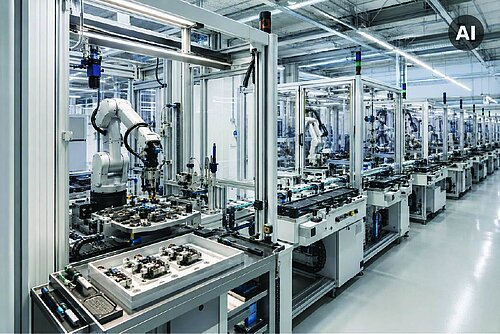
Emerging technologies often begin with a prototype, demonstrator or small number of products assembled by engineers and specialists. At this stage, the primary objective is usually to prove that the technology works.
Successful industrialization requires a different perspective. A product that can be manufactured once under carefully controlled conditions is not automatically ready for repeatable series production. Components must be available in consistent quality, processes need clearly defined parameters, test methods must produce reliable results and the complete manufacturing sequence must support the required output.
The transition from pilot production to industrial manufacturing is therefore not simply a matter of installing faster equipment. Product design, process development, automation, quality assurance, material flow and production data must evolve together.
A phased production strategy helps manufacturers increase capacity while product requirements and market demand continue to develop. The goal is to establish stable manufacturing processes at each stage without creating an inflexible production system that may no longer match the next generation of the product.
Why Scaling Emerging Technologies Is Challenging
Emerging technologies are frequently associated with a high level of uncertainty. Product designs may still change, suppliers may be developing their own processes and future production volumes can be difficult to predict.
At the same time, manufacturers face pressure to shorten time to market and prepare for rapid growth once demand increases.
Typical scaling challenges include:
- Product designs that are not yet optimized for automated assembly
- Processes that work in a laboratory but are not sufficiently stable for production
- Changing components, materials or suppliers
- Uncertain production volumes
- Increasing numbers of product variants
- Limited process and quality data
- Manual operations that depend heavily on specialist knowledge
- Incomplete test strategies
- Long cycle times
- Material-flow bottlenecks
- Missing production interfaces
- Equipment designed for only one development stage
These challenges can occur in fields such as drone manufacturing, battery recycling, smart infrastructure, hydrogen technologies, advanced energy systems and other new product categories.
HAHN Automation Group supports companies in these markets with automation for emerging and transformation technologies, from early production concepts to scalable industrial manufacturing systems.
Product Readiness Is Not the Same as Manufacturing Readiness
A working prototype demonstrates that a product concept is technically viable. It does not necessarily show that the product can be manufactured reliably, economically and at the required volume.
During prototype development, engineers can manually adjust components, compensate for tolerances or repeat individual steps until the desired result is achieved. These interventions may not be documented and often depend on the experience of a small team.
Industrial manufacturing requires processes that are:
- Repeatable
- Measurable
- Controllable
- Documented
- Suitable for the required cycle time
- Transferable between operators, machines or sites
- Capable of producing consistent quality
Before automation is scaled, manufacturers therefore need to evaluate both product maturity and manufacturing readiness.
Important questions include:
- Is the product design sufficiently stable?
- Are the components suitable for automated feeding and handling?
- Are component tolerances clearly defined?
- Can critical processes be measured?
- Are process parameters and acceptance limits available?
- Is the required testing strategy established?
- Can non-conforming products be identified and separated?
- Are suppliers able to provide consistent quality and volume?
- Which product changes are still likely?
A production concept should reflect the answers to these questions. Highly automated equipment may not be the right starting point if the product and its processes are still changing significantly.
Start with a Production Roadmap
A scalable manufacturing strategy begins with a roadmap that connects the current development stage with realistic future scenarios.
Manufacturers do not need to predict every product version or production volume. However, they should define which developments are likely enough to influence the initial production architecture.
A production roadmap can consider:
- Expected product generations
- Planned product variants
- Initial and future production volumes
- Target markets and production locations
- Current process maturity
- Required assembly and joining technologies
- Inspection and testing requirements
- Traceability needs
- Supplier and component availability
- Potential capacity-expansion stages
- Existing equipment that must be integrated
- Investment and floor-space limitations
The roadmap helps determine which operations should remain manual during pilot production, which processes require early automation and which capabilities should be prepared for later expansion.
It also prevents decisions from being based solely on the immediate production requirement. Equipment that is optimized exclusively for a small pilot batch may become a bottleneck during ramp-up. Conversely, a fully automated high-volume line can create unnecessary technical and financial risk when the product is still changing.
Phase 1: Establish a Controlled Pilot Production Process
Pilot production connects product development with industrial manufacturing. It enables manufacturers to produce initial quantities under realistic conditions while continuing to refine the product and the production process.
The objective is not necessarily to maximize output. Pilot production should generate the information required to make later scaling decisions.
Typical pilot-production priorities include:
- Defining a repeatable assembly sequence
- Evaluating component accessibility
- Developing fixtures and workpiece carriers
- Testing feeding and handling concepts
- Verifying joining processes
- Identifying critical process parameters
- Establishing inspection methods
- Developing functional tests
- Recording initial process data
- Identifying ergonomic challenges
- Measuring realistic cycle times
- Recognizing potential bottlenecks
Manual and semi-automated workstations can provide the flexibility needed during this stage. Operators can handle changing components or process sequences while controlled tools, sensors and digital instructions improve consistency.
Quality-critical processes may already benefit from automation. Controlled pressing, screwdriving, dispensing, welding, machine vision or functional testing can generate reliable results even when other operations remain manual.
The key is to create a controlled pilot process rather than reproduce an engineering prototype with undocumented manual adjustments.
Capture Process Knowledge Before Scaling
One of the greatest risks during industrialization is that important process knowledge remains with individual engineers or operators.
A specialist may know how a component must be aligned, how much force can be applied or how to recognize an abnormal assembly condition. If this knowledge is not translated into defined process parameters, inspection criteria and equipment requirements, it can be lost when production is expanded.
Manufacturers should document:
- Component handling requirements
- Correct assembly orientation
- Relevant process sequences
- Fixtures and positioning principles
- Joining parameters
- Acceptable process windows
- Visual quality criteria
- Functional test limits
- Rework procedures
- Causes of known failure modes
- Product-specific adjustments
This information forms the basis for automation specifications and helps equipment designers understand which process characteristics must be controlled.
Process data from pilot production can also reveal natural variation. This supports realistic tolerance definitions and helps distinguish normal process behavior from meaningful deviations.
Stabilize the Process Before Automating It
Automation increases speed and repeatability, but it does not automatically correct an unstable process. If component tolerances, assembly forces or test criteria are not sufficiently understood, automation may reproduce the same problems at a higher rate.
Before increasing the automation level, manufacturers should determine whether the process is:
- Technically feasible
- Repeatable across multiple products
- Robust against normal component variation
- Measurable through relevant parameters
- Supported by defined acceptance criteria
- Compatible with the required cycle time
- Suitable for automated handling
- Capable of identifying non-conforming results
A process capability assessment can help show whether the operation consistently remains within the defined limits. Where variation is too high, the product design, component specification, tooling or process itself may require further development.
This does not mean that every detail must be fixed before automation begins. Automation specialists can contribute during process development by testing handling concepts, evaluating joining technologies and identifying design characteristics that make later automation difficult.
Design the Product for Industrial Manufacturing
A product developed exclusively around functional requirements may be difficult or expensive to manufacture automatically.
Design for Automation considers how product characteristics affect feeding, handling, assembly, inspection, testing and maintenance.
Relevant design questions include:
- Can components be separated and oriented reliably?
- Are parts sensitive to gripping forces or contamination?
- Can robots and tools access the assembly points?
- Are there clear positioning features?
- Can incorrect assembly be prevented through the geometry?
- Are connectors and joining points accessible?
- Can inspection systems see quality-critical features?
- Are test interfaces available?
- Can product variants use common fixtures and processes?
- Can components tolerate the required production speed?
Small product-design changes can significantly simplify industrialization. Adding positioning features, standardizing fasteners, improving component rigidity or making test contacts accessible may reduce equipment complexity and improve process stability.
Cooperation between product development, manufacturing engineering and automation specialists should therefore begin before the product design is fully frozen.
Select the Right Initial Automation Level
The appropriate automation level depends on more than expected production volume. Product maturity, process complexity, quality requirements, labor availability and future flexibility must also be considered.
Manual Production
Manual production can be suitable when:
- Volumes are low
- Product changes are frequent
- Components are difficult to handle automatically
- Processes are still being developed
- Investment flexibility is important
Manual production does not have to mean uncontrolled production. Digital work instructions, scanners, controlled tools, operator guidance and connected test equipment can improve repeatability and traceability.
Semi-Automated Production
Semi-automated systems combine human flexibility with automated quality-critical processes.
Operators may load components or perform complex handling tasks, while the equipment carries out:
- Controlled joining
- Precision positioning
- Machine vision inspection
- Electrical testing
- Functional testing
- Product identification
- Data recording
This approach is often effective during pilot production and early series manufacturing because it increases process control without removing all flexibility.
Fully Automated Production
Full automation becomes more suitable when:
- Product and process designs are stable
- Volumes justify the investment
- Cycle-time requirements are demanding
- Processes are repeatable
- Component supply is consistent
- Quality-critical operations require continuous monitoring
- Production data must be captured automatically
- Manual handling limits capacity or reliability
The best starting point is not necessarily the highest possible automation level. It is the level that supports the current manufacturing stage while creating a structured path for future expansion.
Phase 2: Move from Pilot Production into Series Manufacturing
As product demand increases and the manufacturing process becomes more stable, selected operations can be automated or expanded.
The transition into series production should be based on evidence collected during pilot manufacturing. Manufacturers can identify which processes:
- Limit the current output
- Create the greatest quality risk
- Require high positioning accuracy
- Generate repetitive manual work
- Depend heavily on operator experience
- Require consistent data collection
- Create ergonomic concerns
- Have sufficiently stable parameters
Automating these operations first can provide greater value than attempting to automate the complete process at once.
At this stage, the production system may combine existing manual workstations with automated cells for assembly, joining, inspection or testing. Material can be transferred manually between stations or through a simple transport concept.
The system architecture should nevertheless account for future integration. Mechanical, electrical, software and data interfaces determine how easily individual stations can later be connected into a coordinated production line.
Modular Automation Creates a Path for Growth
A modular production architecture divides the manufacturing process into clearly defined functional units. Each module performs a specific operation, such as feeding, assembly, inspection, testing, marking or packaging.
This makes it possible to expand the system without redesigning the complete production process.
Scalability can be achieved through:
- Adding new process modules
- Duplicating bottleneck stations
- Expanding the number of test positions
- Replacing manual handling with automated transfer
- Connecting previously independent cells
- Adapting fixtures for new products
- Introducing additional inspection processes
- Transferring proven modules to another line or site
The article How Modular Automation Systems Are Designed explains how cells, standardized interfaces, system integration and coordinated material flow contribute to scalable production systems.
Modularity does not mean that every production cell is identical. The individual processes still need to be engineered for the product. The advantage lies in using a consistent system structure and clearly defined interfaces around these customized processes.
Define Interfaces Before They Are Needed
A production module cannot be expanded efficiently if its interfaces were designed only for its current configuration.
Manufacturers should consider future connections during the initial system design, including:
- Mechanical interfaces
- Electrical connections
- Safety systems
- Communication protocols
- Product-status signals
- Recipe and variant information
- Process-data structures
- Material-transfer points
- Workpiece-carrier concepts
- Upstream and downstream equipment
- MES and ERP integration
Clearly defined interfaces make it easier to add capacity, replace equipment or integrate additional processes.
Data interfaces are particularly important. Each module must know which product has arrived, which recipe should be used, which processes have already been completed and whether the product is allowed to continue.
Use Scalable Cell Concepts
Standardized cell platforms can provide a consistent mechanical and control architecture for different process technologies.
A cell may initially operate as an independent production unit. As demand grows, further cells can be added and connected through automated transport, higher-level controls and common data systems.
The MasterCell modular automation platform can integrate robots, feeding systems, machine vision, assembly processes and testing technologies within a scalable cell architecture. Depending on the application, individual cells can be combined into larger automated production systems.
A scalable cell concept can help manufacturers:
- Reduce engineering effort for later expansion
- Reuse established technical standards
- Add process capacity in defined stages
- Maintain a consistent safety and control concept
- Integrate new variants and technologies
- Transfer production concepts to additional sites
The underlying process still requires application-specific engineering. Standardization provides the system framework, while tooling, handling and process technologies are configured for the individual product.
Scale Material Flow Together with Production Capacity
Material flow that works during pilot production may not support industrial output.
Engineers can manually deliver components to a pilot workstation, remove finished products and intervene when parts are incorrectly positioned. As volumes grow, these activities can create interruptions, excessive work in progress and inconsistent component supply.
A scalable material-flow concept considers:
- Supplier packaging
- Internal containers and trays
- Component identification
- Part separation and orientation
- Sensitive-part handling
- Buffer capacity
- Transport between stations
- Empty-container management
- Rejected-part handling
- Transfer to final packaging
The feeding technology must match the component geometry, required output and expected product variants. Flexible tray-based supply may be appropriate during early production, while high-volume manufacturing may require dedicated feeders or automated logistics.
Buffers can decouple processes with different cycle times. However, oversized buffers increase floor-space requirements and work in progress. Undersized buffers may cause frequent interruptions. Their design should therefore be based on realistic process data.
Scale Testing Capacity, Not Only Assembly
Testing frequently becomes a bottleneck when emerging technologies move into series manufacturing.
An individual assembly operation may take only a few seconds, while functional testing, calibration, software flashing or leakage testing can require significantly more time. Increasing assembly speed does not improve total output if the test process cannot handle the same production volume.
Testing capacity can be expanded through:
- Parallel test stations
- Multiple test nests
- Division of long test sequences
- Inline testing during assembly
- Early electrical pre-testing
- Automated loading and unloading
- Faster product connection
- Optimized data acquisition
- Risk-based test strategies
The testing concept should be considered from the beginning. Product design influences how easily components can be connected, stimulated and measured. The expected test duration also affects line architecture, space requirements and investment.
Manufacturers should clearly distinguish between production testing and development validation. Production testing confirms that each manufactured unit meets defined criteria. Development and lifecycle testing address broader questions such as durability, environmental performance or design robustness.
Maintain Quality During Production Ramp-Up
Increasing output can reveal process problems that were not visible during small pilot batches. Component variation becomes more apparent, equipment operates for longer periods and minor delays can accumulate into significant production losses.
The quality strategy must therefore develop alongside production capacity.
Relevant measures include:
- Monitoring joining forces and distances
- Recording torque and angle
- Inspecting component presence and orientation
- Verifying dispensing or adhesive application
- Measuring critical dimensions
- Confirming software and parameter versions
- Recording functional test results
- Identifying non-conforming products
- Controlling rework processes
- Linking process data to each product
Inline inspection helps detect deviations close to the process where they originate. End-of-line testing confirms the function of the completed product. Together, these methods provide greater transparency than relying only on a final quality check.
Ramp-up data can also identify recurring problems, unstable process steps and stations that have not yet reached their target performance.
Balance the Complete Production Line
The output of an industrial production system is determined by its slowest relevant process.
Manufacturers should therefore evaluate the complete manufacturing sequence rather than optimize individual stations in isolation.
Line balancing should consider:
- Component feeding
- Manual operator activities
- Robot and transfer movements
- Assembly operations
- Joining and curing times
- Software flashing
- Calibration
- Inspection and testing
- Product marking
- Rejected-part handling
- Packaging
Processes with longer cycle times may need to be divided between multiple stations or executed in parallel. Other operations can be combined if this does not reduce accessibility, maintainability or process stability.
The objective is not to give every station exactly the same cycle time. It is to create a coordinated process flow that achieves the required output without unnecessary complexity.
Manage Product Variants During Scaling
Emerging technologies often develop quickly. New product generations, alternative components, software versions or regional configurations may be introduced while production is still ramping up.
A production system that supports only one fixed product configuration can become obsolete before the investment has delivered its expected value.
Variant management may include:
- Early product identification
- Recipe-controlled processes
- Flexible fixtures
- Replaceable tooling
- Automated tool changes
- Adaptable grippers
- Variant-specific software
- Component verification
- Product-specific test sequences
- Controlled parameter management
The system should identify each product as early as possible and maintain this assignment throughout production. Each station can then select the correct recipe and verify that the required components and processes are used.
Not every potential future variant needs to be accommodated. Manufacturers should identify which changes are realistic and design the appropriate degree of flexibility into the equipment.
Use Production Data to Guide the Ramp-Up
Industrialization generates valuable information about product and process behavior. When this data is structured consistently, manufacturers can use it to improve process stability and make better scaling decisions.
A production record may connect:
- Product and variant information
- Component batches
- Machine and station data
- Process parameters
- Inspection results
- Calibration values
- Functional test data
- Software versions
- Rework information
- Final product status
During ramp-up, this data can help manufacturers identify:
- Processes with excessive variation
- Relationships between component batches and quality results
- Emerging bottlenecks
- Increasing equipment cycle times
- Tools or fixtures requiring maintenance
- Test values moving towards their limits
- Differences between variants, machines or shifts
The objective is not to record every available machine signal. Manufacturers should define which information supports product quality, process control, traceability and continuous improvement.
Phase 3: Establish Stable Industrial Manufacturing
Industrial manufacturing requires more than higher throughput. The complete production system must deliver stable performance over extended periods and under normal operating conditions.
A mature industrial manufacturing concept should address:
- Reliable component supply
- Defined process windows
- Capable equipment and measurement systems
- Coordinated cycle times
- Automated quality controls
- Maintenance and calibration
- Controlled change management
- Product traceability
- Rework and rejection paths
- Production-data availability
- Operator training
- Spare parts and technical support
- Future capacity expansion
At this stage, previously independent workstations may be connected through automated handling and higher-level controls. Additional modules can be introduced to remove bottlenecks, increase testing capacity or automate end-of-line processes.
The production system should also be prepared for controlled changes. New product variants, software versions and component suppliers must be introduced without losing the validated process knowledge established during ramp-up.
Application Example: Scaling Advanced Drone Manufacturing
Drone manufacturing illustrates many of the challenges associated with emerging technologies. Products combine lightweight mechanical structures, electronics, sensors, drive systems, communication technology and software.
Manufacturers may initially require flexible production for low quantities and multiple product configurations. As demand grows, precision assembly, testing, traceability and material flow must support greater output without restricting future product development.
HAHN Automation Group develops scalable automation solutions for advanced drone manufacturing. The production concepts can combine modular assembly, automated inspection, testing and data integration while remaining adaptable to different products and capacity requirements.
The application demonstrates an important principle: emerging technologies need production systems that can industrialize complex processes without assuming that products and volumes will remain unchanged.
Application Example: From Pilot Builds to High-Volume Smart Meter Production
Smart meter production provides another practical example of phased industrialization. Products can combine molded components, sensors, printed circuit boards, firmware, housings and different testing requirements.
A pilot-production concept may rely on manual or semi-automated processes. As volumes grow, component feeding, firmware flashing, variant management, testing, material flow and packaging must all scale together.
The article From Pilot Production to High Volume: Scaling Smart Meter Manufacturing examines how a modular production strategy can support the transition between these manufacturing stages.
Although the individual processes differ between technologies, the underlying scaling principles remain similar: stabilize the product and processes, automate the right operations, define interfaces early and expand capacity across the complete production system.
Common Mistakes When Scaling Emerging Technologies
Automating Before the Process Is Stable
If the process parameters and component behavior are not understood, automation can increase the frequency of existing problems rather than solve them.
Designing Only for the Current Volume
A pilot system without suitable interfaces or expansion options may need to be replaced when demand increases.
Starting with Unnecessary Full Automation
A highly automated line can create excessive cost and inflexibility when the product is still changing.
Ignoring Product Design
Components that are difficult to grip, orient, assemble or test increase equipment complexity and technical risk.
Focusing Only on the Main Assembly Process
Testing, material flow, software flashing, handling and packaging can become bottlenecks even when assembly capacity is sufficient.
Underestimating Variant Management
New product versions can affect fixtures, feeders, software, test systems and data structures throughout the complete line.
Failing to Capture Pilot-Production Knowledge
Undocumented manual adjustments and specialist knowledge are difficult to transfer into industrial equipment.
Treating Quality as a Final Inspection
Quality must be established through controlled processes, inline monitoring and reliable testing rather than added only at the end of production.
When Is an Emerging Technology Ready to Scale?
There is no single milestone that automatically confirms readiness for industrial manufacturing. Manufacturers should evaluate the complete production case.
Indicators of increasing manufacturing readiness include:
- A sufficiently stable product design
- Defined component specifications
- Repeatable assembly processes
- Known critical process parameters
- Established inspection and testing methods
- Consistent supplier quality
- Realistic cycle-time data
- Controlled handling of rejects and rework
- A clear production-volume roadmap
- Defined requirements for traceability
- Scalable material-flow and system concepts
Not every risk must be eliminated before scaling begins. However, the remaining uncertainties should be understood and reflected in the production architecture.
A phased approach enables manufacturers to continue learning while increasing output. Manual, semi-automated and fully automated processes can be combined according to the maturity of each operation.
Conclusion
Scaling an emerging technology from pilot production to industrial manufacturing is a coordinated development process. Product maturity, process stability, automation, testing, material flow, quality assurance and production data must progress together.
Pilot production provides the opportunity to establish repeatable processes, collect data and identify technical risks. As the product and processes mature, selected operations can be automated and integrated into a modular production system.
The most scalable manufacturing concept is not necessarily the one with the highest initial automation level. It is the one that meets current requirements while providing defined interfaces and expansion paths for future volumes, variants and processes.
By planning industrialization early and treating production as part of product development, manufacturers can reduce technical risk, improve ramp-up and build a more reliable foundation for long-term growth.
Scale Your Emerging Technology with the Right Production Strategy
HAHN Automation Group supports manufacturers in transforming innovative products and processes into scalable industrial production.
From pilot-production concepts and process development to modular automation, integrated testing and high-volume manufacturing systems, our experts develop solutions aligned with your product maturity, quality requirements and growth plans.
Contact us to discuss how your emerging technology can move from an initial production stage to reliable industrial manufacturing.