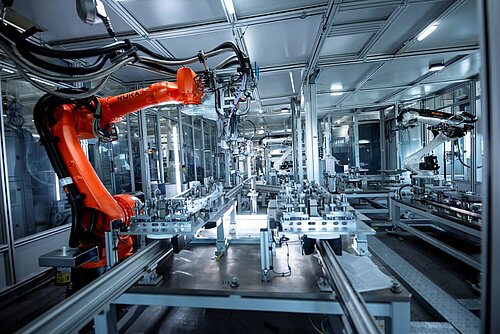
Electronic and mechatronic components are becoming increasingly complex. Products such as sensors, actuators, connectors, control units and power electronics combine mechanical structures with electrical contacts, circuit boards, seals, software and communication interfaces.
Automating their assembly therefore involves more than transferring a manual process to a machine. Sensitive components must be supplied without damage, different joining technologies must be coordinated and critical parameters must remain within narrow process limits.
At the same time, manufacturers need to accommodate multiple product variants, changing production volumes and future design modifications. Successful automation requires a production concept that connects handling, assembly, inspection and material flow from the beginning.
Handling Sensitive and Irregular Components
Many electronic components are small, fragile or difficult to position. Pins can bend, contacts can be damaged and circuit boards may require protection from mechanical stress or electrostatic discharge.
Components such as seals, cables, stamped contacts and flexible parts can also change their position during feeding or handling. Reflective, dark or transparent surfaces may make reliable visual detection more difficult.
An automated handling concept must therefore consider:
- Component geometry and stability
- Permissible gripping forces
- Surface sensitivity
- Electrostatic discharge requirements
- Position and orientation
- Component tolerances
- Cleanliness requirements
- Accessibility within the assembly
Conventional bowl feeding may be suitable for robust components with consistent geometries. More sensitive or variable parts may require tray handling, flexible feeding or vision-guided robotic systems.
The gripper also has to match the individual product. It must hold the component securely without deforming it and position it with the accuracy required by the subsequent assembly process.
HAHN Automation Group combines different automated assembly technologies, including feeding systems, machine vision, precision joining and monitored mechanical assembly. Selecting the appropriate combination depends on the component, production volume and required flexibility.
Combining Different Assembly and Joining Processes
Electronic and mechatronic products rarely rely on a single joining method. One assembly line may need to integrate several processes, including:
- Pressing and insertion
- Screwing
- Crimping
- Soldering
- Laser or resistance welding
- Adhesive dispensing
- Potting
- Heat staking
- Plasma treatment
- Seal installation
Each process places different demands on component positioning, fixtures, tooling and cycle time. Some joining operations also influence subsequent processes. A connector that is not positioned correctly before pressing, for example, may damage the housing or create an unreliable electrical connection.
Critical parameters should therefore be monitored directly during assembly. Depending on the process, these may include force, distance, torque, angle, temperature, pressure or dispensing volume.
This makes it possible to determine whether the process remained within its defined window instead of relying exclusively on an inspection of the finished product.
The production sequence must also be carefully coordinated. Surface treatment may be required before dispensing, while adhesives or potting materials may introduce curing times that affect the layout, buffering concept and overall production cycle.
A practical example is the automated production of DC/DC converters. The production concept combines processes such as contact assembly, plasma treatment, two-component dispensing and end-of-line testing within one automated line.
Managing Component and Assembly Tolerances
Electronic and mechatronic assemblies often combine parts manufactured using different processes and materials. Plastic housings, stamped contacts, machined components, circuit boards and elastomer seals each have their own dimensional tolerances.
Although the individual parts may comply with their specifications, the accumulated tolerances can make automated assembly difficult. A small deviation in a housing or contact position may be sufficient to disrupt insertion, pressing or electrical connection.
The automation system must compensate for realistic variations without concealing non-conforming components. Possible measures include:
- Compliant grippers and fixtures
- Vision-guided position correction
- Controlled search movements
- Force-distance monitoring
- Floating or self-centring tooling
- Defined reference surfaces
- Intermediate dimensional inspections
- Product-specific process limits
The objective is to create a robust process that accommodates acceptable component variation while still detecting deviations that could affect product quality.
This requires close cooperation between product development and automation engineering. Minor changes to reference surfaces, access points or component geometry can significantly improve the suitability of a product for automated assembly.
Supporting Multiple Product Variants
Manufacturers increasingly need to produce several product variants on the same line. These variants may differ in size, connector configuration, electronic components, software, performance class or regional specification.
Variant diversity affects almost every part of the automation system:
- Feeding equipment
- Grippers and fixtures
- Assembly parameters
- Tools
- Inspection programs
- Product identification
- Material provision
- Changeover procedures
Reliable product identification is essential. The line must know which variant is being processed and automatically select the correct recipe, parameters and process sequence.
Flexible feeding, adjustable tooling and recipe-controlled processes can reduce mechanical changeovers. However, maximum flexibility is not always the most economical solution. Designing a system for every theoretically possible variant can increase complexity, investment costs and commissioning effort.
Manufacturers should therefore distinguish between variants that are already defined, changes that are reasonably expected and possibilities that are unlikely to occur.
The solution for multi-variant connector assembly demonstrates how different product configurations can be manufactured within one automated concept. The system combines component assembly, process control and product-specific inspection while maintaining the flexibility required for multiple connector variants.
Integrating Quality Control into the Assembly Process
A visually complete assembly is not necessarily electrically or functionally correct. A contact may be present but not properly connected. A sensor may be installed but incorrectly calibrated. A mechanical component may move while still operating outside its defined range.
For this reason, quality control should be considered during the development of the assembly concept. Critical joining parameters and selected product characteristics can be checked directly within the process.
Depending on the application, this may include:
- Component presence and orientation
- Position of contacts or pins
- Monitored force-distance curves
- Torque-angle results
- Electrical continuity
- Leakage or pressure results
- Basic functional verification
The testing strategy influences product access, fixtures, electrical interfaces and available cycle time. It should therefore be planned early, even when the detailed testing equipment will be developed separately.
The article on automated testing of mechatronic mobility components provides a more detailed overview of integrated inspection and functional testing.
Scaling Production Without Losing Stability
Production requirements can change significantly during a product’s lifecycle. Initial volumes may be suitable for manual or semi-automated assembly, while increasing demand later requires higher throughput and additional automation.
A scalable concept can help manufacturers expand capacity without redesigning the entire production process. Possible approaches include:
- Modular assembly stations
- Additional parallel process modules
- Duplicate feeding systems
- Multiple assembly or test nests
- Automated material transport
- Expansion of manual stations into automated cells
- Standardized mechanical and software interfaces
The appropriate level of automation depends on more than the planned annual volume. Process complexity, product maturity, labour availability, ergonomic risks and quality requirements must also be considered.
Highly repetitive and quality-critical operations are often suitable candidates for early automation. Manual work may remain appropriate for low-volume activities, frequently changing tasks or processes that are difficult to automate reliably.
Scalability must also include the complete production flow. Increasing the speed of one assembly station will not improve total output if component feeding, curing, testing or unloading becomes the new bottleneck.
Planning a Robust Automation Concept
The individual technologies used in a production line are important, but the stability of the overall system depends on how they interact.
Manufacturers should therefore address several questions during the concept phase:
- Which components are difficult to feed or handle?
- Which joining processes are quality-critical?
- Where can component tolerances affect assembly?
- Which variants must the line support?
- Which process parameters need to be monitored?
- Which inspections must be integrated?
- How will material flow through the system?
- Which production volumes are expected over the product lifecycle?
- How can future stations or capacities be added?
- Which product and process data must be recorded?
Early feasibility studies can help evaluate component handling, joining processes and cycle-time risks before the complete system is designed. They can also identify product features that make reliable automation unnecessarily difficult.
Product development, manufacturing engineering, quality management and automation specialists should therefore work together as early as possible. Decisions concerning component design, tolerances and accessibility directly influence the complexity and reliability of the later production system.
Conclusion
Automating electronic and mechatronic component assembly requires the coordination of sensitive handling, precise joining, tolerance management, variant control and integrated quality assurance.
The main challenge is not the implementation of a single process. It is creating a stable production concept in which different components, technologies and process steps work together reliably.
A successful solution considers the complete manufacturing sequence from component feeding to final product handling. It provides the flexibility required for realistic product changes while avoiding unnecessary complexity.
By involving automation specialists early, manufacturers can identify technical risks, improve the suitability of the product for automated assembly and develop a scalable production system that supports both current and future requirements.
Automate Your Electronic and Mechatronic Assembly Processes
HAHN Automation Group develops customized solutions for the assembly of electronic and mechatronic components.
Our experts combine component handling, precision joining, process monitoring and scalable automation to create production systems aligned with your product, quality and volume requirements.