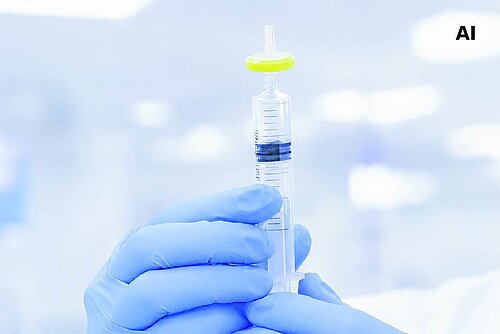
Pharmaceutical manufacturing places demanding requirements on production equipment. Machines must not only perform assembly, handling or testing processes reliably. Their design must also support cleaning, contamination control, process monitoring, documentation and validation.
However, a machine itself cannot be described as GMP-compliant independently of its application. Good Manufacturing Practice applies to the complete manufacturing process, quality system and production environment. The equipment must therefore be designed around the specific product, process, cleanroom and quality requirements defined by the manufacturer.
GMP-oriented machine design translates these requirements into an automation system that supports controlled and documented pharmaceutical production.
What Does GMP-Oriented Machine Design Mean?
GMP-oriented machine design considers how equipment can affect product quality throughout manufacturing.
This includes:
- Materials and surfaces
- Product and material flow
- Cleaning and accessibility
- Contamination risks
- Critical process parameters
- Inspection and testing
- Production data
- Maintenance and calibration
- Qualification documentation
The exact requirements depend on the application. A machine assembling a drug delivery device has different product-contact and contamination risks from equipment handling primary packaging or manufacturing sterile products.
The HAHN Automation Group develops automation solutions for regulated Life Sciences manufacturing, including assembly, testing, inspection and production systems for pharmaceutical and medical applications.
Start with Product and Process Requirements
GMP-oriented engineering begins before the machine is designed. The manufacturer should define the intended process and relevant quality requirements in the User Requirement Specification.
Important questions include:
- Which products and variants will be manufactured?
- Does the equipment contain product-contact areas?
- Which cleanroom classification applies?
- How will the machine be cleaned and disinfected?
- Which materials may be used?
- Which process parameters influence product quality?
- Which inspections and tests are required?
- Which production data must be recorded?
- Which qualification documents are needed?
- How will maintenance and calibration be performed?
These requirements provide the basis for mechanical design, control architecture, inspection technology and documentation.
A risk-based approach can then identify which machine functions have a direct or indirect influence on product quality. The objective is to prevent critical deviations through design wherever possible and to detect remaining risks through process monitoring or inspection.
Design Equipment for Effective Cleaning
Cleanability is one of the most visible aspects of GMP-oriented machine design. Production equipment should be designed so that the defined cleaning procedures can be performed consistently and effectively.
Depending on the application, relevant design principles include:
- Smooth and accessible surfaces
- Suitable and resistant construction materials
- Reduced gaps, cavities and inaccessible areas
- Minimal horizontal ledges where particles can accumulate
- Protected and structured cable routing
- Sealed machine components where required
- Removable or easily accessible format parts
- Defined cleaning access
- Compatibility with the intended cleaning agents
The appropriate solution depends on whether the equipment is cleaned manually, wiped down, disinfected or subjected to another defined cleaning procedure.
Product-contact surfaces may require additional material, surface and documentation specifications. These requirements must be defined according to the product and manufacturing process.
A compact machine is not automatically easier to operate in a cleanroom. If components, fixtures or internal surfaces cannot be accessed, the reduced footprint may make cleaning and maintenance more difficult. Space efficiency and accessibility therefore need to be considered together.
Reduce Contamination Risks Through the Machine Concept
Contamination control goes beyond selecting stainless steel surfaces. The complete production sequence influences how products, components and machine parts interact.
A GMP-oriented automation concept can reduce contamination risks through:
- Controlled component feeding
- Clear material and product paths
- Reduced manual contact
- Enclosed or protected processes
- Gentle and orientation-controlled handling
- Separation of accepted and rejected products
- Reduced intermediate handling
- Controlled use of lubricants and wear parts
- Integration into the manufacturer’s cleanroom concept
The production of medical filters demonstrates the value of reducing unnecessary process transfers. HAHN Automation Group developed an integrated manufacturing solution for 2C medical filters that combines membrane cutting, positioning and overmoulding. Consolidating the processes reduced intermediate handling and the associated contamination risk.
The machine design must also consider how components enter and leave the controlled production area. Packaging, trays, containers and rejected products should follow defined routes that support the customer’s contamination control strategy.
Integrate the Machine into the Cleanroom Environment
Cleanroom compatibility and GMP are related but not identical. An ISO cleanroom classification defines airborne particle concentration, while GMP addresses the broader control and documentation of pharmaceutical manufacturing.
Equipment intended for a cleanroom should therefore consider:
- Particle generation from moving components
- Suitable robots, drives and grippers
- Heat released into the production environment
- Effects on airflow
- Location of cabinets and utility systems
- Machine access for cleaning and maintenance
- Controlled component supply
- Space requirements and operator ergonomics
Maintenance activities should be possible without unnecessarily opening or disturbing critical production areas.
One example is the HAHN Automation Group solution for handling and inspecting transparent pharmaceutical components. The system combines precise handling and 100% inline inspection with a compact ISO 7 cleanroom footprint. Defined maintenance positions provide access to relevant machine areas without compromising the precision of the handling concept.
Monitor Quality-Critical Processes
GMP-oriented machine design should help ensure that critical processes operate within their defined limits.
Depending on the application, the automation system may monitor:
- Force and distance
- Torque and angle
- Pressure
- Temperature
- Flow rate
- Dispensing volume
- Process time
- Component position
- Electrical values
- Vision inspection results
The machine can compare these values with product-specific acceptance limits and prevent a component from continuing when a required process or inspection has not been completed successfully.
Inline inspection detects deviations close to the process where they occur. End-of-line testing confirms whether the completed product meets the defined functional requirements.
The article Automation in Pharmaceutical Device Manufacturing: Quality, Traceability and Scale-Up examines how controlled processes, automated inspection and production data support consistent pharmaceutical device manufacturing.
Connect Process Control with Traceability
Production data creates a documented relationship between the product and the processes used to manufacture it.
A traceable production record may include:
- Product or batch identification
- Component information
- Machine and station data
- Process parameters
- Inspection results
- Functional test results
- Recipe and software versions
- Production timestamps
- Rework or rejection status
The required data structure depends on the manufacturer’s quality system and intended use of the information. Interfaces with MES, ERP or quality systems should therefore be defined during the concept phase.
The same applies to user management, audit trails and electronic signatures. These functions should be implemented according to the system’s intended use and the customer’s data-integrity requirements rather than added as generic features.
Consider Maintenance and Changeovers Early
Production equipment must remain cleanable and controlled throughout its operating life. Maintenance and format changes should therefore be considered during mechanical and software design.
Relevant features include:
- Accessible maintenance components
- Defined service positions
- Replaceable wear parts
- Controlled removal and installation of format parts
- Minimal need for readjustment after maintenance
- Calibratable sensors and measuring equipment
- Documented maintenance intervals
- Recipe-controlled product changeovers
Poor accessibility can increase downtime and create risks when technical work must be performed close to the product area. A well-designed maintenance concept supports both equipment availability and controlled production.
Design the Machine to Support Qualification
Qualification requirements should not be addressed only after the equipment has been built. Design decisions, software functions and documentation structures should support the customer’s validation strategy from the beginning.
Depending on the project, the equipment supplier can support:
- Design Qualification
- Installation Qualification
- Operational Qualification
- Requirements traceability
- Design reviews
- Risk assessments
- Test plans and protocols
- Factory and Site Acceptance Tests
- Material and component documentation
- Software documentation
- Calibration records
- Operating, maintenance and cleaning instructions
Performance Qualification is typically completed within the manufacturer’s production environment and quality system. Responsibilities and required deliverables should therefore be agreed at the start of the project.
The production of insulin pens provides a practical example of phased industrialization. HAHN Automation Group supported the transition from feasibility assessment and pilot production to GMP-oriented automation for large-scale insulin pen production, including inline inspection, traceability and scalable production equipment.
Common Mistakes in GMP-Oriented Machine Design
Several issues can make pharmaceutical production equipment difficult to operate, clean or qualify:
- Considering GMP requirements too late
- Treating cleanroom compatibility as equivalent to GMP compliance
- Creating inaccessible machine areas
- Focusing on compactness at the expense of cleanability
- Defining inspection and data requirements after mechanical design
- Failing to separate product and reject flows
- Underestimating maintenance access
- Collecting data without defining its intended use
- Preparing qualification documentation only at the end of the project
Early cooperation between product development, Manufacturing Engineering, Quality Management, Validation, IT and the automation supplier helps prevent these problems.
Conclusion
GMP-oriented machine design is not defined by one material, surface or machine feature. It results from the coordinated consideration of product risks, cleanability, contamination control, process monitoring, traceability, maintenance and qualification.
The specific solution must always be based on the product, process and quality requirements of the pharmaceutical manufacturer.
When these requirements are addressed during the concept and design phases, automation equipment can support stable processes, reliable documentation and efficient qualification throughout its operating life.
Develop a GMP-Oriented Automation Concept
HAHN Automation Group develops customized assembly, inspection, testing and production systems for regulated Life Sciences manufacturing environments.
Our experts support customers in translating product, process and quality requirements into reliable automation concepts with appropriate machine design, process control and documentation.