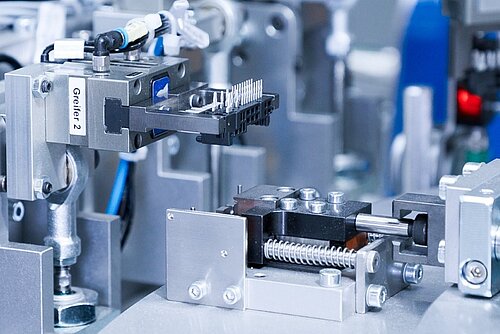
Smart meters play an important role in the digitalization of electricity, water, and gas networks. As their use expands, manufacturers must respond to higher production volumes, new communication standards, evolving regulations, and a growing number of product variants.
Future-ready production systems must therefore do more than assemble and test one predefined product. They need to adapt to new meter generations, connect production data across processes, and scale with changing demand.
Three capabilities are particularly important:
- Flexible production for different meter types and variants
- Connected systems for consistent data and traceability
- Scalable automation for changing production volumes
Together, these capabilities create a manufacturing environment that can respond to technological and market developments without requiring a completely new production line for every product change.
Why Smart Meter Manufacturing Must Become More Flexible
Smart meters combine mechanical components, sensors, printed circuit boards, firmware, communication technology, and product-specific testing. Depending on the application, production may also include flow testing, leak testing, electrical testing, or high-voltage testing.
The article How Are Smart Meters Manufactured? A Step-by-Step Production Overview explains how these processes come together within a complete manufacturing sequence.
The challenge is that smart meter designs continue to evolve. Manufacturers may need to process different:
- Meter types
- Housing geometries
- Sensor configurations
- Printed circuit board versions
- Communication modules
- Firmware packages
- Connection interfaces
- Test specifications
- Labeling and packaging formats
A production line designed exclusively for one fixed product can make these changes difficult and expensive. Future manufacturing concepts should therefore support a clearly defined range of variants through adaptable equipment, tooling, software, and testing technology.
Use Product Identification and Recipes to Manage Variants
Reliable product identification is the basis for producing several smart meter variants on the same equipment. Each meter must receive the correct components, firmware, assembly parameters, test sequence, marking, and packaging.
Identification can be based on data matrix codes, barcodes, RFID, workpiece carrier IDs, or production order data. Once the product has been identified, the system activates the corresponding production recipe.
This recipe can define:
- Required components
- Robot positions
- Fixture settings
- Joining parameters
- Firmware version
- Flashing parameters
- Test procedures
- Acceptance limits
- Label information
Recipe-controlled automation reduces manual adjustments and prevents incorrect configurations. Frequently changing parameters can be selected automatically, while occasional mechanical changes may be handled through controlled fixture or tooling replacement.
The objective is not unlimited flexibility. Manufacturers should define a realistic flexibility corridor based on expected product families, variant frequency, batch size, cycle time, and future development scenarios.
Connect Production Data Across All Processes
Flexible equipment alone is not sufficient. Future smart meter production also requires connected machines and consistent production data.
Relevant manufacturing information can include:
- Product and variant identification
- Component batches
- Firmware version
- Production recipe
- Assembly parameters
- Joining results
- Machine vision results
- Functional test values
- Leak or flow test results
- Electrical test results
- Rework status
- Packaging assignment
When this information is assigned to the individual product, manufacturers gain a complete digital production history from component loading to final inspection.
This end-to-end traceability supports quality assurance and makes root-cause analysis more efficient. If a meter fails during final testing, production teams can review the components, parameters, firmware, and results from every previous station.
New modules must use the same product identity and compatible data structures. Otherwise, expanding the physical production system may create gaps in the digital process history.
Use Process Data to Improve Quality
Connected production data can help manufacturers identify deviations before they lead to higher rejection rates or unplanned downtime.
Changes in pressing forces, screwdriving values, test results, cycle times, or camera corrections may indicate:
- Tool wear
- Component variation
- Fixture misalignment
- Calibration drift
- Feeding problems
- Unstable upstream processes
Monitoring these trends enables production and maintenance teams to react earlier.
Quality control should also be distributed throughout the manufacturing process. Inline inspections can verify component presence, orientation, assembly parameters, electrical connections, firmware flashing, and housing integrity directly after the relevant operation.
End-of-line testing remains essential for confirming the performance of the completed smart meter. However, it should not be the first stage at which assembly errors are detected.
The combination of inline process monitoring, connected quality data, and final testing creates a more robust quality strategy.
Prepare the Software Architecture for Future Products
Software is becoming as important to production flexibility as mechanical equipment.
A future-ready software architecture should support:
- Multiple products and variants
- Parameter-based process programs
- Version-controlled production recipes
- Firmware management
- Product identification
- Process data collection
- Traceability
- Test result management
- Standardized equipment interfaces
- Connections to MES or ERP systems
Only approved recipes and firmware packages should be available for production. Any changes to process parameters, test limits, or software versions should be documented and assigned to the relevant product.
The architecture must also allow additional stations and product configurations to be integrated without redesigning the entire control system. Clearly defined software and data interfaces are therefore essential for scalable production.
Scale Automation with Market Demand
Smart meter demand may change rapidly due to regulatory deadlines, infrastructure programs, regional rollouts, or new market requirements.
A scalable production concept should support several stages:
- Pilot production
- Market introduction
- Medium-volume series production
- High-volume manufacturing
- Additional product variants
- Production at further locations
The article From Pilot Production to High Volume: Scaling Smart Meter Manufacturing examines how automation levels, testing capacity, material flow, and variant management can develop across these stages.
Capacity can be increased by automating manual processes, adding stations, duplicating bottleneck operations, expanding component feeding, or installing additional production cells.
Manufacturers do not necessarily need to accelerate every process. The most efficient strategy is usually to expand capacity at the actual bottleneck, which may be assembly, firmware flashing, testing, labeling, or packaging.
Use Modular Equipment as a Foundation for Growth
Modular production systems divide the manufacturing process into clearly defined functional units. Individual modules can perform assembly, flashing, testing, inspection, marking, or packaging.
Standardized mechanical, electrical, software, and material-flow interfaces make it easier to:
- Add capacity
- Integrate new processes
- Replace individual stations
- Adapt equipment for new variants
- Connect existing machines
- Replicate proven production modules
The MasterCell automation platform provides a scalable framework for integrating robots, vision systems, test stations, feeding equipment, and application-specific processes.
Individual cells can initially operate independently and later be connected through automated handling or conveyor systems. This allows manufacturers to retain proven process modules while expanding the overall production architecture.
Plan Testing Capacity from the Beginning
Testing can become a major bottleneck when smart meter production volumes increase. Some procedures require considerably more time than mechanical assembly and may depend on specialized equipment, calibration, or controlled environmental conditions.
Depending on the meter type, testing may include:
- Flow testing
- Leak testing
- Electrical testing
- High-voltage testing
- Functional testing
- Communication testing
- Firmware verification
- Visual inspection
A scalable test concept can use parallel test positions, interchangeable adapters, configurable test sequences, and recipe-controlled acceptance limits.
Test data should use the same product identity as the assembly data. This ensures that all results remain connected to the correct meter and that traceability continues across every expansion stage.
Testing should therefore be considered during the initial production planning rather than added after the assembly system has already been defined.
Design Production Systems for Future Smart Meter Generations
No manufacturer can predict every future product change. However, production systems can be prepared for likely developments.
A future-ready architecture may include:
- Accessible and replaceable fixtures
- Flexible grippers
- Adaptable vision inspection
- Modular test interfaces
- Parameter-based software
- Expandable controls capacity
- Additional space for future stations
- Standardized product data structures
System frames, safety concepts, controls, user interfaces, and data formats can often remain standardized. Product-specific fixtures, tooling, test adapters, and recipes can then be adapted to new meter generations.
This combination creates a stable manufacturing platform while retaining the flexibility required for future products.
Flexible, Connected and Scalable Production in Practice
HAHN Automation Group develops modular automation concepts for electricity, water, and gas meter production. Depending on the product, production stage, and target output, these concepts range from manual workstations and semi-automated cells to connected high-volume manufacturing lines.
Possible integrated processes include:
- Handling of molded and hybrid components
- Sensor and electronic module assembly
- Printed circuit board handling
- Firmware flashing
- Flexible variant management
- Housing assembly
- Flow, leak, electrical, and high-voltage testing
- Machine vision inspection
- Serialization and traceability
- Final quality control
- Packaging
The case study Modular Automation Solutions for Smart Meter Manufacturing shows how flexible production concepts, integrated testing, and scalable automation can support different meter types, variants, and production volumes.
Preparing Smart Meter Manufacturing for the Future
The future of smart meter manufacturing will not be defined by one technology alone. It will result from the combination of adaptable equipment, connected data, integrated quality control, scalable automation, and qualified employees.
Flexible systems enable manufacturers to handle different variants and future product generations. Connected production creates the transparency required for traceability and continuous improvement. Modular architectures allow capacity and automation levels to grow together with demand.
As part of its focus on Transformation Technologies, HAHN Automation Group supports manufacturers in transferring innovative energy and infrastructure technologies into reliable industrial production.
Further Reading
A complete overview of the manufacturing process is available in How Are Smart Meters Manufactured? A Step-by-Step Production Overview.
The article From Pilot Production to High Volume: Scaling Smart Meter Manufacturing explains how production capacity and automation levels can grow with demand.
The case study Modular Automation Solutions for Smart Meter Manufacturing presents a practical production concept for different meter types and production volumes.
Discuss the Future of Your Smart Meter Production
Are you developing a new smart meter platform, modernizing an existing production line, or preparing for additional variants and higher volumes?
HAHN Automation Group develops flexible, connected, and scalable automation solutions tailored to your products, processes, testing requirements, and long-term production strategy.
Contact our experts to discuss how you can prepare your smart meter manufacturing for future market and technology requirements.