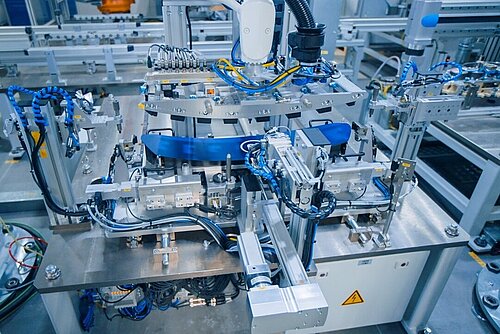
Why Larger Automotive Displays Require New Manufacturing Concepts
Automotive displays are becoming larger, more complex and increasingly integrated into modern vehicle interiors. From curved screens to panoramic and pillar-to-pillar displays, manufacturers are introducing new cockpit concepts that combine multiple functions within a single digital interface.
However, increasing display dimensions also creates significant manufacturing challenges. Larger components require more sophisticated handling, tighter assembly tolerances and greater process stability.
As explored in our previous article, Pillar-to-Pillar Displays: Engineering Challenges Behind Seamless Automotive Screens, these developments place new demands on both display engineering and production technology.
For automotive manufacturers, the challenge is clear: producing increasingly sophisticated displays while maintaining consistent quality, competitive cycle times and cost-efficient series production.
Handling, Positioning and Assembly Precision
Large automotive displays often combine sensitive glass surfaces, electronic components and complex geometries. Handling these assemblies without introducing mechanical stress or surface damage requires highly controlled processes.
Key manufacturing challenges include:
- Component handling: Safely transporting and positioning large, fragile display components
- Alignment accuracy: Maintaining precise positioning across extended assembly surfaces
- Tolerance management: Compensating for dimensional variations between components
- Adhesive application: Ensuring accurate and repeatable dispensing and joining processes
- Process repeatability: Achieving consistent assembly results across production volumes
Curved displays introduce additional complexity because their three-dimensional geometries demand precise alignment and controlled joining conditions.
Bonding processes are particularly important in this context. Our article Precision Bonding for Curved Automotive Displays explores how controlled adhesive application and component positioning contribute to optical quality and long-term durability.
Automated handling systems, precision fixtures and vision-guided positioning help manufacturers manage these challenges while minimizing the risk of component damage.
Cleanroom Assembly and Quality Assurance
As display surfaces become larger, even small particles, scratches or positioning deviations can affect the final product's appearance and functionality.
Controlled manufacturing environments are therefore essential for many high-quality automotive display applications. Depending on the display technology and assembly process, cleanroom conditions help prevent contamination during sensitive production steps.
At the same time, automated quality assurance ensures that critical assembly parameters remain within defined tolerances.
Important measures include:
- Controlled production environments to minimize particle contamination
- Automated optical inspection for surface defects and assembly deviations
- Precise gap measurement and alignment verification
- Inline monitoring of critical process parameters
- Traceability of production and quality data
Combining contamination control with automated inspection allows manufacturers to identify potential defects early and reduce the risk of costly rework.
The objective is not simply to inspect finished displays, but to establish stable, measurable quality throughout the entire assembly process.
Scaling Production Without Compromising Quality
Developing a technically advanced automotive display is only the first step. The real challenge is transferring the manufacturing concept into reliable, high-volume production.
As production volumes increase, manufacturers must balance several requirements:
- Short and consistent cycle times
- High process reliability and equipment availability
- Minimal scrap and rework
- Flexible handling of different display variants
- Consistent quality across every production cycle
Automation plays a central role in achieving these objectives.
A practical example is HAHN Automation Group's high-precision assembly solution for automotive displays.
The project demonstrates how automated assembly, precise component handling and controlled production conditions can be combined in an industrial manufacturing solution. With an approximately 33-second cycle time and an ISO 7 cleanroom environment, the application illustrates the importance of integrating productivity and quality requirements from the beginning.
For manufacturers, this integrated approach is essential to achieving scalable production without compromising the precision required by modern automotive displays.
High-Precision Automation for Large Automotive Displays
The increasing complexity of automotive displays requires manufacturing solutions that consider the entire production process rather than individual assembly steps.
From component handling and positioning to dispensing, inspection and process monitoring, each operation must work together to deliver consistent results.
HAHN Automation Group develops customized automation solutions for demanding automotive manufacturing applications. Our expertise in precision assembly, process integration and automated quality assurance helps manufacturers address the technical challenges of advanced display production.
As display technologies continue to evolve, flexible and scalable manufacturing concepts will become increasingly important. Manufacturers that combine precision engineering with reliable automation will be better positioned to introduce new display generations efficiently.
Explore our automation solutions for the mobility industry to learn more about our capabilities.
Ready to Scale Your Automotive Display Production?
Whether you are developing large-format cockpit displays, curved screens or complex display assemblies, HAHN Automation Group supports you with customized automation solutions designed for precision, quality and efficient series production.
Contact our experts to discuss your manufacturing challenges.