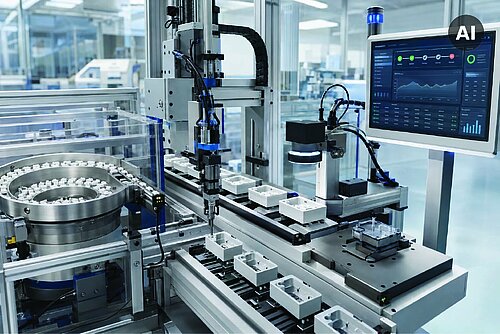
Life Sciences manufacturers must produce complex products with consistent quality while maintaining transparent and well-documented manufacturing processes. Whether the product is a surgical device, diagnostic consumable, drug delivery system or laboratory component, manufacturers need reliable information about how, when and under which conditions it was produced.
This requires more than adding a code to the finished product. Effective traceability connects component information, process parameters, inspection results and test data across the complete manufacturing process.
The result is a digital production record that helps manufacturers understand the history of an individual product, batch or subassembly. When correctly integrated into the production concept, traceability supports quality assurance, deviation analysis and continuous process improvement.
Why Traceability Matters in Life Sciences Manufacturing
Life Sciences products are manufactured in quality-critical and often highly regulated environments. Manufacturers must be able to demonstrate that defined processes were followed and that products met their specified quality requirements.
Depending on the product and manufacturing environment, traceability may support:
- Product and patient safety
- Quality documentation
- Batch and component tracking
- Deviation investigations
- Process verification
- Complaint analysis
- Targeted containment or recall activities
- Continuous process improvement
- Manufacturing transparency
Traceability requirements differ between Medical Devices, Diagnostics, Pharmaceuticals & Biopharma and Lab Automation. The underlying principle, however, remains the same: relevant production information must be captured, linked and made available for its intended purpose.
HAHN Automation Group supports manufacturers across these markets with automation solutions for assembly, testing, inspection and production. Discover our automation expertise for Life Sciences manufacturing.
What Does Manufacturing Traceability Actually Mean?
Traceability is sometimes treated as another term for product marking. However, marking and traceability are not the same.
A barcode, Data Matrix Code, QR code, serial number or RFID tag gives a component or product a unique identity. This identifier makes it possible to connect the physical product with its digital information.
The code itself does not contain the complete manufacturing history. It provides the key through which the relevant data can be retrieved.
A comprehensive traceability concept may answer questions such as:
- Which components were used?
- Which material batches were processed?
- When and where was the product manufactured?
- Which machine and station performed each process?
- Which recipe or software version was active?
- Were all process parameters within their defined limits?
- Which inspections and tests were completed?
- What were the measurement results?
- Was the product accepted, reworked or rejected?
- Which subassemblies belong to the final product?
Traceability therefore extends from physical identification to the structured connection of all relevant manufacturing data.
The Different Levels of Manufacturing Traceability
A complete production record is built from several interconnected levels. The required depth depends on the product, applicable quality requirements and the manufacturer’s production strategy.
Component Traceability
Component traceability documents the materials and parts used to manufacture a product.
Relevant information may include:
- Supplier information
- Component number
- Material batch
- Lot number
- Cavity number
- Expiration date
- Incoming inspection status
- Storage or handling conditions
- Component serial number
This level is particularly important when the quality of the finished product depends on specific materials, purchased components or injection-molded parts.
If a deviation is later associated with a particular batch or cavity, component traceability can help identify which finished products may be affected.
Process Traceability
Process traceability records how the product moved through production and which manufacturing operations were completed.
Typical information includes:
- Machine and station identification
- Process sequence
- Date and time
- Active product recipe
- Tool or fixture identification
- Operator identification where required
- Process status
- Cycle result
- Rework information
- Equipment or software version
The production system should determine whether all required process steps were completed in the correct sequence. This helps prevent products from bypassing critical assembly, inspection or testing operations.
Process Parameter Traceability
For quality-critical operations, a simple pass or fail result may not provide enough information. Manufacturers may also need to record the values that determined the outcome.
Depending on the process, these values may include:
- Force and distance
- Torque and angle
- Pressure
- Temperature
- Dispensing volume
- Flow rate
- Welding energy
- Laser parameters
- Process time
- Positioning data
Recording selected parameters makes the manufacturing process more transparent and supports later analysis. The objective is not to save every available machine signal. Manufacturers should identify which data is relevant to product quality, process control and documentation requirements.
Inspection and Test Traceability
Inspection and testing confirm whether a component, subassembly or finished product meets defined requirements.
A traceable quality record may contain:
- Vision inspection results
- Presence and orientation checks
- Dimensional measurements
- Surface inspection results
- Leak or pressure test values
- Electrical test results
- Functional test data
- Calibration status
- Acceptance limits
- Final test status
Instead of documenting only the final result, manufacturers can retain the relevant measurement values and link them to the individual product or batch.
Product Genealogy
Product genealogy describes the relationship between the finished product and all components or subassemblies used to manufacture it.
For a complex medical device, the production record may connect:
- The final serial number
- Individual component batches
- Preassembled modules
- Electronics
- Software or firmware versions
- Test results
- Packaging information
This structure makes it possible to trace a finished product back to its constituent parts. It can also support forward tracing by identifying all products containing a particular component or material batch.
How Products Are Identified During Production
A reliable identification concept is the foundation for digital traceability. The selected method must be suitable for the product, process and manufacturing environment.
Common identification technologies include:
Data Matrix Codes
Data Matrix Codes can store information within a compact area and are frequently used for the identification of small components and products.
QR Codes
QR codes enable optical identification and can be applied to products, labels or packaging. Their suitability depends on the available marking area, material and required code quality.
Barcodes
Linear barcodes remain relevant for components, batches, containers and packaging where sufficient space is available.
Serial Numbers
A serial number provides an individual identity for a specific product. It can be applied as readable text, encoded within a machine-readable code or stored on an electronic carrier.
RFID
RFID enables contactless reading and writing. Depending on the application, data can be accessed without direct visual contact between the reader and the product.
Laser Marking
Laser marking creates permanent product identification without applying a separate label. The material, surface, marking contrast and product geometry must be considered when developing the process.
For example, HAHN Automation Group developed a flexible laser marker for medical stapler cartridges. The semi-automated system marks refillable cartridges of different sizes with unique QR codes and serial numbers, supporting device tracking and quality control.
This example also illustrates an important distinction: the marking establishes the identity of the cartridge. End-to-end traceability is created when that identity is connected with the relevant product, process and quality information.
From Individual Data Points to a Complete Production Record
Modern production systems generate information at many different stations. A vision system verifies component orientation, a press records force and distance, a test station measures product performance and a laser applies a batch or serial number.
If these results remain isolated, they provide only a fragmented view of production. A complete production record connects them through a consistent product identifier.
A typical data flow may include:
- A component or workpiece carrier is identified.
- The production system loads the correct product recipe.
- Each station confirms that the expected product has arrived.
- Assembly parameters are recorded.
- Vision systems document inspection results.
- Test stations generate measurement data.
- The system evaluates the results against defined limits.
- The completed product receives its final identification.
- All relevant data is consolidated into one production record.
- The product is released, reworked or rejected according to the defined process.
The Medical Device Assembly & Test System demonstrates how these elements can be combined in a semi-automated production environment. Machine vision verifies components and their orientation throughout assembly. Controlled pressing, dimensional inspection, functional testing and electrical testing are integrated into the process. Accepted devices are subsequently batch-numbered by laser.
The example shows that comprehensive production data does not require every manufacturing step to be fully automated. Manual operations can also be integrated when products, components and process results are identified and controlled consistently.
What Information Can a Digital Production Record Contain?
The content of a production record should be based on product requirements, process risks and the intended use of the data.
Depending on the application, it may contain:
- Product type and variant
- Serial or batch number
- Component and material information
- Supplier and lot data
- Cavity information
- Machine and station identification
- Active recipe
- Software and parameter-set versions
- Tool and fixture information
- Operator identification
- Production date and timestamps
- Assembly parameters
- Inspection results
- Measurement values
- Functional test results
- Calibration information
- Rework history
- Acceptance or rejection status
- Packaging and label information
Collecting more data does not automatically create better traceability. An effective concept defines which information is critical, how it is structured and how long it must remain available.
Connecting Automation with MES, ERP and Quality Systems
Production machines are rarely the only systems involved in traceability. Relevant information may also originate from or be transferred to higher-level systems.
These can include:
- Manufacturing Execution Systems
- Enterprise Resource Planning systems
- Quality Management Systems
- Laboratory Information Management Systems
- Production databases
- Serialization platforms
- Maintenance systems
A Manufacturing Execution System can assign production orders, manage product recipes and collect machine data. An ERP system may provide order, material and batch information. A quality system can manage inspection requirements, deviations and approvals.
The automation system connects the physical production process with this digital environment. It identifies products, executes the defined sequence, captures process results and communicates the relevant data through agreed interfaces.
The architecture must clearly define:
- Which system owns each data record?
- Where is the master data maintained?
- Which identifiers are used?
- How are products and orders assigned?
- Which data is exchanged with each machine?
- What happens if the network connection is interrupted?
- How are duplicate or incomplete records prevented?
- Who can access or change the data?
- How are system and recipe changes documented?
These questions should be addressed during the production concept phase. Retrofitting interfaces and data structures after equipment has been commissioned can be significantly more complex.
Traceability in Manual, Semi-Automated and Fully Automated Production
Traceability is not limited to high-volume, fully automated production lines. The same principles can be applied at different automation levels.
Manual Production
In manual production, traceability may be supported through:
- Scanning components and work orders
- Digital work instructions
- Operator authentication
- Guided assembly sequences
- Manual confirmation of process steps
- Connected measuring equipment
- Electronic inspection records
The main challenge is preventing incorrect or incomplete input. Wherever possible, data should be acquired automatically from scanners, tools or test equipment.
Semi-Automated Production
Semi-automated systems combine manual handling or assembly with automated inspection, joining or testing.
Traceability can help verify that:
- The correct components were loaded
- The product is in the correct fixture
- All required steps were completed
- Automated process results meet the limits
- Rejected products cannot continue unnoticed
- Manual and automated operations belong to the same record
This approach is particularly useful during product launch, at moderate volumes or when certain processes cannot be fully automated economically.
Fully Automated Production
In fully automated production, products can be tracked continuously through work piece carriers, direct part marking or digital station records.
The system can automatically:
- Identify each product
- Select the correct recipe
- Record process parameters
- Link inspection and test results
- Control production routing
- Prevent incorrect processing
- Manage rejected products
- Transfer production records to higher-level systems
The appropriate solution depends on the product, volume, risk profile and required data depth rather than on the highest possible automation level.
How Traceability Supports Quality and Continuous Improvement
Traceability provides more than documentation. Structured production data can help manufacturers understand and improve their processes.
Faster Deviation Analysis
If a problem occurs, manufacturers can review the relevant component, process and test records. This can help narrow down when and where the deviation originated.
Targeted Product Containment
Product genealogy makes it possible to identify products that share a particular batch, component, machine setting or production period. This can support more focused containment decisions.
Process Comparison
Manufacturers can compare results between:
- Machines
- Production lines
- Tools and cavities
- Shifts
- Product variants
- Material batches
- Sites
These comparisons may reveal patterns that would remain hidden when only final pass or fail results are considered.
Early Trend Detection
Process values can change gradually while still remaining within their defined limits. Monitoring trends can help manufacturers identify drift before it results in a quality issue.
Data-Driven Process Optimization
Connected production records allow engineering and quality teams to investigate relationships between materials, process settings and product performance. This supports more informed optimization decisions.
Common Challenges When Implementing Traceability
The technical collection of data is only one part of a traceability strategy. Manufacturers also need consistent processes and clearly defined responsibilities.
Isolated Data Systems
Different machines may store information in separate formats or local databases. Without a common identifier, connecting those records later can be difficult.
Inconsistent Product Identification
Traceability breaks down when the same product is identified differently across machines, production lines or IT systems.
Missing Manual Process Data
Manual assembly, inspection and rework activities must be considered alongside automated operations. Otherwise, gaps remain in the production history.
Unclear Data Requirements
Collecting every available machine value can create large volumes of data without a clear benefit. Manufacturers should define which values are needed and why.
Legacy Equipment
Existing machines may not provide modern communication interfaces or structured data. Retrofitting sensors, scanners or software interfaces requires a careful assessment of the equipment and process.
Variant and Recipe Management
As product variants increase, recipes and parameter sets must be assigned reliably. Changes should be controlled so that the production record shows which version was used.
Data Integrity and Availability
Traceability data must remain complete, consistent and retrievable. The system architecture should address storage, access rights, backups, network interruptions and long-term availability according to the manufacturer’s requirements.
Building Traceability into the Production Concept
Traceability should not be added at the end of an automation project. It affects product identification, material flow, machine controls, test equipment, software architecture and interfaces.
Manufacturers should define the following requirements early:
- Required tracking level
- Product, batch and component identifiers
- Critical process parameters
- Inspection and test data
- Product genealogy requirements
- Manual process integration
- Rework and reject handling
- System interfaces
- Data ownership
- User roles and access rights
- Reporting requirements
- Data retention and retrieval
- Future product and capacity changes
Early collaboration between product development, Manufacturing Engineering, Quality Management, IT and automation specialists helps ensure that the traceability concept supports both the product and the production process.
Conclusion
Traceability in Life Sciences manufacturing extends far beyond marking a finished product. It creates a connected manufacturing history that begins with components and materials and continues through assembly, inspection, testing and final product identification.
A complete production record can connect:
- Component and batch information
- Production sequences
- Critical process parameters
- Inspection results
- Functional test data
- Product genealogy
- Acceptance and rework decisions
When these elements are integrated consistently, manufacturers gain greater transparency across their production processes. They can investigate deviations more efficiently, identify affected products more precisely and use manufacturing data to support continuous improvement.
The objective is not to collect as much information as possible. It is to create a reliable data structure that captures the information required to understand and document how each product was manufactured.
Further Reading
The article Endoscope Manufacturing Automation: Challenges, Technologies and Best Practices explores how precision assembly, product genealogy, inspection and scalable automation come together in the production of complex medical devices.
For a closer look at connected production, real-time monitoring and digital quality documentation, read The Future of High-Volume COC Syringe Production: Smart Manufacturing and Industry 4.0.
Build Traceability into Your Life Sciences Production
HAHN Automation Group supports Life Sciences manufacturers with customized solutions for assembly, testing, inspection, product identification and production data integration.
Whether you are developing a new product, expanding an existing production line or connecting previously isolated manufacturing processes, our experts can help you develop a traceability concept tailored to your product, quality and production requirements.