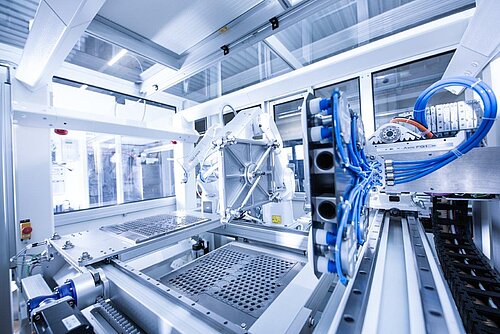
The pharmaceutical industry is changing rapidly. Biologics, personalized medicine, vaccines, and advanced injectable therapies are driving the demand for highly reliable drug delivery systems. At the same time, manufacturers are facing increasing pressure to improve scalability, product quality, and manufacturing efficiency.
One technology gaining significant momentum in this environment is the use of cyclic olefin copolymer (COC) syringes.
COC syringe systems are increasingly replacing conventional glass solutions in many pharmaceutical applications. Their material properties make them particularly suitable for sensitive biologics and advanced drug delivery devices. However, manufacturing these systems at industrial scale requires far more than material expertise alone.
Modern COC syringe production combines:
- precision injection molding
- automated assembly
- cleanroom manufacturing
- intelligent handling systems
- automated inspection
- digital process monitoring
- traceable quality control
This article explores the most important aspects of COC syringe manufacturing — from material advantages and production challenges to automation technologies and future smart manufacturing trends.
Why COC Syringes Are Becoming More Important
Traditional glass syringes have been used for decades in pharmaceutical applications. However, the increasing complexity of injectable therapies is driving demand for alternative materials with improved performance characteristics.
COC materials offer several important advantages:
- high transparency
- low moisture absorption
- excellent dimensional stability
- strong chemical resistance
- reduced breakage risk
- low extractables and leachables
- compatibility with sensitive biologics
These properties make COC syringes highly attractive for:
- biologics
- vaccines
- ophthalmic drugs
- personalized medicine
- self-administration systems
- autoinjectors
- wearable drug delivery devices
As pharmaceutical products become more sensitive and patient-centric therapies continue to grow, COC syringe platforms are becoming increasingly relevant across the healthcare industry.
Our first article on why COC syringes are transforming modern drug delivery explains the material and market drivers behind this development in more detail.
The Role of Precision Injection Molding
High-quality COC syringe production begins with precision manufacturing of polymer components.
Because syringe systems require extremely tight tolerances, even small dimensional deviations can affect:
- sealing performance
- dosing accuracy
- assembly stability
- functionality
- product safety
This makes precision injection molding a critical process step in pharmaceutical syringe manufacturing.
Modern injection molding systems for medical and pharmaceutical applications must support:
- repeatable part quality
- cleanroom compatibility
- stable cycle times
- minimal particle generation
- traceable process control
The combination of material behavior, mold precision, and process stability is essential for producing reliable syringe components at industrial scale.
Why Automation Is Essential in COC Syringe Manufacturing
Manufacturing COC syringes involves much more than molding individual components. High-volume pharmaceutical production requires stable and highly repeatable assembly processes.
Automated production systems help manufacturers achieve:
- consistent product quality
- scalable production capacity
- reduced contamination risks
- high process repeatability
- traceable manufacturing data
Modern automated assembly solutions for medical technology support the precise integration of sensitive syringe components while maintaining pharmaceutical quality requirements.
Automation is particularly important because COC syringe systems often include highly sensitive assemblies where small process deviations can impact product performance.
Handling Transparent and Sensitive Components
One of the most challenging aspects of COC syringe production is the handling of transparent polymer components.
Unlike opaque materials, transparent components can be more difficult to detect, orient, and inspect during high-speed manufacturing processes.
At the same time, manufacturers must avoid:
- scratches
- particles
- contamination
- surface damage
- mechanical stress
Highly precise handling systems help manufacturers move sensitive components safely and repeatably throughout the production process.
Advanced robotic handling solutions support:
- precise positioning
- controlled transport
- gentle component interaction
- stable cleanroom processes
Especially in pharmaceutical manufacturing environments, stable handling is essential for maintaining consistent product quality.
Inspection and Quality Control for COC Syringes
Quality assurance is one of the most important elements of pharmaceutical manufacturing.
Because COC syringes are highly transparent, manufacturers require advanced inspection technologies capable of detecting:
- scratches
- particles
- molding defects
- contamination
- assembly deviations
- cosmetic defects
Modern testing technologies help manufacturers ensure stable product quality while reducing manual inspection effort.
Machine vision systems are becoming increasingly important for pharmaceutical inspection processes. Especially in high-speed production environments, automated vision inspection systems can improve both inspection accuracy and process reliability.
AI-supported inspection technologies also enable faster defect detection and more data-driven quality assurance strategies.
Smart Manufacturing and Industry 4.0
Pharmaceutical manufacturing is becoming increasingly digital.
Manufacturers are integrating automation systems with:
- real-time process monitoring
- traceability platforms
- AI-supported analytics
- predictive maintenance
- connected manufacturing systems
These technologies improve:
- process transparency
- equipment utilization
- production efficiency
- root-cause analysis
- validation processes
Modern Industry 4.0 solutions enable pharmaceutical manufacturers to connect machines, production data, and inspection systems across the entire manufacturing environment.
In parallel, technologies such as the digital twin are helping manufacturers simulate production processes before commissioning begins, reducing ramp-up risks and improving process optimization.
Automation Challenges in COC Syringe Manufacturing
Although automation provides significant benefits, manufacturing COC syringes remains technically demanding.
Key challenges include:
- handling transparent materials
- maintaining assembly precision
- ensuring contamination control
- achieving stable high-speed production
- reliable inline inspection
- regulatory compliance
- traceability requirements
Our second article on automation challenges in COC syringe manufacturing explores these production challenges and potential solutions in greater detail.
Future Trends in Pharmaceutical Syringe Production
The demand for injectable therapies and biologics is expected to continue growing significantly over the coming years.
As a result, manufacturers will increasingly focus on:
- flexible manufacturing systems
- scalable automation
- AI-supported inspection
- sustainable production
- connected quality systems
- predictive process optimization
Future production environments will likely combine:
- advanced robotics
- machine learning
- smart inspection systems
- real-time analytics
- fully connected manufacturing platforms
These technologies will help manufacturers respond faster to changing market demands while improving efficiency and product quality.
Our upcoming article on smart manufacturing for COC syringe production will explore these future developments in more detail.
Conclusion
COC syringes are becoming an increasingly important part of modern pharmaceutical manufacturing and advanced drug delivery systems.
Their material advantages make them highly attractive for biologics, injectable therapies, and patient-centric healthcare applications. At the same time, manufacturing these systems at industrial scale requires sophisticated automation, stable handling processes, intelligent inspection systems, and connected quality control.
By combining expertise in injection molding, automated assembly, handling technologies, testing systems, and Industry 4.0 solutions, manufacturers can build scalable and future-ready production environments for the next generation of pharmaceutical devices.
Looking for scalable automation solutions for pharmaceutical manufacturing?
Discover how HAHN Automation Group supports manufacturers with automation, inspection, and assembly solutions for modern drug delivery systems and COC syringe production: