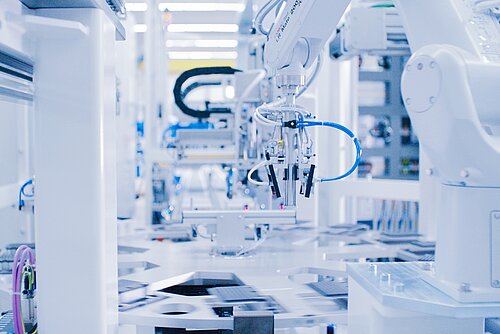
Modern medical devices are becoming smaller, more complex and increasingly sophisticated. Surgical instruments, diagnostic products, drug delivery devices, wearable systems and implantable devices can combine precision-moulded parts, metals, electronics, sensors, adhesives, wires and flexible tubes within a single product.
This complexity creates demanding manufacturing requirements. Components must be handled without damage, assembled within tight tolerances and inspected throughout production. At the same time, manufacturers need to manage product variants, meet documentation requirements and increase capacity as demand grows.
Automation can help address these challenges, but only when the production concept is designed around the product, process and quality requirements. The appropriate solution may range from a guided manual workstation to a fully automated high-volume production line.
HAHN Automation Group develops automation solutions for modern medical device manufacturing, including assembly, inspection, testing and traceability systems for regulated Life Sciences production environments.
Increasing Product Complexity and Miniaturization
Many modern medical devices contain components that are difficult to feed, position and assemble.
Typical challenges include:
- Very small components
- Tight dimensional tolerances
- Thin wires and flexible tubes
- Delicate plastic or optical parts
- Multiple materials within one assembly
- Complex component geometries
- Restricted access for grippers and tools
- Sensitive electronic elements
Even minor handling or positioning deviations can affect the functionality of the finished device. A flexible tube may deform during feeding, a miniature component may rotate inside a gripper or a sensitive plastic part may be damaged by excessive force.
These risks increase as products become smaller. The automation system must still identify each component, determine its orientation and place it accurately within the available cycle time.
The production of single-use endoscopes demonstrates these requirements. HAHN Automation Group developed a concept for the automated production of miniaturized medical devices that handles wires with diameters between 0.2 and 0.4 millimetres as well as precision components measuring approximately 1 by 0.6 millimetres.
The solution combines automated wire feeding, laser cutting, flexible part feeding, vision-guided handling and monitored joining processes. This example shows why miniaturization must be considered across the complete production sequence rather than at one assembly station alone.
Reliable Component Feeding and Handling
A production process cannot operate reliably if components do not arrive at the assembly station in the correct orientation and condition.
Conventional feeding methods may not be suitable for components that are:
- Flexible
- Transparent
- Easily scratched
- Difficult to separate
- Geometrically unstable
- Available in several variants
- Supplied in protective trays
The feeding concept must match the component geometry, material, packaging and required output. Depending on the application, components may be supplied through trays, reels, containers, flexible feeders or dedicated feeding systems.
Machine vision can identify the position and orientation of randomly arranged parts. A robot can then adapt its movement to the detected component instead of relying on a fixed mechanical orientation.
The gripper also requires product-specific engineering. It must hold the component securely without deforming, contaminating or damaging it. Vacuum, mechanical or adaptive gripping principles can be used depending on the part.
Manufacturers should therefore consider automated handling during product development. Clear positioning features, accessible gripping surfaces and robust component geometry can significantly reduce the complexity of the future production equipment.
Controlling Complex Assembly Processes
Medical device assembly frequently combines several joining and processing technologies within one production system.
These may include:
- Pressing
- Screwdriving
- Adhesive dispensing
- Welding
- Laser processing
- Coating
- Cutting
- Crimping
- Component insertion
A successful cycle does not automatically confirm that the process was completed correctly. Quality-critical operations should therefore be monitored through relevant process parameters.
A pressing process can record force and distance. A screwdriving operation may monitor torque and angle. Dispensing equipment can control the applied volume, position and process time.
The production system can compare these values with predefined acceptance limits. If a result falls outside the permitted process window, the product can be stopped or transferred to a controlled rejection path.
This approach helps detect deviations close to the operation where they originate. It also creates a more complete quality record than a final pass-or-fail result alone.
Quality Control Beyond Visual Inspection
A completed medical device can appear correct while still containing a functional or assembly-related defect. Quality assurance therefore requires a combination of inspection, process monitoring and functional testing.
Automated inspection can verify:
- Component presence
- Correct orientation
- Assembly completeness
- Critical dimensions
- Surface defects
- Connector positions
- Adhesive application
- Marking quality
- Product identification
Functional testing then determines whether the assembled product performs according to the defined requirements.
Depending on the device, testing may include:
- Force measurement
- Electrical testing
- Leakage testing
- Pressure and flow testing
- Sensor verification
- Movement and position testing
- Communication checks
- Calibration
The HAHN Automation Group’s integrated medical device assembly and testing system illustrates how these elements can be combined within a semi-automated production line.
Machine vision verifies that the correct components have been loaded and checks their orientation. Controlled pressing and dimensional inspection are followed by mechanical and electrical functional testing. Accepted devices are subsequently laser marked with a batch number.
The example also demonstrates that reliable quality assurance does not always require full automation. Manual operations can remain part of the process when they are supported by suitable fixtures, guided sequences and automatic verification.
Cleanroom and Contamination Requirements
Many medical devices are manufactured in controlled environments. Production equipment must therefore be compatible with the required cleanroom and contamination control concept.
Relevant considerations include:
- Particle generation from machine components
- Suitable surfaces and construction materials
- Controlled component and product paths
- Reduced manual handling
- Accessible machine areas
- Defined cleaning procedures
- Separation of accepted and rejected products
- Cleanroom-compatible drives, robots and grippers
- Controlled material transfer
Cleanroom compatibility must be considered together with machine accessibility. A compact system saves valuable production space, but cleaning and maintenance must remain practical.
The required solution depends on the product and process. Equipment for assembling an implantable device may require a different cleanliness concept from a machine producing an external diagnostic component.
An ISO cleanroom classification also does not independently confirm compliance with all regulatory requirements. The complete manufacturing process must be evaluated within the manufacturer’s quality system and intended production environment.
Traceability Across the Manufacturing Process
Modern medical device manufacturers need more than a record confirming that the finished product passed its final test. They may need to understand how the product was manufactured and which components, processes and test results belong to it.
A traceable production record can contain:
- Product and variant identification
- Serial or batch numbers
- Component and material batches
- Machine and station information
- Process parameters
- Inspection results
- Functional test data
- Recipe and software versions
- Production timestamps
- Rework and rejection information
Product identification can be established through serial numbers, Data Matrix codes, QR codes, barcodes or RFID technology. The selected identifier connects the physical product with its digital manufacturing history.
The article Traceability in Life Sciences Manufacturing: From Components to Complete Production Records explains how component information, process data, inspection results and product genealogy can be combined.
Data should not be collected without a defined purpose. Manufacturers should determine which information is required for product quality, process control, documentation and later analysis.
Managing Multiple Product Variants
Medical devices are frequently manufactured in different sizes, configurations or regional versions. New variants may also be introduced during the operating life of the production system.
Variant diversity can affect:
- Component feeding
- Grippers and fixtures
- Assembly parameters
- Inspection programs
- Test sequences
- Software and recipes
- Product marking
- Packaging
A flexible production concept can use product identification and recipe-controlled processes to select the correct settings automatically. Adaptable grippers, flexible feeding systems and replaceable tooling can reduce the effort required for product changeovers.
However, maximum flexibility is not always the best solution. Supporting every possible future product can increase equipment complexity, validation effort and investment costs.
Manufacturers should instead identify which product characteristics are likely to change and design the required level of flexibility around realistic scenarios.
The flexible production of implantable medical devices provides a relevant example. The automated system handles more than 30 product formats in an ISO 7 cleanroom environment. Flexible feeding, robotics and intelligent transport enable rapid format changes without extensive mechanical conversions.
Scaling Production Without Losing Quality
A manufacturing process that works for product development or initial market introduction may not support higher production volumes.
Early production frequently depends on manual assembly and the experience of individual operators. This provides flexibility, but growing volumes can increase variation, documentation effort and ergonomic challenges.
Manufacturers must determine which processes should remain manual and which operations benefit from automation.
Automation may be particularly valuable when a process:
- Requires high positioning accuracy
- Involves repetitive manual handling
- Limits the current output
- Creates ergonomic risks
- Requires consistent parameter monitoring
- Includes repetitive inspection tasks
- Depends heavily on operator experience
A phased approach can begin with guided manual or semi-automated workstations. Quality-critical joining, inspection or testing processes can be automated first. Additional stations and automated material handling can then be introduced as the product and demand mature.
Testing capacity must scale alongside assembly. A faster assembly process does not increase total output if functional testing, software configuration or packaging becomes the new bottleneck.
Validation-Oriented Production Concepts
Medical device production systems should be developed with documentation and validation requirements in mind.
Depending on the application and customer requirements, this may include:
- Clearly defined user requirements
- Documented functional specifications
- Risk-based design decisions
- Requirements traceability
- Test plans and protocols
- Calibration concepts
- Software documentation
- Factory and Site Acceptance Tests
- Support for qualification activities
Considering these requirements early creates a clear relationship between product requirements, machine functions and test results. It also reduces the risk of extensive changes during commissioning or qualification.
The exact responsibilities for qualification and validation must be agreed between the manufacturer and equipment supplier. The medical device manufacturer remains responsible for the validated production process within its quality system.
Conclusion
Modern medical device production must manage increasing product complexity, miniaturized components, demanding assembly processes, strict quality controls and growing traceability requirements.
At the same time, production equipment must support clean manufacturing environments, changing product variants and increasing output.
Automation helps manufacturers address these challenges through precise handling, monitored assembly, inline inspection, functional testing and structured production data. The appropriate automation level depends on the product, process maturity, required volume and quality strategy.
Successful production concepts consider these factors from the beginning. Close cooperation between product development, Manufacturing Engineering, Quality Management and automation specialists helps transform complex medical device designs into stable and scalable manufacturing processes.
Automate Your Medical Device Production
HAHN Automation Group develops customized production solutions for the assembly, inspection and testing of modern medical devices.
Whether you are introducing a new product, replacing operator-dependent processes or scaling an existing production line, our experts support the development of reliable automation concepts tailored to your product and quality requirements.