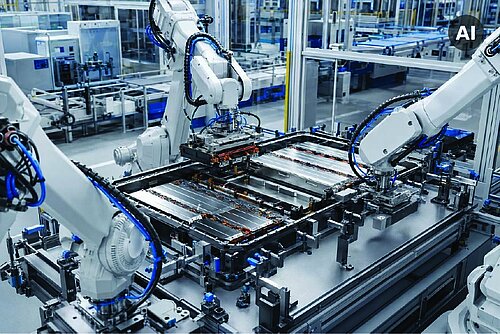
As electric vehicle adoption continues to accelerate, battery recycling is becoming a critical part of the circular economy. Recovering valuable materials from end-of-life lithium-ion batteries begins with one of the most complex steps in the entire recycling process: battery disassembly.
Unlike conventional manufacturing processes, battery disassembly must deal with products that vary significantly in design, condition, and chemistry. At the same time, recycling facilities must meet strict safety requirements while maintaining high throughput and consistent process quality.
Automation is helping address these challenges by enabling safer, more flexible, and more efficient battery disassembly processes.
Why Battery Disassembly Is Challenging
Battery packs are designed for durability, performance, and safety during operation—not for easy disassembly at the end of their life.
Manufacturers use different:
- Battery pack architectures
- Cell formats
- Fastening concepts
- Cooling systems
- Electrical connections
As a result, recycling facilities must process a wide variety of battery designs without standardized procedures.
This diversity makes battery disassembly one of the most demanding applications in industrial automation.
Challenge 1: Battery Design Diversity
Every battery manufacturer follows its own design philosophy.
Differences in housing geometry, module layout, connection technologies, and joining methods require automation systems that can adapt to multiple product variants.
Instead of highly specialized equipment, future recycling facilities increasingly rely on modular and flexible automation concepts that can evolve alongside battery technologies.
Learn more about this approach in How Modular Automation Systems Are Designed.
Challenge 2: High-Voltage Safety
Even batteries that have reached the end of their service life may still contain hazardous residual energy.
Potential risks include:
- High-voltage exposure
- Electrical short circuits
- Thermal runaway
- Fire hazards
- Damaged battery cells
Automated handling reduces direct operator exposure and enables controlled, repeatable processes that improve overall plant safety.
Challenge 3: Unknown Battery Condition
Recycling facilities rarely receive batteries in identical condition.
Some battery packs arrive intact, while others may be damaged during vehicle accidents, transportation, or storage.
Automation systems therefore require intelligent inspection capabilities to evaluate battery condition before disassembly begins.
Machine vision and sensor technologies help identify damaged batteries and determine the safest processing strategy.
Challenge 4: Flexible Robotic Disassembly
Unlike conventional production lines, recycling systems cannot assume that every product follows identical assembly sequences.
Robots must adapt to:
- Different screw locations
- Various housing designs
- Changing module configurations
- Different battery sizes
This requires advanced programming strategies, flexible tooling, and intelligent process control.
Challenge 5: Throughput Without Compromising Safety
Battery recycling capacity must increase significantly over the coming years.
At the same time, safety requirements remain the highest priority.
Automation enables recycling facilities to combine:
- Higher productivity
- Repeatable processes
- Improved worker safety
- Consistent quality
- Reduced manual intervention
Finding the right balance between throughput and safe battery handling is one of the industry's biggest engineering challenges.
Challenge 6: Traceability and Documentation
Future battery recycling will require complete documentation of every processing step.
Automation systems support digital traceability by recording:
- Battery identification
- Process parameters
- Material flow
- Quality data
- Processing history
These digital records improve transparency while helping companies comply with evolving regulations.
DemoRec: Developing Automated Battery Disassembly Solutions
Innovation in battery recycling depends on close collaboration between industry and research partners.
Through the DemoRec Project, HAHN Automation Group contributed to the development of automation concepts for battery disassembly and recycling.
The project demonstrates how robotics, intelligent handling, and flexible automation technologies can help industrialize battery recycling processes while improving safety and efficiency.
Looking Ahead
Automated battery disassembly will become increasingly important as battery volumes continue to grow worldwide.
Future recycling facilities must be capable of handling greater product diversity while maintaining high safety standards, efficient material recovery, and economically viable operations.
Automation provides the flexibility and precision needed to meet these requirements and will remain a key technology for the future of battery recycling.
Further Reading
Continue exploring battery recycling automation:
- Battery Recycling Automation: Technologies, Challenges and Future Trends
- Battery Recycling Process Explained: From Battery Pack to Recovered Materials
- How Battery Recycling Automation Supports the Circular Economy
Ready to Develop the Next Generation of Battery Recycling?
Whether you are planning automated battery disassembly, scaling recycling capacity, or developing new recycling technologies, HAHN Automation Group supports innovative automation solutions for the future of battery recycling.
Contact our experts to discuss your battery recycling application.