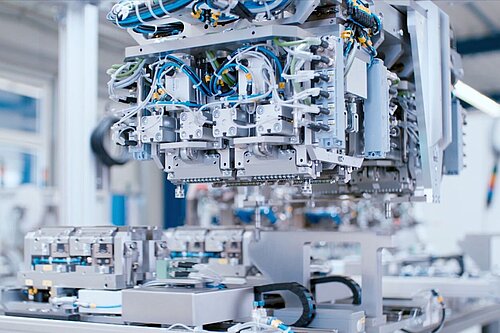
Why Scaling Production Is More Complex Than Increasing Output
Scaling from prototype production to high-volume manufacturing is one of the most challenging phases in industrial production.
A process that performs well in small batches often behaves very differently under full production conditions. Cycle times become critical, manual workarounds stop scaling, and even small process variations can lead to significant quality issues.
For manufacturers in industries such as MedTech, Automotive, Electronics, Diagnostics, and Drug Delivery, successful scale-up requires more than simply increasing output. It requires a production strategy capable of maintaining quality, traceability, and process stability at every stage of growth.
This article explores the most important factors manufacturers should consider when transitioning from prototype manufacturing to scalable high-volume production.
1. Standardize Processes Early
One of the most common scaling mistakes is delaying process standardization for too long.
Prototype environments often rely on:
- Manual adjustments
- Operator expertise
- Temporary tooling
Flexible workflows
Manufacturers should define standardized:
- Process parameters
- Inspection criteria
- Material handling concepts
- Validation procedures
- Data collection methods
as early as possible.
2. Design for Manufacturability — Not Only for Functionality
Products developed in prototype phases are often optimized primarily for functionality.
But a product that works technically is not automatically suitable for scalable manufacturing.
Engineering teams should work closely with manufacturing experts early in development to avoid later redesigns that increase cost and delay ramp-up timelines.
The importance of scalable product and process design can also be seen in emerging technologies such as LiDAR Manufacturing Challenges.
3. Integrate Quality Control Directly Into Production
Quality control can no longer remain a separate downstream activity once production scales.
In high-volume environments, manufacturers increasingly rely on:
- Inline inspection
- Automated vision systems
- Leak testing
- Functional testing
- Traceability systems
- Real-time process monitoring
Integrated quality systems help identify deviations immediately before they affect larger production batches.
Industries with highly regulated production environments already depend heavily on integrated inspection concepts, as discussed in Reducing Contamination Risks in Blood Tube Production.
4. Automation Must Scale With Production Requirements
One of the biggest challenges during scale-up is selecting the correct level of automation.
Too little automation can create:
- Labor bottlenecks
- Inconsistent quality
- Limited throughput
Too much automation too early can create:
- High investment risks
- Reduced flexibility
- Complex change management
Successful manufacturers typically implement automation progressively.
A practical framework for evaluating automation maturity can be found in Choosing the Right Level of Automation.
5. Build Scalable Data and Traceability Systems
As production volumes grow, manual documentation quickly becomes unsustainable.
Manufacturers increasingly require:
- Automated production tracking
- Batch traceability
- Digital process documentation
- Centralized production data
- Statistical process monitoring
These systems improve compliance, root cause analysis, process optimization, and audit readiness.
6. Plan for Future Variants and Production Changes
Scalable manufacturing systems should therefore support:
- Flexible tooling
- Recipe management
- Fast changeovers
- Modular line extensions
- Future automation upgrades
Manufacturers adopting Flexible Automation in Special Machine Engineering are often better prepared for long-term scalability challenges.
7. Scaling Requires Cross-Functional Collaboration
Scaling production successfully is not only an engineering challenge.
It requires close collaboration between:
- Product development
- Manufacturing engineering
- Quality teams
- Supply chain management
- Automation specialists
- Validation experts
Why Many Scale-Up Projects Fail
Many scale-up initiatives encounter similar problems:
- Processes that worked manually cannot be automated efficiently
- Inspection systems become bottlenecks
- Product tolerances are too tight for stable production
- Data collection systems are insufficient
- Production flexibility disappears too early
In many cases, these issues originate during prototype development — long before high-volume production begins.
Final Thoughts
Scaling from prototype production to high-volume manufacturing without losing quality requires more than increasing machine capacity.
Manufacturers must build scalable systems for:
- Process control
- Automation
- Quality assurance
- Traceability
- Data management
- Production flexibility
The earlier these factors are considered, the smoother and more cost-efficient the transition to high-volume manufacturing becomes.
Ready to Scale Your Manufacturing Process?
Scaling production successfully requires the right balance between automation, flexibility, quality control, and long-term scalability.
The HAHN Automation Group supports manufacturers in developing scalable production systems tailored to complex products, regulated industries, and future growth requirements.
Whether you are transitioning from prototype manufacturing, optimizing an existing production line, or preparing for high-volume production, our experts help create automation strategies built for long-term performance.
Get in touch with our automation experts